Which criteria should you compare?
The right format depends mainly on how much space you need for fresh and frozen food. Once you’ve worked that out, compare the stated energy consumption of appliances with similar configurations and capacities.
Fridge-freezer
Consider this if: you regularly use both compartments and one appliance offers the capacity you need.
Bear in mind: an oversized fridge-freezer adds capacity you may not use.
Separate fridge and freezer
Consider this if: you consistently need plenty of freezer space and have room for two appliances.
Bear in mind: each appliance takes up space, and you’ll need to add their annual energy consumption together.
Fridge with a small freezer compartment
Consider this if: you mainly store fresh food and only a small amount of frozen food.
Bear in mind: the compartment limits how much frozen food you can store. Check its specifications if you also want to freeze fresh food.
| Criteria |
What to check |
Who this matters to |
| Annual energy consumption |
Compare the kWh/year and energy ratings from A to G of models with similar capacities and configurations. |
If I’m replacing an appliance that runs constantly, I want to limit its energy use without losing the capacity I need. Around 36% of consumers would make this their priority. |
| Usable capacity |
Check the fridge and freezer capacities in litres separately, then note the external dimensions. |
When space is limited, I don’t want to give up room for compartments that are too large for my groceries. This would be the priority for around 29% of consumers. |
| Freezing capacity |
Check the capacity and type of compartment. If you’re buying two appliances, add together their stated kWh/year. |
I regularly store frozen food and need enough capacity to suit this habit. Around 21% of consumers would put this need first. |
| Features and installation |
Check the noise level, dimensions, climate class and required clearances. Choose features that suit how you’ll actually use the appliance. |
In my kitchen, the available space or noise level might determine my choice, even if other appliances have a similar capacity. This would be a priority for around 14% of consumers. |
The DGCCRF describes the energy label as a tool to help you compare products when shopping. Bosch’s guide explains that, for cooling appliances, the label shows details including annual energy consumption, compartment capacities and noise level.
Fridge-freezers to consider on Joybuy
These appliances combine fridge and freezer storage. Their capacities and installation options vary, so start by choosing the format that suits your household. Then check the energy label for the exact model before comparing its annual energy consumption.
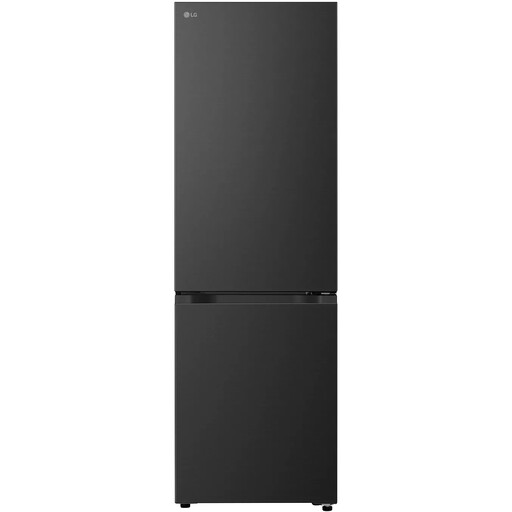 Image unavailable
LG GBBS312AEV, 333 L No Frost fridge-freezer, energy rating A
Consider this if you’re looking for a 333 L fridge-freezer with No Frost. To compare its energy use, check the kWh/year and the capacity of each compartment on the energy label for this model.
View on Joybuy
 Image unavailable
Haier HTW5618ENMG, 360 L three-door Total No Frost fridge-freezer, energy rating E
Consider this if the three-door layout and 360 L capacity suit the way you store food. Check you have enough space, then compare its stated kWh/year with models of a similar capacity.
View on Joybuy
 Image unavailable
Sonlu CC-520WE, 444 L frost-free fridge-freezer, energy rating E
The 444 L capacity is worth considering if you’ll make use of all that space. Measure the area for the appliance and compare its annual energy consumption with other large models that suit your needs.
View on Joybuy
 Image unavailable
AEG NSC6M18FES, 249 L built-in fridge-freezer with TwinTech No Frost, energy rating E
This built-in model is worth considering if your kitchen requires this type of installation. Check the housing dimensions and door-fixing system, along with the model’s kWh/year, before assessing its energy use.
View on Joybuy
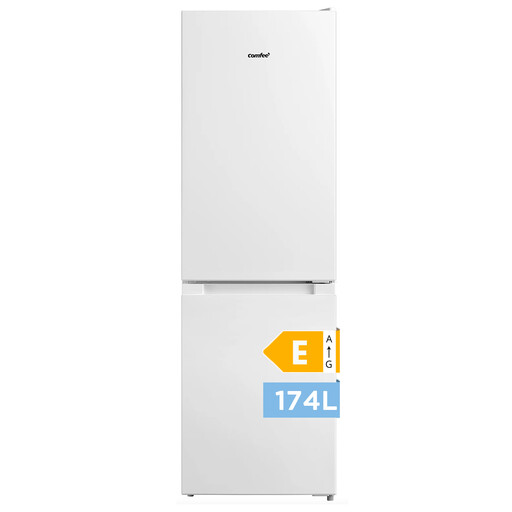 Image unavailable
Comfee' RCB169WH2(E), 174 L Low Frost fridge-freezer with 4-star freezer compartment, energy rating E
Consider this if you’re looking for a modest-capacity fridge-freezer with a 4-star freezer compartment. Its 174 L capacity and Low Frost system don’t tell you how much energy it uses, so compare the kWh/year shown on the energy label.
View on Joybuy
Frequently asked questions
What should I look for on a new fridge’s energy label?
Check the model reference, energy rating, annual energy consumption in kWh, compartment capacities and stated noise level. The DGCCRF says the energy label applies to new fridges sold in France, including online, but not to second-hand products. Scan the QR code to view the product information registered in EPREL.
Is a better energy rating enough to make a choice?
No. Compare the kWh/year of appliances with capacities and configurations that meet the same needs too. ADEME says that size and having more features than you need can affect energy consumption. The rating alone won’t tell you whether you’ll make use of extra capacity.
What should I check before installing a new cooling appliance?
Check the appliance’s dimensions, the route to its intended position, the manufacturer’s required ventilation clearances and the climate class suitable for the room. For a built-in model, also check the housing dimensions and that the door system is compatible.
How should I arrange for my old fridge to be taken away?
Before placing your order, ask the seller how to arrange collection of your old fridge when the new one is delivered. The French ministries responsible for ecological transition also say that electrical appliances can be returned to a retailer or taken to a collection point or recycling centre.


