Which households is it for ?

Households replacing an energy-hungry fridge freezer

If you buy fresh and frozen food every week, compare the stated kWh/year, net capacities and noise level for an equivalent storage requirement. ADEME reminds us that these appliances run continuously and that their size or extra features can increase your energy bill.

Households with a high freezing requirement

If you batch-cook, store lots of frozen food or shop less frequently, it is worth deciding whether a fridge freezer is sufficient or whether a separate freezer is genuinely justified, rather than automatically choosing a very large multi-door model.

Small and open-plan kitchens

When space or noise matters, check the dimensions, delivery route, whether the door can be reversed and the stated noise level, as well as the information on the energy label.

Buying priorities

Priority What to check Your requirements
Electricity consumption Compare the kWh/year between appliances with a similar format, capacity and intended use. Read the A to G rating alongside this figure, and check the EPREL QR code when available. I want to compare stated consumption on a consistent basis before prioritising an energy rating or highlighted feature.
Usable capacity Check the net capacities of the fridge and freezer separately. Also measure the installation space and delivery route. My shopping and meal preparation need to fit inside the appliance, without paying for a large compartment that will barely be used.
Food storage Set and check the temperature : Anses recommends between 0 °C and +4 °C at the coldest point. Make sure there is enough air circulation inside the appliance. I am looking for an interior layout that helps keep food fresh without overloading the shelves or relying solely on a cooling feature.
Noise and features Compare the stated noise level in dB(A) and the noise class. Choose No Frost, water, ice or connectivity features only if you will use them regularly. In an open-plan kitchen, noise matters every day. I also prefer features that genuinely make maintenance or everyday use easier.

Mistakes to avoid

  • Comparing only the energy-rating letter

    The A to G rating alone is not enough to tell you whether the capacity or the balance between fresh and frozen storage suits your household. The energy label also shows kWh/year, net capacities and noise level.

    Rule out unsuitable formats first, then compare the kWh/year, rating, capacity of each compartment and noise level between comparable models.

  • Choosing an oversized appliance or features you will rarely use

    Fridges and freezers run continuously. ADEME states that size and extra features, including continuous ice production, can increase your energy bill.

    List your regular requirements for fresh food, frozen food, water or ice, and choose the smallest configuration that will meet them reliably over time.

  • Comparing the old A+, A++ or A+++ ratings directly with today’s scale

    The rating scale for refrigeration appliances was revised in 2021 : the old ratings with « + » have been replaced by a stricter A to G scale.

    When replacing an old appliance, compare the current kWh/year, capacities and exact model reference rather than relying solely on the wording from the old label.

  • Overlooking the size and delivery access for a multi-door model

    A multi-door model can be considerably wider than a standard fridge freezer. Samsung recommends measuring doors, lifts and hallways to make sure the packaged appliance will fit through.

    Measure the installation space, the clearances specified in the manual and the entire delivery route before ordering. Also check the direction in which the doors open.

Relevant brands at a glance

Bosch

Bosch offers integrated and freestanding fridge freezers, allowing you to compare separate capacities, noise levels, dimensions, No Frost technology and energy ratings according to the specific model.

  • Bosch product pages provide detailed information on compartment capacities, noise levels, dimensions and features, making factual comparisons easier.
  • Claims relating to freshness or air circulation come from the manufacturer : check the model reference, configuration and energy label for the model you choose.

Liebherr

Liebherr offers single-door models and fridge freezers, which are useful for comparing interior organisation, reduced frost build-up and separate cooling circuits.

  • The manufacturer’s pages specify capacities, dimensions and solutions such as SmartFrost and DuoCooling.
  • These features may meet a need for easier maintenance or odour separation, but they are not enough on their own to conclude that consumption will be lower. Compare kWh/year, capacity, climate class and configuration.

LG

LG is worth considering for freestanding fridge freezers whose product information lists capacity, noise level and air-circulation or cooling technologies.

  • LG presents the GBV22NCCPY as a 387 L fridge freezer with a noise level of 35 dB.
  • LG states that the results of its internal tests may vary depending on actual use ; compare the label, compartment capacities and dimensions before prioritising these features.

Samsung

Samsung may suit households with a proven need for very large capacity and water or ice features, particularly in the multi-door category.

  • The RF59C701EB1 is a 649 L multi-door model with an auto-fill water jug and ice maker, according to Samsung France.
  • Its large capacity and convenience features require a substantial amount of space and do not automatically make it an economical choice. Check access through doors, hallways and lifts.

Options available on Joybuy

These Joybuy options include fridge freezers for storing both fresh and frozen food, in compact, standard and high-capacity formats.

CHiQ JR263LGE 262 L fridge freezer

CHiQ JR263LGE 262 L Low Frost

Suitable for a household needing separate compartments for weekly shopping in a narrow kitchen.

187 L fridge capacity, 75 L freezer capacity, 215 kWh/year, width of 54 cm and stated noise level of 39 dB(A). Reversible door and adjustable feet stated.

The Low Frost system still requires manual defrosting. The stated operating range is 16 °C to 38 °C.

Joybuy

Haier HTW5618ENMG 360 L fridge freezer

Haier HTW5618ENMG 360 L Total No Frost

An option for a household that regularly stores fresh and frozen food in a single appliance.

235 L fridge capacity, 125 L freezer capacity, 271 kWh/year, 35 dB(A), Total No Frost and stated dimensions of 185 × 59,5 × 66,7 cm.

The capacity and depth mean you should check the installation space and delivery route. Wi-Fi, Bluetooth and specialist zones are worth choosing according to your actual needs.

Joybuy

CHiQ JR227LSE 227 L fridge freezer

CHiQ JR227LSE 227 L Low Frost

A compact format for a small space requiring separate compartments for fresh and frozen food.

153 L fridge capacity, 74 L freezer capacity, width of 54 cm, 4-star freezer, Low Frost, reversible door and stated noise level of 39 dB.

Check the annual consumption in kWh on the energy label or product page before making any comparison based on usage. Low Frost does not eliminate the need for defrosting.

Joybuy
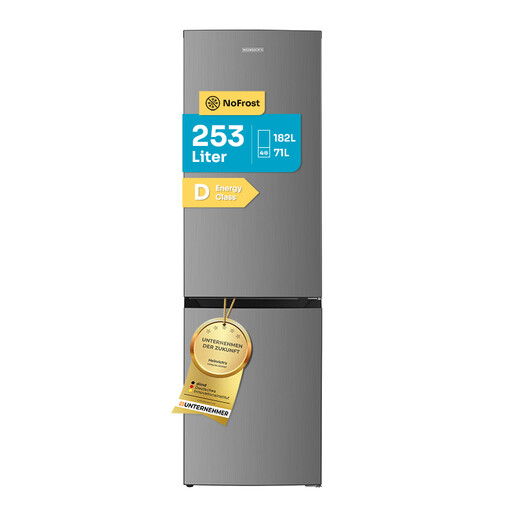
Heinrichs 253 L fridge freezer

Heinrichs 253 L No Frost fridge freezer

Could meet the everyday storage needs of a small household, with separate areas for fresh and frozen food.

182 L fridge capacity, 71 L freezer capacity, No Frost, large freezer drawers, reversible door, LED lighting and stated noise level of 39 dB.

Check the kWh/year, external dimensions and installation clearances in the technical specifications before ordering.

Joybuy

CHiQ JR525WSE 525 L side-by-side fridge freezer

CHiQ JR525WSE 525 L side-by-side No Frost

Large capacity for households with a lasting need to store substantial amounts of fresh and frozen food.

333 L fridge capacity, 192 L freezer capacity, No Frost, Multi-Airflow, touch controls and stated noise level of 37 dB.

Before ordering, check the kWh/year, dimensions, delivery access and whether this 525 L capacity matches your habits.

Joybuy

Frequently asked questions

Which figures on the energy label should you compare ?

First compare appliances that meet the same storage requirement. The label shows, among other things, the A to G rating and annual consumption in kWh ; for refrigeration appliances, also check the net fridge and freezer capacities, noise level, noise class and exact model reference. The QR code may link to EPREL.

Is a better energy rating enough to choose the cheapest model to run ?

No. You need to consider the rating alongside the kWh/year, usable capacities and configuration. ADEME states that a very large or highly equipped appliance can increase your energy bill without meeting any more of your regular needs.

What temperature should you aim for in the fridge ?

Anses recommends a temperature between 0 °C and +4 °C at the coldest point. Check the temperature regularly, avoid overfilling the appliance and allow cold air to circulate.

Is an energy label compulsory for a new fridge sold in France, including online ?

Yes. The official economie.gouv.fr portal states that the requirement applies in particular to new fridges and covers both in-store and online sales. This requirement does not apply to second-hand products.

What should you do with your old fridge when replacing it ?

Household appliances come under the WEEE recycling scheme. The FAQ published by the Ministry for Ecological Transition states that the « one-for-one » take-back scheme applies when buying an appliance of the same type, with no minimum sales-area threshold for electronic equipment, household appliances and lamps.