Households doing a mixed weekly shop
You buy fresh food every week along with a moderate amount of frozen food, and want a single appliance with a capacity split that matches your habits.


Start by choosing the usable capacity you need for fresh and frozen food, then compare the capacity of each compartment, kWh/year and installation dimensions. A fridge freezer is suitable when your fresh and frozen food needs remain balanced in a single space; two appliances may be worthwhile if you regularly keep substantial frozen reserves, provided you can install them without unnecessary clutter or excess energy consumption.
You buy fresh food every week along with a moderate amount of frozen food, and want a single appliance with a capacity split that matches your habits.
You regularly build up frozen-food reserves, cook in batches or freeze prepared meals: compare the freezer’s actual usable litres, not just the total capacity.
You have limited space or keep only small reserves; a reduced capacity may be suitable if the dimensions, door opening and ventilation are compatible with the available space.
Consider it if: fresh and frozen food take up fairly similar amounts of space and only one appliance space is available.
Compromise: the ratio between the two compartments is fixed, so check each capacity separately.
Consider it if: your frozen-food reserves, meals to be frozen or bulk purchases remain substantial throughout the year.
Compromise: two appliances run continuously and each requires suitable space, clearance and delivery access.
Consider it if: you shop frequently, buy little frozen food or have a kitchen constrained by its width and depth.
Compromise: reduced capacity limits large reserves and may mean shopping more often.
| Priority | What to check | Your needs |
|---|---|---|
| Fresh and frozen capacities | Compare the fridge and freezer’s usable litres separately. Also measure the width, depth, height and door opening. | I need to store my usual shopping without buying significantly more capacity than I need. Frozen food, ready meals and bulk purchases determine how much freezer space is required. |
| Continuous energy use | Read the kWh/year alongside the energy class, capacities and appliance format. Compare models designed for the same purpose. | I want to limit the energy consumption of an appliance that runs continuously. ADEME points out that size and excessive features can increase the cost of running it. |
| Installation and delivery | Check the clearances specified in the manual, door swing, access routes, floor stability and delivery conditions. | My appliance must fit into the kitchen, open without obstruction and retain the ventilation required by its manufacturer. If the kitchen is open-plan, I will also check the noise level shown on the label. |
| Food preservation | Check the temperature setting, temperature display, storage zones and defrosting type. | I want to be able to check the temperature after installation rather than relying solely on the advertised technology. Anses recommends a temperature of 0 to +4 °C at the coldest point. |
Two appliances with the same total capacity can offer very different amounts of space for fresh and frozen food. An unsuitable split may lead you to choose an oversized appliance or add a separate freezer.
Make a list of a typical week’s shopping, then compare the litres in each compartment and the external dimensions.
The label also provides information about energy consumption and capacity. ADEME points out that a fridge or freezer runs continuously.
Compare kWh/year, usable capacities and the features of models intended for the same use; the energy class alone is not enough to distinguish between two configurations.
An appliance that is larger or more fully equipped than necessary can increase ongoing electricity consumption.
An appliance may fit between two units but still lack ventilation, block a door or fail to pass through the access route into your home.
Measure the width, height, depth, door swing, access routes and flooring, then compare these measurements with the product information and manual.
Replacing an old appliance requires you to coordinate access to your home, the delivery slot and any collection service.
In France, the order of 8 October 2014 provides for used equipment to be collected from the place of use when new equipment is delivered. Ask the seller about the practical arrangements before placing your order.
The range includes freestanding fridge freezers, multi-door models, single-door fridges and freezers, with different formats and features depending on the model.
Liebherr offers freestanding and built-in fridges, as well as fridge freezers with options such as BioFresh or NoFrost, depending on the range.
The range includes freestanding and built-in fridge freezers, with different capacities, widths and No Frost or Dual No Frost options.
Joybuy fridge-freezer options for everyday shopping, with separate fresh and frozen capacities to compare according to the size of your household and kitchen.
 Image unavailable
For weekly shopping combining fresh and frozen food, its separate capacities make it easy to check whether the split suits your household.
193 L fridge capacity, 89 L freezer capacity, 228 kWh/year, NoFrost system for the freezer and a width of 60 cm.
Check that the dimensions of 1760 × 600 × 660 mm, clearances and delivery access suit your kitchen; also check the noise level if the appliance is close to a living area.
 Image unavailable
This configuration may suit a household doing a mixed shop that wants a slim appliance with more space for fresh food.
187 L fridge capacity, 75 L freezer capacity, 215 kWh/year, 540 mm width, reversible door and class E.
The Low Frost system means manual defrosting is recommended approximately once or twice a year. Also check the ventilation clearances and delivery conditions.
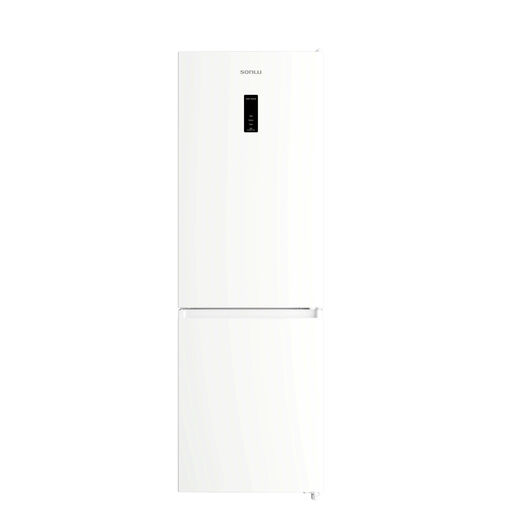 Image unavailable
Its slightly larger freezer capacity may appeal to a household that regularly keeps frozen food without moving to two separate appliances.
211 L fridge capacity, 99 L freezer capacity, 60 cm width, reversible doors, electronic controls and a Full Frost-Free system.
Before comparing this model, check the kWh/year, noise level, height, depth, ventilation clearances and door swing.
 Image unavailable
A compact option to consider for a small kitchen and more frequent shopping, with moderate frozen-food storage.
153 L fridge capacity, 74 L four-star freezer capacity, 54 cm width, 55 cm depth, reversible door and class E.
This capacity may be limited for large shops or long-term frozen-food reserves; check the kWh/year, full dimensions, noise level and ventilation before buying.
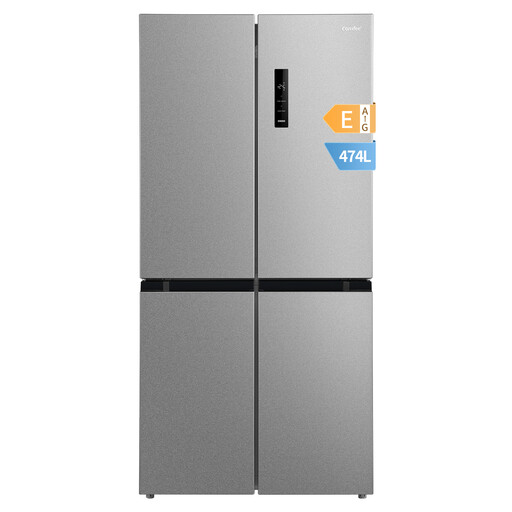 Image unavailable
This format is designed for households looking to organise several storage zones and with enough space for a wide appliance.
Total capacity of 474 L, four doors, Vario Box, vegetable drawer with three temperature settings and combination freezer drawers.
Check the fresh and frozen capacities separately, along with the kWh/year, noise level, defrosting, ventilation and dimensions of 838 × 653 × 1775 mm before choosing this format.
Compare the A to G rating, energy consumption, capacities and, where shown on the label, noise emissions. To distinguish between two appliances, compare their kWh/year with similar fridge and freezer capacities.
As a starting point, Que Choisir suggests 100 to 150 litres for one person, followed by around 50 additional litres per person. Adjust this guideline according to how often you shop, batch cooking and the amount of frozen food you actually store.
Yes, always follow the instructions for the model you have chosen. Bosch recommends at least 200 cm² of clear space behind and beneath its appliances for ventilation; check the manufacturer’s instructions for the appliance you buy before installation.
Anses states that the ideal temperature is between 0 and +4 °C at the coldest point. Check the actual temperature, particularly after delivery, filling the appliance substantially or during a hot spell.
When new equipment is delivered to the place where it will be used, the French order of 8 October 2014 requires the distributor to offer collection of the used equipment from that location during delivery. Confirm access, disconnection and delivery-slot arrangements with the seller before placing your order.