Households buying a mix of fresh and frozen food
If your weekly shop includes both fresh and frozen food, look at the space allocated to each compartment rather than just the total capacity.


Choose a fridge if your groceries are mostly fresh food and you have little need for freezer space. A fridge-freezer combines both in one appliance; separate fridge and freezer appliances are worth considering if you store more frozen food and have two suitable spaces. Whichever option you choose, compare the usable capacities, installation requirements and annual energy consumption of appliances that meet your needs.
If your weekly shop includes both fresh and frozen food, look at the space allocated to each compartment rather than just the total capacity.
When space is limited, the appliance’s dimensions aren’t the only thing to consider: you’ll also need to allow for ventilation and enough room to open the door.
If you stock up or often buy frozen food, first check the freezer capacity of the fridge-freezer you’re considering. A separate appliance may suit greater freezing needs, provided you have a suitable space for it.
Consider this if: fresh food makes up most of your shopping and you have little need to store frozen food.
The trade-off: any small freezer compartment may not meet your regular need to stock up, as UFC-Que Choisir points out.
Consider this if: you need both functions in one appliance.
The trade-off: its total capacity is split between fresh and frozen food, so check that both compartments are large enough for your shopping.
Consider this if: you need dedicated freezer capacity and have two suitable, ventilated spaces.
The trade-off: you’ll need to make room for both appliances and check the annual energy consumption of each.
Once you’ve chosen a type, compare appliances in this order: capacity to suit your shopping, whether installation is possible, then energy consumption and noise. The European Commission says that the energy labels on refrigeration appliances show these details, as well as capacity.
| Criterion | What to check | Who this matters to |
|---|---|---|
| Fresh and frozen food capacity | Compare the usable litres in each compartment with the space your shopping usually takes up. | If the amount of frozen food in my shopping varies, I want to avoid a large total capacity hiding a freezer that’s too small; around 42% of consumers would prioritise this split. |
| Installation and door opening | Measure the space and check the manual for ventilation clearances and door-opening space. | In a narrow kitchen, I need to be able to install the appliance and open its compartments without obstructing nearby units; this would be a priority for around 33% of consumers. |
| Energy consumption and noise | Once you’ve settled on a type and capacity, compare the kWh/year and noise levels shown for appliances that meet the same needs. | As an appliance runs continuously, I want to check its energy consumption; nearly 25% of consumers would prioritise this or noise, especially if the appliance is near a living space. |
Two appliances with a similar total capacity may allocate space differently between the fridge and freezer. The compartment for frozen food could end up being too small for your supplies.
Estimate separately how much you store in the fridge and freezer, then compare your needs with the capacity listed for each compartment.
An appliance may fit in the measured space but still lack the clearance needed for ventilation or for opening the doors and drawers. Bosch, for example, recommends leaving clear space when installing its fridge-freezers.
Before ordering, check the dimensions, the route to the installation space, the door swing and the clearances specified in the manual for the exact model.
If the space doesn’t meet these requirements, you may need to adapt the cabinetry or choose a different model.
The energy efficiency rating alone doesn’t tell you whether an appliance has the capacity you need. According to the European Commission, the label for refrigeration appliances also shows annual energy consumption, capacity and noise levels.
First make sure the type and capacity are right for you, then compare the kWh/year and noise levels of appliances that suit your shopping.
Bosch offers fridge-freezers with features such as VitaFresh or NoFrost, depending on the model.
The range includes freestanding and built-in fridge-freezers, with features that vary by model.
Beko offers freestanding and built-in fridge-freezers; some models have a reversible door or a specific door-opening configuration.
The appliances below combine fridge and freezer functions in one unit, with different capacities for each. Before choosing a model, compare how much space it offers for frozen food and check its installation requirements.
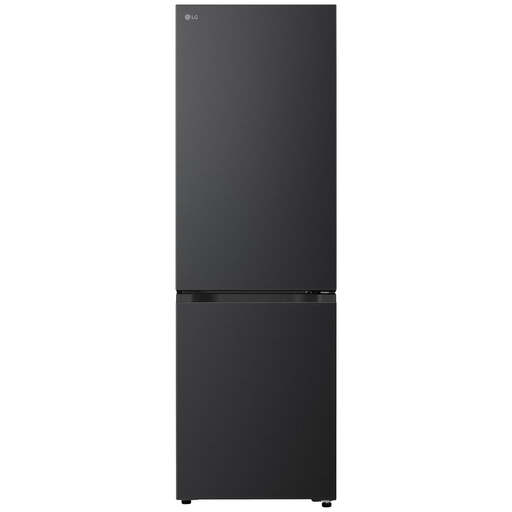 Image unavailable
A fridge-freezer to consider if you want to keep fresh and frozen food in one appliance. The model name indicates a total capacity of 333 L and a C energy efficiency rating. Check how the capacity is split between compartments and make sure you have the necessary installation clearances.
 Image unavailable
Worth considering if a stated width of 54 cm and a reversible door suit your kitchen. The product name lists the 227 L capacity as 153 L for refrigeration and 74 L for freezing; it also specifies Low Frost and an E energy efficiency rating. Check the height, ventilation clearances and kWh/year before comparing this model with others.
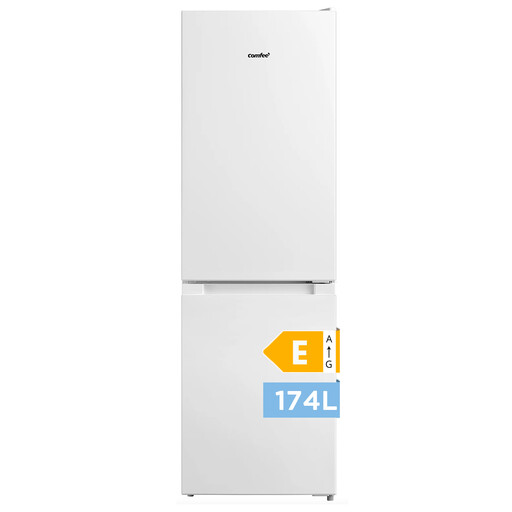 Image unavailable
Consider this model if you’re looking for separate fresh and frozen food capacities in a fridge-freezer: the product name lists 115 L for refrigeration and 59 L for freezing. It also specifies a reversible door, Low Frost, 39 dB and an E energy efficiency rating. Check the exact dimensions, ventilation clearances and kWh/year to assess how it will fit and how much energy it uses.
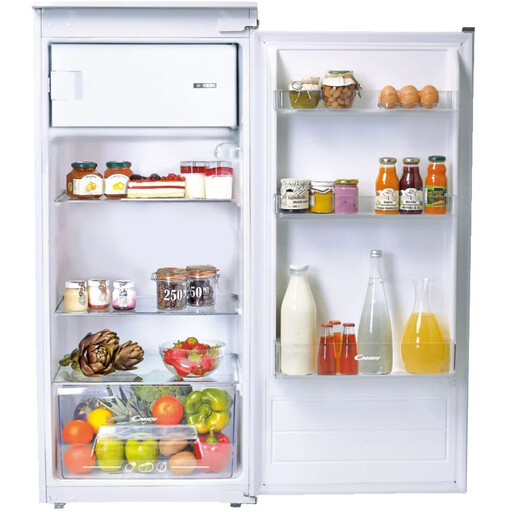 Image unavailable
This one-door model is worth considering if you mainly store fresh food and only need a smaller freezer compartment. The product name gives a total capacity of 179 L, so check how much space is allocated to freezing before choosing. Also confirm the installation type and the clearances required.
 Image unavailable
Worth considering if your shopping requires plenty of space for both fresh and frozen food, and you have room for a side-by-side appliance. The product name lists 333 L for refrigeration and 192 L for freezing, along with No Frost, 37 dB and an E energy efficiency rating. Check the dimensions, door clearance, ventilation and kWh/year before deciding.
Compare the energy efficiency rating, kWh/year, usable capacity and noise level shown on the European energy label for refrigeration appliances. First choose a type and capacity that suit your shopping: the rating letter alone isn’t enough to compare appliances with different capacities.
Not necessarily: it must also have the ventilation clearances specified in its manual. Check the depth, how far the doors and drawers open, and, for a built-in model, the housing dimensions and mounting system.
No: changing the way the door opens doesn’t guarantee that the door and drawers will open fully. Check the hinges, door projection and required clearance from the wall and nearby units for the exact model.