Households replacing an appliance
You’re looking for a capacity that suits your habits, without automatically choosing the same format or energy consumption as your old appliance. Remember to arrange for the old appliance to be collected, too.


If you regularly store frozen food, a fridge-freezer could meet your needs without taking up space for a second appliance. If you don’t need a freezer, compare fridges instead. Que Choisir recommends considering your kitchen layout and how you use frozen food; ADEME points out that fridges and freezers run continuously. So check the available space and the product manual, then compare usable capacity and kWh/year separately. A separate freezer makes sense if you genuinely need the extra capacity and have room for another appliance.
You’re looking for a capacity that suits your habits, without automatically choosing the same format or energy consumption as your old appliance. Remember to arrange for the old appliance to be collected, too.
You need to choose an appliance that fits the space available. If it’s going in an alcove or behind a cabinet door, check the dimensions and installation instructions for the specific model.
You’re comparing the freezer compartment in a fridge-freezer with the capacity of a separate appliance, taking into account the space required and each appliance’s energy consumption.
Start by working out whether you need a freezer compartment and how much capacity you’ll need. Then check the available space and compare the energy consumption of models that will actually fit.
| Consideration | What to check before buying | Who it matters most to |
|---|---|---|
| Fridge and freezer capacity | Compare the fridge and freezer capacities in litres with your shopping habits and how much frozen food you usually store. | If you need to store fresh and frozen food in specific proportions, the space allocated to each compartment matters as much as the total capacity. Around 31 % of consumers put usable capacity first. |
| Positioning and ventilation | Measure the space. For an integrated model, check the housing, door fitting and instructions for the specific model. | If you’re fitting an integrated kitchen or replacing an appliance in a tight space, you’ll need to check the dimensions and installation instructions. Around 25 % of consumers make positioning their top priority. |
| Energy consumption | Compare the kWh/year figures for each model. If you choose two appliances, check their combined energy consumption. | If you want to keep the energy use of appliances that run continuously under control, compare models with similar useful capacity and features. Around 25 % of consumers prioritise this. |
| Replacement and collection | Check the delivery and installation options available, as well as the arrangements for collecting your old appliance. | If you’re replacing an appliance, you’ll need to coordinate delivery with the removal of the old one. Around 13 % of consumers prioritise the arrangements involved in replacing an appliance. |
| Ease of use and defrosting | Check the technology listed for each compartment, whether it needs defrosting and the noise level stated for the model. | If you want to minimise maintenance or place the appliance near a living area, these features can make a difference day to day. Around 6 % of consumers put them first. |
Two appliances with a similar total capacity can divide the space differently between the fridge and freezer. So a large total capacity doesn’t necessarily mean you’ll have enough room for the frozen food you need to store.
Compare the capacity of each compartment in litres with your usual shopping and storage needs.
A separate freezer takes up space and runs continuously. Compare its capacity with that of the fridge-freezer you’re considering before deciding on this setup.
Choose this option if a fridge-freezer compartment won’t meet your needs and you have a suitable space. Add together the kWh/year figures for both models.
The second appliance’s energy consumption is in addition to that of the fridge, and varies by model.
The stated dimensions alone don’t confirm that the appliance can be fitted, that the door can be attached or that there’ll be enough airflow in your kitchen.
Before ordering, check the model and its manual against the housing, door system and ventilation instructions.
The documented models include freestanding fridges and freestanding fridge-freezers.
The ENS5LE18S is an example of an integrated fridge-freezer, worth considering if your kitchen has a compatible housing.
The documented models include an integrated single-door fridge and a chest freezer. These are two separate appliances to consider if you need separate storage.
The French catalogue includes single-door fridges, two-door fridges, multi-door models and fridge-freezers.
The products below are fridge-freezers, including freestanding, multi-door and integrated models.
 No image available
This freestanding fridge-freezer could suit you if you want your fridge and freezer in one appliance.
Listed capacity: 230 l for the fridge and 114 l for the freezer. The stated energy consumption is 254 kWh/year, and the door is reversible. Listed dimensions: 59,5 × 185,3 × 65,8 cm.
 No image available
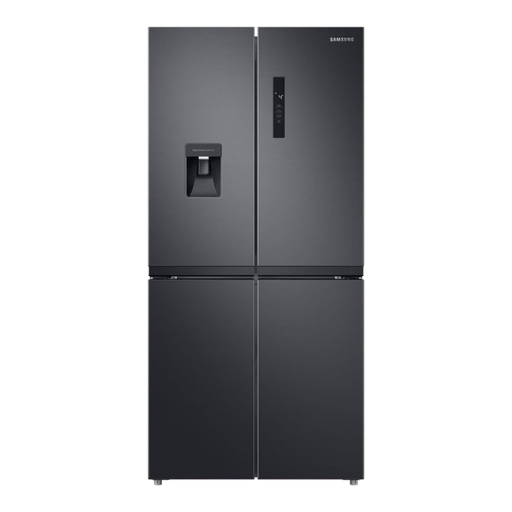
This freestanding model is worth considering if you’re looking for a multi-door fridge-freezer and have enough space for its width.
Listed capacity: 329 l for the fridge and 159 l for the freezer. The stated energy consumption is 298 kWh/year; the product details mention Twin Cooling and a width of 83,3 cm.
 No image available
Consider this integrated fridge-freezer if your kitchen can accommodate this model.
The description lists two cooling systems and TwinTech Total No Frost. Check the housing dimensions and installation instructions in the model’s manual.
 No image available
This high-capacity fridge-freezer is worth considering if both compartments meet your needs and you have a suitable space.
The description lists a total capacity of 444 l, energy consumption of 289 kWh/year and a Total No Frost system. Check the dimensions and detailed specifications for this model before installation.
 No image available
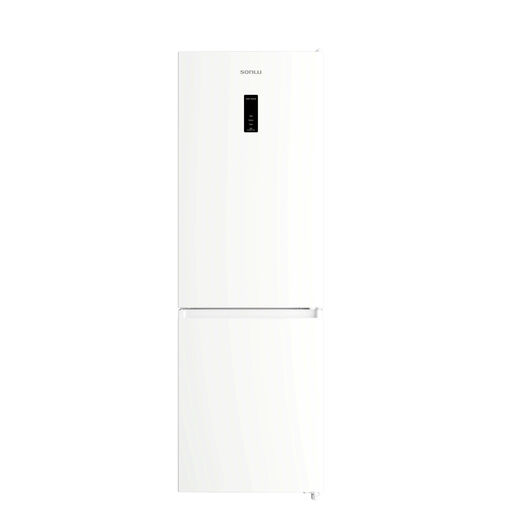
This 60 cm-wide freestanding fridge-freezer could suit you if you want a single appliance for fresh and frozen food.
Listed capacity: 211 l for the fridge and 99 l for the freezer. The description lists a Frost Free system, an inverter compressor and a reversible door.
Compare the fridge and freezer capacities in litres separately, then check the models’ kWh/year figures. The European energy label rates appliances from A to G, but kWh/year figures are still useful when comparing models of different sizes or with different features. These figures can’t predict your exact energy consumption at home.
Don’t assume you can without checking the model’s manual. Check the dimensions, door opening and airflow. Electrolux’s installation instructions say to follow the appliance-specific guidance and allow air to circulate, but don’t specify a universal clearance for all models.
It depends on the compartment and the model. For example, Electrolux describes the ENS5LE18S freezer as LowFrost with manual defrost, while Bosch lists NoFrost for the KGN36NLEA. Check the specifications and manual for the model you choose.
For a contract between a consumer and a professional seller, the legal guarantee of conformity may apply if a fault appears within two years of the goods being delivered, subject to the legal conditions. Service-Public.fr also states that the retailer must arrange free collection of your old appliance when you buy one to replace it. Ask how this will work when your new appliance is delivered.