Households focused on fresh food every day
If you mainly need fridge space for your shopping and already have a way to freeze food, consider a fridge on its own. Compare its usable capacity with the amount of fresh food you usually keep.


Choose according to how much space you need for fresh food and frozen meals: a fridge on its own is suitable if you mainly store fresh food and already have a way to freeze food; a fridge freezer combines both in one appliance; a separate freezer is worth considering if you regularly need extra space for frozen food, alongside your fridge. Check the capacity of each compartment, the space available and annual energy consumption. The ADEME notes that these appliances run continuously, so their size affects how much energy they use.
If you mainly need fridge space for your shopping and already have a way to freeze food, consider a fridge on its own. Compare its usable capacity with the amount of fresh food you usually keep.
If you keep both fresh food and frozen portions in one appliance, take a look at fridge freezers. Check the fridge and freezer capacities separately: a large total capacity doesn’t guarantee enough freezer space for your needs.
If you regularly freeze home-cooked meals or keep a supply of frozen food, it’s worth considering a separate freezer alongside your fridge. Its capacity, storage layout and footprint all matter.
Start by working out how much space you need for fresh and frozen food, then check that your chosen appliance will fit and work well in your home.
Worth considering if: most of your food is fresh and you already have a freezer elsewhere.
The trade-off: this appliance won’t give you extra space for meals you want to freeze.
Worth considering if: you need space for both fresh and frozen food but only want to install one appliance.
The trade-off: the space is shared between the two compartments, so check how much capacity is actually available in the freezer.
Worth considering if: you already have a fridge and regularly build up a supply of frozen meals.
The trade-off: you’ll need space for a second appliance, which also runs continuously, as the ADEME points out.
| What matters to you | What to check | Who this suits |
|---|---|---|
| Space for fresh food | Compare the usable fridge capacity, in litres, with any space set aside for frozen food. | If most of my shopping is fresh, I want enough room for it every day. Around 29% of consumers would make fridge capacity their top priority. |
| Fresh and frozen food in one appliance | For a fridge freezer, check the capacity in litres of each compartment separately, as well as the installation dimensions. | To store fresh food and a few frozen portions without installing two appliances, I need a split of space that works for me. Around 29% of consumers would prioritise this mix of storage. |
| Space for frozen meals | Check the usable freezer capacity and the layout of the model’s drawers or baskets. | If I regularly prepare meals to keep for later, I need accessible freezer space. Around 24% of consumers would put dedicated freezer capacity first. |
| Installation and continuous use | Measure the space and delivery route, then compare the annual energy consumption of appliances with a similar type and capacity. | An appliance needs to fit in my kitchen and be suitable for everyday use, without choosing a capacity that’s larger than I need. For around 18% of consumers, fitting the available space and being suitable for continuous use would be the main priority. |
A high total capacity can hide a freezer compartment that’s too small for your portions. For its ENS3LE18S built-in fridge freezer, Electrolux lists 198 L of fridge space and 73 L of freezer space, making 271 L in total.
Work out separately how much fresh food you keep and how much you freeze, then compare your needs with the usable capacity of each compartment.
The ADEME points out that refrigeration appliances run continuously, and that an unnecessarily large appliance or excessive features can increase energy consumption.
Once you’ve worked out how much capacity you need, compare the annual energy consumption shown on the energy label for models with a similar function and capacity.
The appliance’s dimensions aren’t the only thing to consider: an alcove, the route to the room and the door swing can all affect whether installation is possible.
Measure the space and the delivery route. Check with the retailer what installation services are available and how to arrange collection of your old appliance.
Bosch offers a range of integrated and freestanding fridge freezers.
Whirlpool offers freestanding upright freezers for extra storage.
Liebherr offers both fridges and fridge freezers, with freestanding and integrated options depending on the model.
This selection of Joybuy appliances includes fridge freezers for storing fresh and frozen food in one appliance, as well as separate freezers for building up a supply.
 Image unavailable
Worth considering if you want to store fresh food and frozen food in a three-door fridge freezer.
The model name indicates a total capacity of 360 L, energy rating E and Total No Frost technology. Check the capacity of each section, as well as the space available and the delivery route.
 Image unavailable
Worth considering if you’re looking for one appliance for fresh shopping and frozen food, with a stated total capacity of 467 L.
The model name specifies energy rating E and Total No Frost. Measure the space you’ll need, including room to open all four doors, and compare the usable capacity of each section.
 Image unavailable
Worth considering if you need to store fresh and frozen food together and have limited width available.
The model name indicates 153 L of fridge space, 74 L of freezer space, a width of 54 cm, a reversible door, Low Frost and energy rating E. Check the height, depth and annual energy consumption before choosing.
 Image unavailable
Worth considering for extra storage if you have room for a chest appliance with a top-opening lid.
The product name indicates a capacity of 291 L, switchable fridge and freezer modes, a removable basket and energy rating E. Check the settings available in each mode, the clearance needed around the appliance and the delivery route.
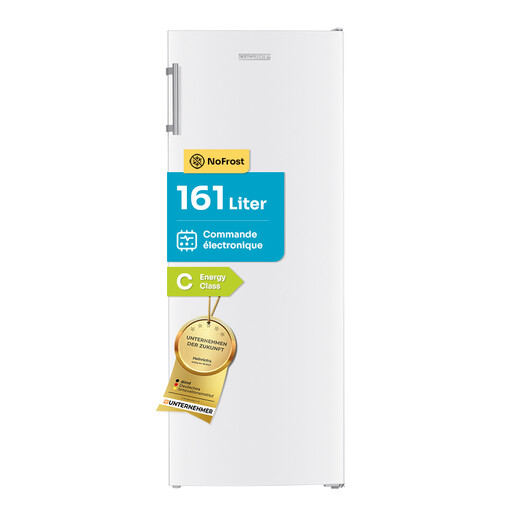 Image unavailable
Worth considering if you already have a fridge and want to organise extra frozen food storage in a separate appliance.
The product name indicates a capacity of 161 L, drawers, No Frost and energy rating C. Check its external dimensions and annual energy consumption to see how well it will fit and suit continuous use.
Compare the annual energy consumption and specifications of appliances designed for the same purpose and with a similar capacity. The ADEME recommends using the energy label as a guide when choosing. The European Commission also lets you check the declared specifications of models in EPREL.
No. Check the fridge and freezer capacities in litres separately. For its ENS3LE18S integrated fridge freezer, Electrolux lists a total capacity of 271 L, split between 198 L of fridge space and 73 L of freezer space. Make sure this suits the meals you plan to store.
If the appliance is integrated, measure the space it will fit into. Then check the dimensions of your chosen model, the delivery route and the clearance needed to open the doors. Measurements for another model won’t confirm whether yours can be installed.
Before placing your order, ask the retailer how to arrange collection of your old fridge or freezer when your new one is delivered. Confirm the delivery address and check how to prepare the appliance for collection.