Households that cook and shop throughout the week
If you store fresh food, leftovers and a modest supply of frozen food, compare the net capacity of both compartments in a fridge-freezer, as well as its noise level and energy label.


If you store fresh food and frozen food in one place each week, start by comparing fridge-freezers. A fridge on its own is suitable if you mainly need space for fresh food and already have a way to freeze food elsewhere; a separate freezer is worth considering if you regularly run short of freezer space, but it takes up extra room and runs continuously. In every case, compare the usable capacities, stated energy consumption and dimensions before planning to replace your old appliance.
If you store fresh food, leftovers and a modest supply of frozen food, compare the net capacity of both compartments in a fridge-freezer, as well as its noise level and energy label.
If you prepare meals in advance or buy in bulk, a separate freezer can give you dedicated storage space. You’ll need room for it and should factor in that it runs continuously, as ADEME points out for refrigeration appliances.
Measure the space, any housing recess and the delivery route before choosing. The external dimensions alone won’t tell you how much food each compartment can hold.
Choose this if: your meals are mainly based on fresh food and you already have somewhere to freeze food, or you very rarely freeze anything.
Bear in mind: this appliance doesn’t provide storage for frozen food.
Choose this if: you need space for fresh and frozen food every week, but only have room for one appliance.
Bear in mind: the amount of freezer space depends greatly on how the model’s capacity is divided between compartments.
Choose this if: you regularly run short of freezer space and have room for an additional appliance.
Bear in mind: it adds to your refrigerated storage rather than replacing it, and means another appliance running continuously.
| Criteria | What to check | Who it suits |
|---|---|---|
| Keeping fresh food | Temperature settings and control; fridge net capacity. Anses advises setting your fridge below 4 °C. | If I store fresh food every day, I want to be able to check its temperature rather than rely only on the displayed setting. Around 36% of consumers would put this need for freshness first. |
| Fresh and frozen food in one appliance | Net capacity of each compartment and the clearance needed to open the doors. | For my regular shopping, leftovers and a few frozen items, I want both spaces in one appliance. Around 29% of consumers would prioritise this versatility. |
| Freezer storage | Freezer net capacity and an interior layout suited to portions or large packs. | When I prepare meals in advance or buy in bulk, I need freezer space that’s genuinely practical to use. This would be the main concern for around 21% of consumers. |
| Energy use, noise and installation | Annual energy consumption in kWh/year and noise in dB for appliances with a similar purpose and capacity; dimensions and delivery route. | In a kitchen where space and noise matter, I want to replace my appliance without choosing one that’s bigger than I need. Around 14% of consumers would put these operating and installation considerations first. |
An energy rating alone isn’t enough to compare appliances of different sizes or for different uses. ADEME points out that the size of refrigeration appliances and choosing more capacity than you need can increase energy consumption.
Compare the stated annual consumption in kWh/year of models with a similar capacity for your needs, then consider how much space you actually have for fresh and frozen food.
A large total capacity may leave less room than you expect for frozen food or prepared portions.
Work out what you want to freeze regularly and check the fridge and freezer net capacities separately.
Adding a separate freezer later would take up more space and mean another appliance running continuously.
The appliance needs to be able to get into your home, and the collection arrangements must suit your property and order.
Measure doorways, corridors, stairs and lifts, then confirm the delivery and old-appliance collection arrangements with the seller before placing your order.
The refurbished description alone doesn’t tell you whether the appliance’s capacity, noise level, energy consumption or condition will meet your needs.
Check the full model number, the specifications provided, the tests carried out, the appliance’s condition and the delivery terms.
Worth considering if usable capacity, fitting into your kitchen or freshness compartments are priorities.
Worth considering among fridge-freezers offering VitaFresh or No Frost features, depending on the model.
Worth considering for a built-in fridge-freezer if the dimensions of the housing and the way the storage is divided are decisive.
Worth considering if you’re looking for a large capacity or a particular compartment layout.
This selection includes fridge-freezers for storing fresh and frozen food in one appliance, as well as a separate freezer to consider if you need dedicated freezer space. Compare their size with the space available and the capacity you need.
 Image unavailable
For keeping fresh shopping and frozen food together in a multi-door appliance.
Stated total capacity of 467 L, Total No Frost and energy rating E. Measure the delivery route and available space before choosing this size.
 Image unavailable
Worth considering if you’re looking for a multi-door appliance for your regular shopping and frozen food.
Stated capacity of 495 L and energy rating E. Check the capacity of each compartment and the space needed for installation.
 Image unavailable
For a fitted kitchen where fresh and frozen food need to fit into one built-in appliance.
Stated capacity of 249 L, TwinTech No Frost and energy rating E. Check the housing dimensions and the capacity of each compartment before you buy.
 Image unavailable
Worth comparing if width is limited, but you still want a compartment for frozen food.
The model name lists 153 L for the fridge and 74 L for the freezer, a reversible door, Low Frost and energy rating E. Low Frost doesn’t mean you’ll never need to defrost it manually; also check the height and depth.
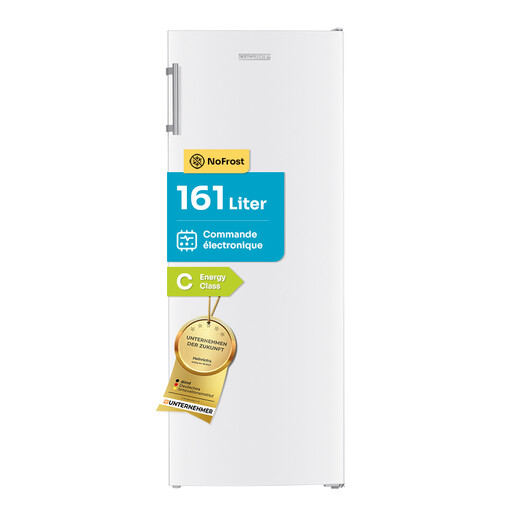 Image unavailable
For adding freezer space if you regularly need more room for frozen food; this appliance doesn’t replace a fridge.
Stated capacity of 161 L, No Frost function and energy rating C. Check its dimensions, noise level and annual energy consumption to decide whether it suits the space you have in mind.
Compare the energy rating and stated annual consumption, then consider them alongside the net capacity you need. The DGCCRF describes the energy label as a way to compare appliances sold in France, including online; it doesn’t replace checking the noise level, dimensions and compartment layout.
Ask the seller about collection arrangements before placing your order and confirm that they’ll work with your delivery. ecosystem describes a free ‘one-for-one’ collection service when you buy a new appliance; check access to your home, the delivery slot and any installation services separately.
Anses advises setting your fridge below 4 °C. Check the actual temperature, particularly if the appliance is old or very full, rather than relying solely on the selected setting.
In France, the DGCCRF states that the statutory guarantee of conformity also applies to refurbished goods sold by a business to a consumer. Check the seller’s identity, the description and tests for the appliance on offer, and the delivery terms; any commercial guarantee is separate from this statutory guarantee.