Households that shop once a week
If fresh food, drinks and containers of leftovers all arrive at once, look at the fridge capacity and how much space is left in the freezer. Que Choisir links the choice of format to how often you shop.


For a weekly shop that includes leftovers and frozen food, a fridge freezer is a good starting point, provided both compartments have enough capacity for your household. A small freezer compartment may suit lighter freezing needs; consider a multi-door model or a separate freezer if you need extra storage over the long term and have room for the appliance in your kitchen.
If fresh food, drinks and containers of leftovers all arrive at once, look at the fridge capacity and how much space is left in the freezer. Que Choisir links the choice of format to how often you shop.
The amount of space you actually need for freezing becomes a key consideration. Que Choisir says a small freezer compartment may not be enough if frozen food makes up a significant part of your shop.
You need to be able to get the appliance into your home, install and ventilate it, and open its doors in the space available. In an open-plan kitchen, also compare the noise level listed for each model.
Start by working out how much space you need for fresh and frozen food, then rule out formats that won’t fit the location or delivery route. Finally, compare the energy and noise information for the models on your shortlist.
| Consideration | What to check | Who is this for? |
|---|---|---|
| Fresh food and leftovers | Compare the fridge compartment capacity in litres and the shelf layout for your dishes and containers. | When I need to fit the week’s shopping alongside leftovers, I want to put everything away without losing sight of it; around 27% of shoppers put this need first. |
| Frozen food storage | Check the freezer capacity in litres separately and look at the drawer layout. If you need a lot of freezer space long term, consider a separate freezer too. | If frozen food makes up a significant part of my shop, a small freezer compartment may not give me enough room; around 27% of shoppers prioritise freezing capacity above other criteria. |
| Space, access and noise | Measure the space, delivery route and door clearance; check the manual for ventilation requirements and the energy label for noise levels. | In a narrow or open-plan kitchen, I need to be able to install the appliance and live with its noise day to day; this is a priority for around 33% of shoppers. |
| Energy use and maintenance | Compare kWh/year between appliances with suitable capacities and check the model’s information on defrosting. | Once I have enough storage space, I want to be able to assess energy use and routine maintenance; around 13% of shoppers make this their priority. |
An appliance may offer plenty of space overall without dividing it up in a way that suits your leftovers and frozen food. The European energy label lists fridge and freezer capacities separately.
Picture what will be in your fridge just after you’ve done the shopping, then compare the capacity of each compartment and the shape of the shelves and drawers.
The capacity won’t be much use if the appliance won’t fit through your doors or cannot be opened and ventilated in its intended position.
Measure the delivery route and the space needed to open the doors too; follow the clearances specified in the manual for the model you choose.
Difficult access can make delivery and installation more complicated.
More capacity is no substitute for keeping your food organised. ADEME recommends checking what you have before you shop and tidying your fridge regularly.
Make sure your containers are easy to see and reach, and get into the habit of keeping track of food that needs using up.
The energy rating alone doesn’t tell you the annual energy use, capacity or noise level. A defrosting feature won’t tell you how much storage space is available either.
For models that suit your kitchen, look at kWh/year, the capacity of each compartment and the noise level together; check the features of each specific model.
Its fridge freezers and multi-door models are worth comparing for their storage layout and capacity; specifications vary by model.
The brand offers a range of fridge freezers with a bottom freezer, including the B3RCNE364HDS, which is listed with frost-free cooling.
Its multi-door models are worth considering if you need plenty of space and have enough width available.
This selection includes fridge freezers in a range of capacities and multi-door models. Compare the space for fresh and frozen food, then check that the format you choose will suit your kitchen.
 Image unavailable
Worth considering if you shop for the week and want to store fresh food, leftovers and frozen food in a single appliance.
The model title lists a capacity of 360 L, three doors, Total No Frost, an energy rating of E, Wi-Fi and My Zone. Compare the capacity of each compartment and check the dimensions and installation clearances in the manual.
 Image unavailable
This format is for shoppers who want to compare models with plenty of space for their groceries and frozen food.
The title lists four doors, a capacity of 467 L, Total No Frost and an energy rating of E. Measure the available width, door clearance and delivery access; check the manual for ventilation clearances.
 Image unavailable
Worth comparing if you need plenty of storage over the long term and have enough room for a multi-door model.
The title lists a capacity of 495 L and an energy rating of E. Check fridge and freezer capacities, delivery access and the installation requirements for this model.
 Image unavailable
Consider this for a compact kitchen if both compartments can hold your groceries and frozen food.
The title splits the 227 L capacity into 153 L of fridge space and 74 L of freezer space; it also lists a width of 54 cm, a reversible door, Low Frost and an energy rating of E. Low Frost does not mean you’ll never need to defrost it manually. Check the kWh/year on the energy label, as well as the full dimensions and installation instructions.
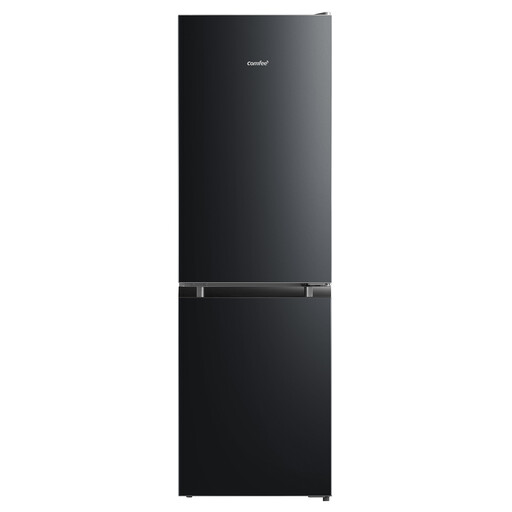 Image unavailable
This model is worth considering if a compact appliance suits your kitchen and the amount you usually shop for.
The title lists a capacity of 174 L, Low Frost, an adjustable thermostat, LED lighting and a reversible door. Check that each compartment has enough capacity, then compare kWh/year and dB(A) on the energy label. Low Frost does not mean you’ll never need to defrost it manually.
It may be suitable if you store very little frozen food, but not if frozen food makes up a significant part of your shop. In that case, Que Choisir recommends looking for a proper freezer compartment; compare the capacity of a fridge freezer and, if your needs remain high, consider a separate freezer.
When choosing a fridge freezer, compare its annual energy use, the capacity of its compartments and its noise level. The European Commission says this information is shown on the label; check it for appliances that already suit your space and storage needs.
Yes. The clearance required depends on the appliance and how it is installed. Beko recommends at least 5 cm at the sides and rear for appliances covered by its support advice, but this measurement does not apply to every model: check the manual before ordering.
Choose shelves that make your containers easy to see and reach, rather than relying on the appliance’s total capacity alone. ADEME also recommends checking your food before shopping and tidying your fridge regularly so you can spot anything that needs using up.