Brands to consider by model
These examples can help you compare specific features, without assuming that every appliance from a brand has the same qualities.
Bosch
The freestanding KGN33NWDA fridge-freezer shows why it’s worth looking at the capacity of both compartments, noise level and energy rating together.
- Bosch lists the KGN33NWDA as having 189 L of fridge space, 90 L of freezer space, a D rating, a 40 dB noise level and Total No Frost.
- These figures are for the KGN33NWDA. They don’t mean another Bosch model will have the same energy consumption or fit the same space.
Liebherr
The CNd 5704 fridge-freezer can be a useful comparison if storage capacity and stated noise level are important to you.
- Liebherr lists the CNd 5704 as having a total capacity of 359 L and a noise level of 35 dB, with NoFrost and EasyFresh.
- The capacity needs to suit your household’s habits; NoFrost alone isn’t enough to determine running costs.
Whirlpool
The fridge-freezer range includes different cooling systems, so compare the specific model rather than relying on the brand name alone.
- Whirlpool describes the W9C841COX as a C-rated fridge-freezer with Dual No Frost and dedicated drawers.
- Other Whirlpool fridge-freezers may have different features. Check the capacity and energy consumption of the model you’re considering before choosing its functions.
Fridge-freezers available on Joybuy
These appliances combine refrigeration and freezing. Compare their stated capacities and installation requirements with your needs. To assess electricity costs, also check the exact model’s annual energy consumption on its energy label.
 Image unavailable
Samsung RB33B612EBN, 344 L black fridge-freezer
Worth a look if you want to store fresh and frozen food in a single appliance. The stated capacity is 344 L and the energy rating is E. Before choosing, check the capacity of each compartment, annual energy consumption and required clearances.
View on Joybuy
 Image unavailable
Candy CFQQ5T817EPS, four-door, 467 L, silver
Consider this if your regular needs call for a large-capacity fridge-freezer. The product title lists a capacity of 467 L, Total No Frost and an E rating. Check that you’ll use all that space, that the doors can open freely and that the annual energy consumption suits you.
View on Joybuy
 Image unavailable
Bosch KGN33NLEB, 282 L fridge-freezer, stainless steel finish
Compare this if you’re looking for an appliance that combines fridge and freezer space, with the freezer at the bottom. The product title lists a capacity of 282 L and an E rating. Check how the capacity is split, along with the noise level, dimensions and kWh/year for the KGN33NLEB, before making your decision.
View on Joybuy
 Image unavailable
AEG NSC6M18FES, 249 L white built-in fridge-freezer
Worth a look if your kitchen needs a built-in fridge-freezer. The product title lists a capacity of 249 L, TwinTech No Frost and an E rating. Check that it’s compatible with your kitchen housing and door system, and look up the exact model’s kWh/year.
View on Joybuy
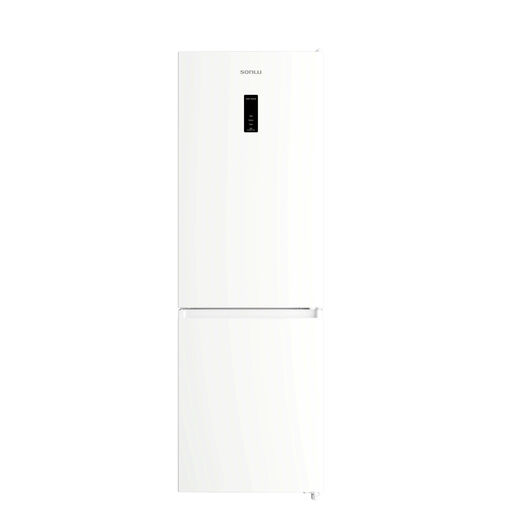 Image unavailable
Sonlu CD‑350RW, 310 L fridge-freezer
Compare this if you need both compartments and have a suitable space for its width. The product title lists 211 L for the fridge, 99 L for the freezer, a width of 60 cm, a reversible door and an E rating. Also check the other dimensions, noise level and kWh/year.
View on Joybuy
Frequently asked questions
How should I compare two appliances with different capacities?
First compare the capacity you actually need, then look at each model’s kWh/year. The energy rating letter alone isn’t enough to judge running costs. The energy label for the relevant appliances also shows the fridge and freezer capacities, helping you check whether you’ll make use of any extra space.
Do fridge and freezer energy labels run from A to G?
Yes. For the household fridges and freezers covered by the scheme in the European Union, the European Commission says this scale has applied since 1 March 2021. Also check the annual energy consumption, capacity and noise emissions listed for the model you’re considering.
Does No Frost always lower your electricity bill?
No. No Frost alone doesn’t prove that an appliance will use less electricity. If avoiding manual defrosting matters to you, check which compartment benefits from the feature, then compare the exact model’s annual energy consumption and capacity.
What should I do with my old appliance when replacing it?
Ask about collection when you place your order: ADEME says a fridge or freezer being replaced can be handed over to the retailer or delivery person. If the appliance still works, donating it is another option. Confirm the practical arrangements before delivery.


