Households that freeze portions every week
A fridge freezer gives you separate space for frozen food and prepared meals. Compare the capacity in litres of each compartment: the total capacity won’t tell you how much room is available in the freezer.


If you regularly freeze groceries or prepared portions, compare the fridge and freezer capacities of a fridge freezer. UFC-Que Choisir points out that a small freezer compartment may not be enough for households that eat a lot of frozen food. To manage your stocks more effectively, choose a capacity that suits your habits and a layout that makes everything easy to find. Then take stock before you shop, as ADEME recommends: a larger appliance is no substitute for keeping track.
A fridge freezer gives you separate space for frozen food and prepared meals. Compare the capacity in litres of each compartment: the total capacity won’t tell you how much room is available in the freezer.
Easy-to-reach shelves and separate drawers can help you find fruit, vegetables and other foods between shops. Check the layout of the model rather than looking at its total capacity alone.
A fridge with a small freezer compartment may suit you if you mainly store fresh food. UFC-Que Choisir advises taking your consumption of frozen food into account before opting for this format.
Start by considering how often you shop and how much frozen food you store, then compare the usable capacities with the space available in your kitchen.
Best for: households that buy frozen food or regularly freeze portions.
Bear in mind: the split between fridge and freezer capacity needs to suit your usual stocks; a large total capacity alone won’t help you decide.
Best for: households that mainly store fresh food and very little frozen food.
Limitation: UFC-Que Choisir says a small freezer compartment won’t be enough if you eat a lot of frozen food.
| Factor | What to check | To suit your needs |
|---|---|---|
| Usable capacity | Compare the fridge and freezer capacities in litres shown on the energy label. UFC-Que Choisir suggests starting with 100 to 150 litres for one person, then adding 50 litres for each additional person. | I shop less frequently or freeze portions, so I need enough room in both compartments and shouldn’t rely on the total capacity alone. |
| Storage layout | Look at how easy it is to reach the shelves, how the drawers are arranged and how easy it is to see food that’s already been opened. Check the features of each specific model rather than assuming that every model in a range has a particular drawer. | I want to see what’s left before I shop again. ADEME advises checking what you have in stock before making a list to avoid buying duplicates. |
| Temperature | Check how to set and monitor the temperature, and make sure there’s enough room for air to circulate. Anses recommends storing food between 0 and +4 °C at the coldest point. | If the fridge is often full, I need to be able to store food without overfilling it and check its temperature. |
| Size and energy label | Measure the space and access routes; for a built-in model, check the housing space too. According to the European Commission, the energy label shows details including annual energy consumption, capacity and noise level. | In a small kitchen or open-plan room, the space the appliance takes up and how noisy it is matter just as much as its capacity. |
Two appliances with a similar total capacity may have different amounts of space for fresh and frozen food. The freezer may not have enough room for the portions you want to store.
Compare the capacity of each compartment with the amounts you usually keep.
A practical layout can make food easier to see, but it won’t, by itself, prevent you from buying duplicates or forgetting about food.
Check what you have in stock before you shop. ADEME recommends doing this before preparing your shopping list.
The advertised feature doesn’t remove the need to check the temperature or allow air to circulate inside the fridge.
Check the coldest point: Anses recommends a temperature between 0 and +4 °C for storing food. Also avoid overfilling the appliance.
An appliance may fit in its final position but be difficult to get through doorways or corridors. A built-in model also needs a compatible housing space and door-fitting system.
Measure the access routes and the packaged appliance, then check the instructions for the required housing dimensions and door fitting, if applicable.
These models illustrate different layouts. Their features apply to the specific models listed and don’t represent every range from each brand.
The freestanding KGN39AIAU fridge freezer has a stated capacity split of 260 l for the fridge and 103 l for the freezer.
The ICBSd 5122 Plus BioFresh is a 255 l built-in fridge freezer, designed for a compatible fitted kitchen.
Samsung describes the RB38T602CSA/EF as a 385 l fridge freezer, 595 mm wide.
Depending on the model, Beko’s fridge freezer range offers different layouts for fresh food.
This selection includes compact and built-in fridge freezers, as well as larger, multi-door appliances. Compare the space available for fresh and frozen food with what you usually buy, rather than assuming that a higher total capacity will suit every household.
 Image unavailable
Worth considering if your groceries take up plenty of space in both the fridge and freezer compartments. Compare their respective capacities with the amount you usually store.
The model name indicates four doors, Total No Frost and an E energy rating. Measure the space and access routes before choosing this format.
 Image unavailable
This fridge freezer offers separate storage for fresh and frozen food in a kitchen where width is a consideration. Check that the freezer capacity suits the portions you usually store.
The product name indicates Low Frost, a 70/30 split, a width of 54 cm and a height of 176 cm.
 Image unavailable
Worth considering for a fitted kitchen if you want to keep fresh and frozen food separate. Check the capacity of each compartment before deciding how much usable space you’ll have.
The model name indicates TwinTech No Frost and an E energy rating. Check the housing dimensions and door-fitting system required for installation.
 Image unavailable
At 54 cm wide, this model may suit a smaller space, provided the 74 L freezer has enough room for your stocks.
The product name lists 153 L for the fridge and 74 L for the freezer. It also mentions Low Frost, a reversible door and an E energy rating.
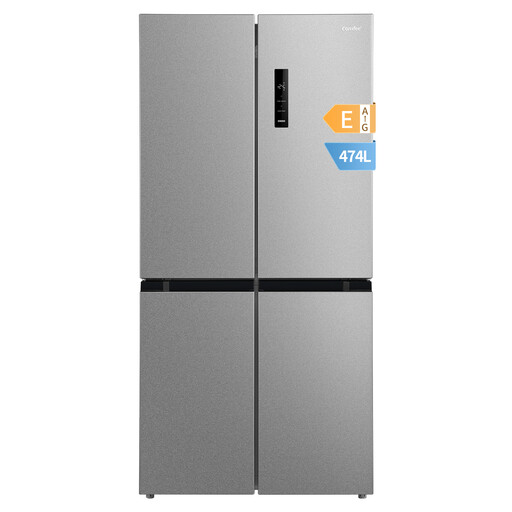 Image unavailable
This total capacity may appeal to a household that stores lots of fresh and frozen food. Check how many litres are available for each before choosing.
The product name mentions a vegetable drawer with three temperature settings, Vario Box, Flip Tray and an E energy rating. Also measure the space needed for this four-door format.
UFC-Que Choisir suggests starting with 100 to 150 litres for one person, then adding 50 litres for each additional person. Adjust this starting point to how often you shop, and compare the space available in the fridge and freezer separately.
No. Air circulation doesn’t replace keeping track of what you have in stock. ADEME recommends checking what you already have before shopping. Also check the temperature and avoid overfilling the fridge.
Anses recommends storing food between 0 and +4 °C at the coldest point. Set the appliance and check this spot rather than relying on the name of its cooling technology alone.
Measure the housing space, delivery access routes and the room needed to open the doors. Check the instructions for installation dimensions, ventilation requirements and the door-fitting system.
According to the European Commission, fridge energy labels show details including the energy rating, annual energy consumption, storage capacities and noise level. Consider all this information together: the rating alone won’t tell you how much room there is for fresh and frozen food.