Start by choosing an appliance that suits the amount of fresh and frozen food you actually store. A single-door fridge could be right if you rarely need freezer space, while a fridge freezer combines both functions; a standalone freezer means you’ll need another way to keep fresh food. Next, compare the annual energy use of models with similar sizes and capacities, and make sure you have enough room to install your chosen appliance. The ADEME reminds us that these appliances run continuously, so it’s worth checking that any extra capacity or features are justified by how you’ll use them.
Who is this choice for?
Households replacing an appliance that runs continuously
If your electricity bill is prompting you to replace your appliance, compare the energy use of models that meet the same storage needs. A small fridge and a large fridge freezer don’t do the same job.
Small households with few frozen foods
If you mainly shop for fresh food and have limited kitchen space, consider whether you’d actually use a freezer compartment or a separate appliance.
Households that regularly store frozen food
If you buy in bulk or prepare meals in advance, freezer capacity matters just as much as total volume. You’ll also need to allow for the space the appliance takes up and its ongoing energy use.
Which criteria should you look at first?
Single-door fridge
Consider it: if you mainly store fresh food and don’t need much freezer space.
Limitation: on its own, it won’t meet your needs if you regularly store frozen food.
Fridge freezer
Consider it: if you regularly need to store both fresh and frozen food in one appliance.
Limitation: the space available in each compartment needs to suit your shopping habits. A large total capacity doesn’t necessarily mean the split is right for you.
Standalone freezer
Consider it: if you store frozen food regularly enough to justify a dedicated appliance, and already have somewhere to keep fresh food.
Limitation: it won’t replace a fridge and takes up extra space.
| Criterion |
What to check |
Who it matters to |
| Annual energy use |
Compare the kWh/year shown on the energy label for appliances with similar formats and useful capacities. The energy rating letter alone doesn’t tell you how much energy an appliance uses. |
If my electricity bill is guiding my choice, I want to compare appliances that can store my usual shopping without choosing a larger model than I need. Around 42% of consumers would prioritise energy use when comparing appliances with similar capacities. |
| Fresh and frozen capacity |
Check the litres available for refrigeration and freezing separately, then compare them with your usual shopping habits. |
If I regularly store frozen food, I want enough room for it without sacrificing too much space for fresh food. Around 33% of consumers would put the balance of storage space ahead of other criteria. |
| Installation and comfort |
Measure the space, delivery route and door clearance. Check the manual for ventilation requirements and the product information for the stated noise level. |
If I have a narrow or open-plan kitchen, I want to be able to install the appliance properly and live with its noise day to day. Around 25% of consumers would prioritise whether it suits their home and their comfort. |
What should you watch out for?
-
Relying on the energy rating alone
The same energy rating letter doesn’t mean two appliances offer the same capacity or meet the same freezing needs. The European Commission says EPREL product information includes details such as annual energy use, dimensions and capacity.
To compare similar models, check the kWh/year and useful capacity, then look at the stated dimensions and noise level.
-
Choosing more capacity than your usual shopping needs
The ADEME gives average figures of 180 kWh/year for a fridge, 315 kWh/year for a fridge freezer and 300 kWh/year for a freezer. These averages are for different types of appliance, so they can’t predict the energy use of a specific model or compare appliances with the same capacity.
Start by working out how much fresh and frozen food you actually store. Then choose a format and compare models within it.
-
Forgetting about ventilation and the delivery route
The appliance dimensions may not include the clearance required for installation. This depends on the model and how it is fitted.
Measure the space, doors and access routes, then check the manual for ventilation clearances. Also check the delivery and old-appliance collection options available when you order.
-
Putting a freezer in a cold room without checking the manual
The permitted room temperature range depends on the model. Beko highlights some appliances designed to operate in particular conditions, but this doesn’t apply to all freezers.
If you plan to keep your appliance in a cellar, garage or unheated utility room, check the permitted temperature range in the documentation for the model you’re considering.
Brands to consider for different formats
Bosch
Bosch Home Appliances offers single-door fridges, fridge freezers, freezers and integrated models. It’s a range worth exploring if you’re still deciding between formats or installation types.
- The brand provides energy information so you can assess models individually.
- Check capacity, dimensions, noise and energy use for each model. The range as a whole isn’t a measure of the performance of every appliance it includes.
Liebherr
Liebherr offers fridges, fridge freezers and freezers, with a focus on energy use, noise and storage space.
- These are useful features to compare across models with similar capacities.
- Liebherr’s claims are made by the brand, so base your choice on the figures shown on the product information and energy label for the specific model.
Beko
Beko offers a range of domestic freezers, including No Frost models and some designed to operate at particular room temperatures.
- You can compare capacity and installation requirements with the space available and the amount of frozen food you store.
- No Frost features and permitted temperature ranges vary by model. Check the product documentation for details.
Fridge freezers to compare on Joybuy
These five appliances combine refrigeration and freezing. If you’re considering a single-door fridge or a separate freezer instead, treat that as a different format to compare with these fridge freezers. For each model, check the useful capacities, kWh/year and installation requirements before making your decision.
 Image unavailable
Candy CFQQ5T817EPS, 4-door fridge freezer, 467 L
Worth considering if you regularly store fresh and frozen food and have room for an appliance of this size.
- Claimed total capacity: 467 L; Total No Frost system and E energy rating listed in the product title.
- Check the capacity of each compartment, annual energy use and installation clearances in the model documentation.
View on Joybuy
 Image unavailable
Haier HTW5618ENMG, 3-door fridge freezer, 360 L
Compare this model if you want to keep fresh and frozen food in one appliance and check whether its capacity suits your shopping habits.
- Claimed total capacity: 360 L; Total No Frost, E energy rating, Wi-Fi and My Zone listed in the product title.
- Check the split between compartments, kWh/year and required ventilation clearances before choosing this model.
View on Joybuy
 Image unavailable
Sonlu CC-520WE, 444 L fridge freezer
Worth considering if a large total capacity suits your storage habits and you have enough room for the appliance.
- Claimed total capacity: 444 L; frost-free operation, E energy rating and stated noise level of 40 dB listed in the product title.
- Check how the capacity is split between compartments, the full dimensions and the kWh/year before comparing models.
View on Joybuy
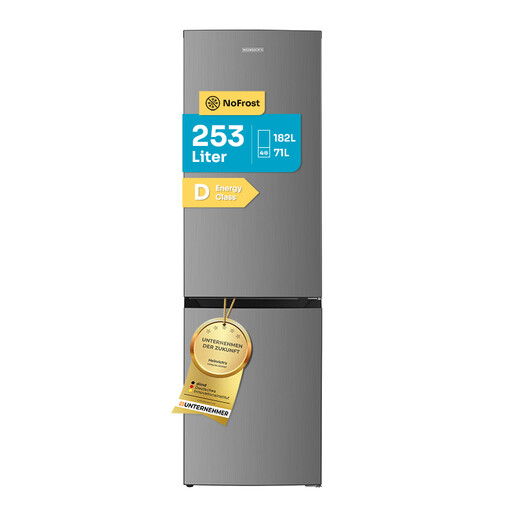 Image unavailable
Heinrich´s, 253 L fridge freezer, stainless steel finish
Consider this model if you want a clear split between fresh and frozen storage in a 253 L fridge freezer.
- Claimed capacities: 182 L for the fridge and 71 L for the freezer; No Frost and a stated noise level of 39 dB.
- Check the annual energy use on the energy label, along with the dimensions and installation clearances.
View on Joybuy
 Image unavailable
CHiQ JR227LSE, 227 L fridge freezer, silver finish
Worth considering for a kitchen where width is important, but check that each compartment meets your needs.
- Claimed capacities: 153 L for the fridge and 74 L for the freezer; 54 cm wide, reversible door and E energy rating.
- The Low Frost system is described as reducing frost build-up, but may not remove the need to defrost. Check the kWh/year, height, depth and clearances specified in the manual.
View on Joybuy
Frequently asked questions
What should I compare besides the energy rating?
First, compare the kWh/year for appliances with similar formats and capacities, then look at the litres available for fresh and frozen food. Dimensions, installation requirements and stated noise levels can help you choose between models that meet your storage needs.
How much space should I leave around a freestanding fridge?
Follow the clearances given in the manual for your chosen model. Whirlpool recommends 5 cm above and 10 cm behind its freestanding fridges, but this guidance doesn’t replace the instructions provided by another manufacturer or for an integrated appliance.
How can I arrange for my old appliance to be collected?
Check the collection arrangements when you order your new appliance. ecosystem offers free collection when you buy a new, equivalent appliance. It also states that, for home delivery, the old appliance is collected from where it is used.
Does No Frost mean an appliance uses less energy?
No. This feature alone doesn’t tell you whether a model uses less energy. To compare energy use, check the kWh/year for appliances with similar formats and capacities. Consider frost-related features separately, based on how much maintenance you’re happy to do.


