
Livraison le jour même ou le lendemain

Qualité garantie

Débloquez vos offres de bienvenue: Livraison GRATUITE | Jusqu'à -80 % | 30 jours d'essai gratuits à JoyPlus
Téléchargez l'application
A fridge freezer combines a fridge compartment and a freezer compartment in a single appliance. It's a practical setup for couples, families and homes where every centimetre counts. It also saves you from buying two separate appliances, but not all models are created equal.
Before choosing your fridge freezer, keep an eye on three common pitfalls:
For a single person or a student, a compact fridge can be perfectly adequate. Appliances with 80 to 100 litres can easily fit in a student room, an office or a second home. However, their small freezer compartment is very limited.
For two or three people, a total volume between 170 and 270 litres offers more flexibility. Pay particular attention to the split between the two zones. A 174-litre model might offer 115 litres for the fridge and only 59 litres for the freezer. For a family, a large-capacity fridge freezer of 280 to 360 litres, or even more, makes storing both fresh and frozen goods much easier.
Adjustable shelves, salad crispers and freezer drawers matter just as much as the litre count on the spec sheet. Well-separated compartments help you organise food better and avoid leaving the door open for long seconds every time you search for something.
Measure the available width, height and depth, then allow for the clearance recommended in the manual to ensure proper air circulation. Also think about the door's opening angle and whether the appliance can be manoeuvred through stairs, hallways and door frames.
A freestanding fridge freezer is generally straightforward to install, provided you place it on a stable floor and level it using its adjustable feet. Models with reversible doors are particularly handy when your kitchen layout requires the door to open on the left rather than the right.
As a guide, some compact combi models are around 54 cm wide, while a standard family model is closer to 60 cm. A narrower appliance can therefore be a better fit for a small kitchen, without necessarily sacrificing all storage capacity.
The noise level, expressed in dB(A), deserves special attention in an open-plan kitchen, a studio flat or a home near a bedroom. Models rated between 38 and 40 dB(A) are generally quieter in daily use than noisier appliances. However, the perceived level can vary depending on the floor type, ventilation and compressor cycles.
The European energy label ranges from A to G. An E energy rating fridge freezer can be a common compromise, but it's the annual consumption in kWh that you should really compare. To estimate running costs, multiply this figure by your electricity tariff. The energy class letter alone isn't enough.
Static cooling remains simple and common on budget appliances. Low Frost slows down frost build-up and allows you to defrost less often. No Frost circulates air to limit ice formation in the relevant compartments. Whichever technology you choose, avoid overloading the shelves and never put a hot dish straight into the fridge.
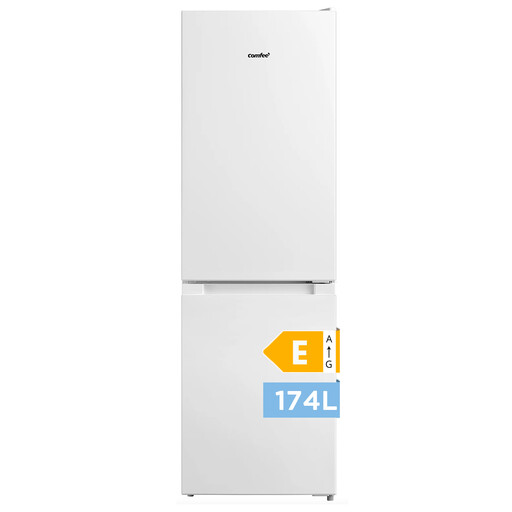
Why this choice suits this profile: at 150 cm tall, this model is ideal for a couple, a first home or a medium-sized kitchen. It offers 115 L for the fridge and 59 L for the freezer.
The spec sheet clearly separates the volumes for fresh and frozen food. Low Frost technology limits frost build-up, without promising no defrosting at all.
39 dB, reversible door, LED lighting, adjustable glass shelves and three freezer drawers.

Why this choice suits this profile: its 360 L capacity and three doors meet the needs of a household that regularly stocks fresh produce, drinks and frozen food.
The volume is split into 235 L for the fridge and 125 L for the freezer. Total No Frost and electronic controls reduce maintenance tasks.
35 dB(A), Inverter compressor, fast-freeze function, dedicated zones and Wi-Fi/Bluetooth connectivity.
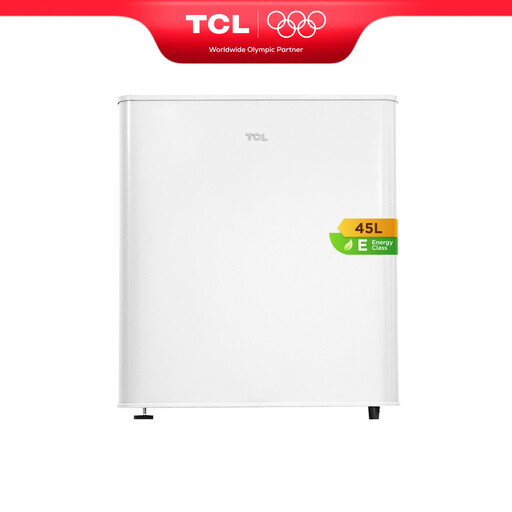
Why this choice suits this profile: this mini fridge is ideal for an office, a bedroom, student accommodation or a second home where storage needs are modest.
Its dimensions of 44.9 × 48.5 × 51.2 cm are clearly stated. However, you'll need to manage manual defrosting and the 3 L freezer compartment, which is particularly small.
45 L, energy class E, tempered glass shelf, door bin that can hold a large bottle and a stated noise level of 40 dB.
We've put together a complete, real-time updated selection of products that meet these exacting criteria, as well as European safety standards.
A total volume of around 170 to 230 L can work for a couple, depending on your shopping habits. If you regularly freeze ready meals or fresh food, aim for a freezer compartment of at least 50 to 70 L and prioritise models with separate drawers.
Place it on a level floor, away from a radiator, oven and direct sunlight. Follow the ventilation gaps specified in the manual and plug the appliance into an earthed socket. After transport, leave it upright for the time recommended by the manufacturer before switching it on.
It all depends on the annual consumption stated in kWh and your electricity price. The calculation is simple: annual consumption × rate per kWh. Also compare the usable volume: a larger appliance generally uses more energy, even if its layout suits your needs better.