Which households is this for?

Households that do a weekly shop

You buy enough for several days and need to organise fresh food, fruit and vegetables, prepared portions and frozen food. According to the E.Leclerc Observatory of New Consumer Trends, batch cooking involves preparing and then storing food in the fridge or freezer to use throughout the week.

Cooks who prepare several meals in advance

You store ready-to-eat dishes, fresh ingredients and sometimes portions to freeze at the same time. Interior organisation and the amount of space actually dedicated to the freezer matter just as much as the total capacity.

Households short of freezer space

Your fridge works well for fresh food, but prepared portions or frozen shopping quickly fill the freezer. A separate appliance could meet this need if you have enough room and compare its everyday use with that of a fridge freezer.

Buying criteria

Fridge freezer

Choose this if you want to keep fresh food and frozen portions in one appliance, with daily access to both sections.

Bear in mind the balance between fridge and freezer space is fixed by the model. Check the capacity of each compartment, not just the total.

Separate fridge and freezer

Choose this if the space you need for fresh food and frozen portions is consistently unbalanced.

Bear in mind you need two spaces and two appliances to compare, including their respective annual energy consumption.

Upright or chest freezer

Choose this if frozen storage becomes your main requirement alongside an existing fridge.

Bear in mind an upright freezer makes access easier with drawers, while a chest freezer needs floor space and opens from the top.

Priority What to check Your needs
Capacity split Compare the litres allocated to the fridge and freezer, along with the drawers, adjustable shelves and bins of the exact model. I want to know how many portions and fresh products can be stored at the same time, rather than relying on the total capacity alone.
Ongoing energy use Read the kWh/year alongside the energy class and capacities. For two appliances, add together the annual consumption of both models under consideration. I want to compare appliances of the same type and similar capacity, without assuming that the energy-class letter alone determines running costs.
Organisation and access Look at the format and number of drawers, baskets, shelves and bins, as well as the door-opening direction and dimensions. My portions need to remain easy to identify and access several times a week, without having to reorganise all the storage.
Noise and defrosting Compare noise emissions in dB and check the defrosting system for the relevant compartment. No Frost should be confirmed for the exact model. In an open-plan kitchen, I take everyday noise and maintenance requirements into account before choosing.

Mistakes to avoid

  • Choosing based on total capacity

    Two appliances with the same total capacity can offer very different amounts of space for fresh and frozen food. A freezer compartment that is too small can become restrictive when storing prepared meals.

    Make a note of the amount of fresh food and number of portions you need to store at the same time, then compare the capacity of each compartment on the energy label or product information sheet.

  • Comparing only the energy class

    The energy class does not replace checking the kWh/year or comparing appliances of a similar type and capacity. Different storage solutions do not offer the same performance.

    Record the kWh/year, usable capacities and noise levels for each model. With two separate appliances, add their annual consumption together before comparing them with a fridge freezer.

  • Assuming all No Frost appliances are the same

    Defrosting and air-circulation technologies vary by model and sometimes by compartment. A marketing name alone does not describe every aspect of how an appliance is used.

    Consult the documentation for the exact model to confirm the areas covered, the defrosting method, drawer layout and any usage restrictions.

  • Ordering before checking the space

    An appliance that is the wrong size or installed without sufficient air circulation can be difficult to use and may not operate under the conditions for which it was designed.

    Measure the width, height, depth, door-opening clearance and ventilation space. Also check the climate class and follow the instructions after transport.

Brand guide

Bosch

In France, Bosch offers freestanding and built-in fridge freezers whose capacities, dimensions, noise levels, energy classes and defrosting functions are published for each model.

  • For the KGN39AIAU, Bosch lists 260 L of fridge space, 103 L of freezer space, 29 dB(A), an A energy class and Total NoFrost.
  • The VitaFresh and flexibility benefits highlighted by the brand should be checked for your chosen model; they do not automatically apply across the entire range.

Whirlpool

Whirlpool offers large-capacity fridge freezers as well as upright and chest freezers, allowing you to compare an all-in-one solution with separate frozen storage.

  • Whirlpool lists 490 L and two independent Dual No Frost systems for the WHK26494X6E fridge freezer. The UW8F2YWBIF2 upright freezer is listed with a 260 L capacity, drawers and NoFrost.
  • These specifications apply to the models mentioned and do not constitute a guarantee for all Whirlpool appliances.

Liebherr

Liebherr is worth considering when your planned solution includes a chest freezer to increase frozen storage outside the main fridge.

  • The brand highlights StopFrost and less frequent defrosting for its chest freezers.
  • These points come from Liebherr’s own product communication. Check the capacity, noise level, energy consumption, climate class and domestic-use specifications of the exact model.

Joybuy products

Joybuy options for organising your weekly shop, fresh food and prepared portions, including fridge freezers and dedicated freezers to suit your storage needs.

CHiQ JR263LGE 262 L black Low Frost fridge freezer

CHiQ JR263LGE 262 L Low Frost, black

For weekly shopping split between fresh food and portions to freeze.

187 L fridge, 75 L freezer, 215 kWh/year, 39 dB(A), three freezer drawers and a width of 54 cm. Low Frost means manual defrosting is required; climate class N-ST, from 16 to 38 °C.

Joybuy

CHiQ JR227LSE 227 L silver Low Frost fridge freezer

CHiQ JR227LSE 227 L Low Frost, silver

A compact option for combining fresh shopping and frozen portions in a small kitchen.

153 L fridge, 74 L freezer, E energy class, 54 cm width, adjustable shelves, reversible door and four-star freezing. Check the kWh/year on the energy label for the exact model.

Joybuy

AUCMA 291 L convertible chest freezer

AUCMA 291 L convertible chest freezer

For increasing separate storage for prepared portions and frozen food when the main freezer is full.

291 L, 226 kWh/year, 38 dB, removable basket, LED lighting and five-level digital controls. Fridge or freezer mode can be selected as required; check the climate class and defrosting system before installing it in an unheated room.

Joybuy
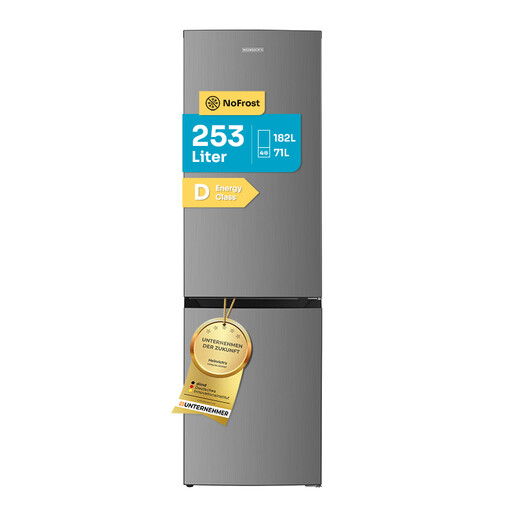
Heinrich's 253 L stainless steel fridge freezer

Heinrich's 253 L fridge freezer, stainless steel

For storing several days’ worth of shopping while keeping fresh and frozen food in one appliance.

182 L fridge, 71 L freezer, D energy class, 39 dB, LED lighting, large freezer boxes and No Frost. Check the kWh/year, dimensions and climate class before buying.

Joybuy

Heinrich's 161 L stainless steel No Frost upright freezer

Heinrich's 161 L No Frost upright freezer

A dedicated solution for frozen portions you need to find frequently, alongside a main fridge.

161 L, C energy class, three drawers, two shelves, LED display, alarm, reversible door, No Frost and Fast Freeze function. It does not provide fridge space; check the energy consumption, noise level, dimensions and climate class.

Joybuy

Frequently asked questions

Which figures on the energy label should you check first?

Compare the energy class from A to G, annual consumption in kWh, fresh and frozen capacities, and noise emissions. The European Commission recommends comparing this information between appliances of the same type and similar capacity. For two separate appliances, check both labels and add their kWh/year together.

Is a fridge freezer enough for batch cooking?

Yes, if the freezer capacity genuinely matches the number of portions you need to store and you use both sections every day. If frozen portions regularly fill the compartment while the fresh-food capacity remains suitable, a separate freezer meets a different need.

What should you check before installing a cooling appliance?

Follow the instructions for your model. Electrolux recommends, among other things, waiting at least four hours before plugging the appliance in after transport, allowing air to circulate around it, keeping it away from heat sources and checking its climate class.

How should you set the fridge for chilled prepared meals?

Anses recommends setting the fridge below 4 °C. This setting relates to food use and storage; it does not distinguish between appliances, but reliable temperature control is useful for ready-to-eat meals.

What should you do with your old fridge or freezer in France?

A cooling appliance comes under France’s waste electrical and electronic equipment recycling scheme. Check the take-back or collection service offered when you replace it, as well as the collection points available near you.