
Livraison le jour même ou le lendemain

Qualité garantie

Débloquez vos offres de bienvenue: Livraison GRATUITE | Jusqu'à -80 % | 30 jours d'essai gratuits à JoyPlus
Téléchargez l'application
Buying a fridge-freezer isn't just about comparing capacity or finish. An appliance that's too wide can block a door or make it awkward to get past, while a model marketed as quiet can quickly become annoying in an open-plan kitchen if you haven't checked its noise level. Energy rating, cooling technology and the split between fridge and freezer space all have a direct impact on everyday convenience and running costs.
Here are the key factors to consider before choosing a fridge-freezer combination, an American-style fridge freezer or a compact appliance.
The stated capacity usually refers to the total net volume, but how that space is divided matters just as much. A 350-litre appliance with a small freezer won't necessarily suit a family that freezes a lot of food. Conversely, a large freezer compartment can eat into the space available for fresh produce.
Always check the two figures separately: fridge volume and freezer volume. For a couple, 200 to 300 litres may be enough, depending on shopping habits. A family or household that buys in bulk would be better off looking at a large-capacity fridge of 400 litres or more.
No Frost limits frost build-up in the compartments and generally eliminates the need for manual defrosting. Low Frost, on the other hand, slows down ice accumulation without necessarily preventing it altogether. Occasional defrosting may still be required.
Static cooling, fan-assisted cooling and multi-airflow cooling don't all serve the same purpose. Focus on whether there's automatic defrosting, how the cold air is distributed and the manufacturer's recommendations, rather than relying solely on a marketing label.
A fridge that's 60 cm wide might seem standard, but you also need to measure its depth, the door opening angle and the space required for ventilation. Don't forget skirting boards, walls, wall units and the clearance needed to open the doors fully.
To choose a quiet fridge, compare the noise level given in decibels. As a guide, several models featured here are rated between 35 and 40 dB(A). This figure relates to stated operating conditions – the actual noise you hear may vary depending on installation, flooring and compressor cycles.
Measure the available width, height and depth, then allow for the clearance recommended in the manual. A reversible door makes installation easier in a corner or against a wall. A fridge with a freezer at the bottom often gives more comfortable access to fresh food, while a top freezer can offer a more traditional layout and direct access to frozen items.
Also look at the number of drawers, whether the shelves are adjustable, whether there's a salad crisper and the width of the door bins. For storing large packaging, total volume isn't enough – the interior layout needs to be genuinely practical.
The current European energy label runs from A to G. Several appliances in this selection are rated E. This rating alone isn't enough to estimate annual running costs – also check the consumption figure in kWh per year and compare it with your electricity tariff.
A larger appliance may use more energy, even if its layout is more practical day to day. To compare models objectively, always look at net volume, annual consumption and noise level together.
A freezer rated 4 stars is designed to reach a temperature suitable for freezing fresh food, in line with the manufacturer's instructions. The freezing capacity, given in kilograms per 24 hours, is particularly useful if you regularly freeze large quantities.
How long the appliance keeps food cold during a power cut depends on the model and conditions of use. In any case, keeping the doors closed is the best way to preserve the cold for as long as possible. Appliances using R600a refrigerant must be installed and maintained according to the manual, without blocking the ventilation openings.

Why this suits this profile: With 153 L for the fridge, 74 L for the freezer and a width of 54 cm, this model fits easily into a small kitchen or as a first appliance.
Its compact width and reversible door reduce installation constraints. The Low Frost technology limits ice build-up without promising a completely defrost-free appliance.
227 L capacity, 54 cm width, 4-star freezing and a stated noise level of 39 dB.

Why this suits this profile: This American-style multi-door fridge is aimed at households looking for generous capacity, well-organised compartments and smart features.
At 81.7 cm wide, you must check the available space before buying. Its generous volume comes with a stated consumption of 301 kWh per year, which needs to be factored into your budget.
495 L, No Frost technology, water and ice dispenser, Wi-Fi connectivity and a stated noise level of 40 dB.

Why this suits this profile: This chest freezer can operate in either fridge or freezer mode. It's ideal for a garage, store room, small business or a home that already has a main appliance.
Its 7-level thermostat and removable basket allow it to be adapted for different uses. However, make sure you allow enough clearance above the appliance to open the lid fully.
95 L volume, stated operation at 38 dB, annual consumption of 165 kWh and a drain for defrosting.
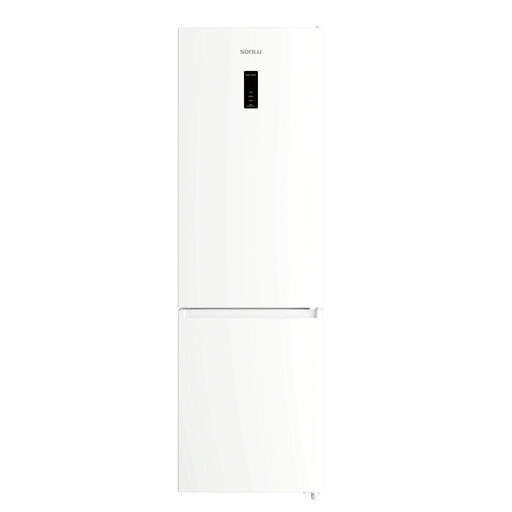
Why this suits this profile: With its 60 cm width, bottom freezer and 355 L capacity, this model suits a household that cooks regularly and wants a clear separation between fresh and frozen food.
The capacity is clearly split between 252 L for the fridge and 103 L for the freezer. The reversible door makes installation easier, but do check the full dimensions before ordering.
Full Frost-Free technology, variable speed compressor, electronic controls and a fast-freeze function.
We've put together a comprehensive, real-time selection of products that meet these exacting criteria and European safety standards.
For two people, a volume of 200 to 300 litres may be suitable, depending on how often you shop and how much space you need for frozen food. A large family or a household that freezes regularly would be better off aiming for 350 litres or more. The split between compartments matters just as much as the total volume.
The No Frost system is designed to limit frost build-up in the areas it covers. It doesn't eliminate the need for cleaning, and you should check whether it applies to the fridge, the freezer or both. A Low Frost model reduces the amount of ice, but manual defrosting may still be needed.
Compare the energy label from A to G and, most importantly, the annual consumption in kWh. A class E rating may suit your budget, but the actual running cost also depends on the appliance's size, your electricity price, the room temperature and how often you open the doors.