For most households that do their food shopping every week, a fridge-freezer offers a practical balance between fresh and frozen food without taking up the space required by a larger model. Pay particular attention to the usable capacity of each compartment, installation dimensions, annual energy consumption, noise level and climate class. A multi-door model is worthwhile when the extra capacity meets a genuine need and your kitchen has room for it.
Which households is it for?
Households doing one big weekly shop
You want to keep fresh food for the week along with a supply of frozen food, without choosing an unnecessarily large appliance. The balance between fresh and frozen storage, how often you shop and the space available in your kitchen matter more than the number of people in your household alone.
Households that eat lots of frozen food
You need a dedicated freezer compartment with drawers and a useful capacity that works for you. If you eat a lot of frozen food, a fridge-freezer with the freezer at the bottom may be more suitable than an appliance designed mainly for fresh food, as Bosch indicates for its range.
Large kitchens and high-capacity storage needs
You may be considering a multi-door model to store large dishes or organise greater quantities of food. In that case, check the overall size, delivery route, annual energy consumption and whether the extra capacity will genuinely be useful.
Buying priorities
Fridge-freezer
Choose this if: your weekly shop regularly includes both fresh and frozen food, and your kitchen is designed for a standard-width appliance.
Check: the fridge and freezer capacities separately, as the total capacity does not show how the space is divided.
Single-door fridge and separate freezer
Choose this if: your fresh and frozen storage needs are consistently very uneven and you have two suitable spaces available.
Check: the dimensions, ambient temperature requirements and specifications of each appliance, as they need to be assessed separately.
Multi-door fridge
Choose this if: you genuinely need a large amount of storage and both your kitchen and delivery route are spacious enough.
Check: the width, depth, door-opening clearance and annual energy consumption before choosing this format.
| Priority |
What to check |
Your needs |
| Capacity split |
Compare the fridge and freezer capacities in litres, rather than looking only at the total capacity. UFC-Que Choisir’s average guide of 100 to 150 L for one person, followed by 50 L for each additional person, provides a starting point that should be adjusted to suit your needs. |
I want to store a full weekly shop without dedicating excessive space to foods I buy less often. The amount of frozen food, ready meals and bulk purchases all affect the capacity required. |
| Space for frozen food |
Check the freezer capacity, number of drawers and position. A bottom-freezer model may be more suitable when frozen food takes up a significant amount of space. |
My frozen food needs to fit without reducing the space required for the week’s fresh food. |
| Size and access |
Measure the width, height, depth, door-opening clearance, doorways, hallways and delivery access. According to UFC-Que Choisir, larger models can be close to 1 m wide and 75 to 80 cm deep. |
I need to be able to get the appliance into my kitchen, open the doors and access the drawers. |
| Energy use, noise and room |
The EU energy label shows annual consumption in kWh, compartment capacities and airborne acoustical noise emissions. Also check that the climate class covers the actual temperature of the room. |
In an open-plan kitchen, the noise level matters every day. For a garage, conservatory or warm room, I check the temperatures at the installation location first. |
Mistakes to avoid
-
Choosing the total capacity without checking the space allocated to frozen food
Two appliances with a similar total capacity can offer very different amounts of fridge and freezer space. A small freezer may not be enough if frozen food is a regular part of your shop.
Make a list of the contents of a typical full shop and compare the fridge and freezer capacities separately. If frozen food consistently takes up a lot of space, look at bottom-freezer fridge-freezers or two separate appliances.
-
Buying a large model before checking the measurements
A wide, deep appliance may not fit through an entrance, hallway or kitchen door, and its doors must be able to open without obstructing movement around the room.
Measure the available space, the clearance required and the entire delivery route. Where the manufacturer provides them, also compare the packaged dimensions.
-
Comparing only the letter on the energy label
The energy efficiency class alone is not enough to compare two appliances with different capacities or formats. The label also shows annual consumption, compartment capacities and noise levels.
Compare similar-sized models for annual kWh consumption, fresh and frozen capacities, and dB levels. The label’s QR code provides access to detailed information in EPREL.
-
Installing the appliance in an unheated room without checking the climate class
The climate class indicates the ambient temperature range in which the appliance is designed to operate. A heated kitchen, garage and conservatory do not have the same conditions.
Record the minimum and maximum temperatures in the room, then check that the model’s climate class covers them.
What to know about the brands
Bosch
The range includes fridge-freezers, single-door models, multi-door appliances and side-by-side models, with different freezer positions.
- Bosch states that fridge-freezers with the freezer at the bottom suit households that eat more frozen food.
- Capacity, dimensions, energy consumption, noise level and climate class can vary considerably from one model to another.
Whirlpool
The French range includes freestanding and built-in fridge-freezers, including some models with fan-assisted cooling.
- For the WHK26494X6E, Whirlpool states a total capacity of 490 L, including 340 L of fridge space and 150 L of freezer space, as well as a noise level of 36 dB.
- This model is 70 cm wide and 74.5 cm deep, so check the available space and access route before buying.
Samsung
The range includes fridge-freezers, American-style refrigerators and multi-door models, with a particularly strong presence in larger formats.
- Samsung states that some multi-door models feature spacious compartments, convertible zones and independent cooling systems.
- A large model should only be chosen if the available space, storage needs and annual energy consumption justify it.
Fridge options on Joybuy
These Joybuy options mainly include fridge-freezers for dividing fresh and frozen food during a weekly shop, as well as side-by-side models for households that need more storage capacity.
 Image unavailable
Haier HTW5618ENMG 360 L
A fridge-freezer offering 235 L of fridge space and 125 L of freezer space for organising your weekly shop.
Advertised features include Total No Frost, a bottom freezer with three drawers, 35 dB(A), 271 kWh/year and climate class SN/N/ST/T.
Check the height of 185 cm, depth of 66.7 cm and the ventilation clearances required.
Joybuy
 Image unavailable
CHiQ JR263LGE 262 L
This compact fridge-freezer offers 187 L of fridge space and 75 L of freezer space.
Advertised specifications include a width of 54 cm, height of 176 cm, depth of 55 cm, a bottom freezer with three drawers, 39 dB(A) and 215 kWh/year.
Its advertised climate range of 16 to 38 °C is not suitable for a colder garage or outbuilding.
Joybuy
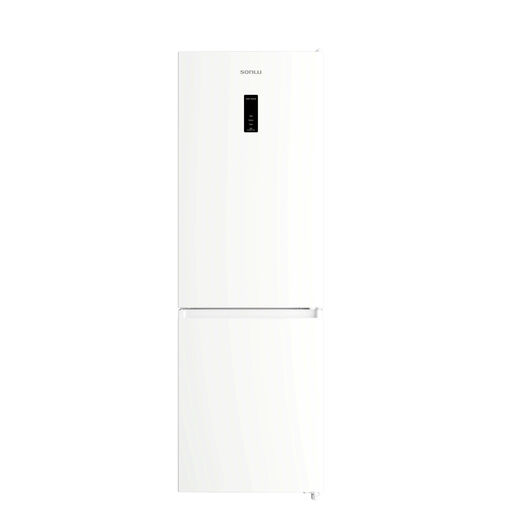 Image unavailable
Sonlu CD-350RW 310 L
A fridge-freezer with 211 L of fridge space and 99 L of freezer space for shops combining fresh and frozen food.
Advertised features include a width of 60 cm, reversible doors, electronic temperature control and energy class E.
Before buying, check the annual energy consumption, noise level, climate class, height and depth for your room.
Joybuy
 Image unavailable
CHiQ JR525WSE Side-by-Side 525 L
This large model offers an advertised 333 L for fresh food and 192 L for frozen food.
Advertised features include No Frost, Multi-Airflow, 37 dB, touch controls, adjustable feet and energy class E.
Be sure to measure the width, height, depth and door-opening clearances, then check the climate class and annual energy consumption.
Joybuy
 Image unavailable
Sonlu CC-520WE Side-by-Side 444 L
A large-capacity appliance designed for households that want to increase their overall storage capacity.
Advertised specifications include a total net capacity of 444 L, Total No Frost, 40 dB, 289 kWh/year, energy class E and climate class SN-T.
Check the dimensions, door clearances and the split between fresh and frozen capacity before choosing this model.
Joybuy
Frequently asked questions
How can I estimate the usable capacity without applying a rigid per-person rule?
Which energy-label details should I compare?
For household refrigeration appliances, the EU energy label shows the efficiency class from A to G, annual consumption in kWh, compartment capacities and airborne acoustical noise emissions. Compare these details between similarly sized appliances and use the QR code to view detailed information in EPREL.
What temperature should I aim for in a fridge loaded after shopping?
Anses recommends a temperature between 0 °C and 4 °C in the coldest part of the fridge. When the appliance is very full or opened frequently, a thermometer can help you monitor it. Arrange food without overpacking the shelves so that air can circulate.
Why should I check the climate class for a garage or conservatory?
The climate class defines the ambient temperature range for which the appliance is designed. Bosch states, for example, that SN covers 10 to 32 °C, N covers 16 to 32 °C, ST covers 18 to 38 °C and T covers 18 to 43 °C. Check the range for the exact model against the temperatures actually recorded in the room.


