Which households is it for?

Households replacing a fridge freezer used every day

You need everyday refrigeration and freezing, and must balance usable capacity, the annual consumption shown on the energy label and the appliance’s footprint, rather than choosing based on total capacity alone. ADEME and the European Commission present the energy label as a useful point of comparison.

Small households that buy few frozen foods

A compact appliance or one with a freezer compartment may be suitable when frozen storage is limited. UFC-Que Choisir recommends matching usable capacity to your household’s habits rather than defaulting to family-sized capacity.

Households with significant freezing needs

If you regularly need to store large quantities of frozen food, it is worth considering a separate fridge and freezer by comparing the space required with their combined annual energy consumption. LG presents this configuration as practical for maximum storage.

Buying priorities

Fridge freezer

Best for: households that regularly use both fresh and frozen food and want the two compartments combined in a single appliance.

Check: the capacity of each compartment and the kWh/year still need to be compared model by model; the fridge-freezer format alone does not determine energy consumption.

Fridge with freezer compartment

Best for: households that only buy frozen food occasionally and whose shopping habits and kitchen suit a smaller capacity.

Limitation: freezer capacity may become insufficient if your storage needs change.

Separate fridge and freezer

Best for: households with a regular, substantial need for freezer capacity that is distinct from everyday refrigeration.

Trade-off: two appliances run continuously, so compare their combined energy consumption and the space they require.

Priority What to check Your needs
Annual energy consumption Compare kWh/year between appliances with similar capacities and configurations. Also check the energy class and the capacity of each compartment. I want a comparable figure for continuous use, without assuming that the cost will be identical in every home.
Usable capacity Distinguish between the fridge and freezer litres. UFC-Que Choisir suggests 100 to 150 L for one person, followed by 50 L for each additional person, adjusted to suit individual habits. My shopping should fit without unnecessarily powering a large empty space, while still leaving enough room for fresh and frozen food.
Configuration and maintenance Check the cooling system, whether No Frost is included and the sound emission in dB(A) shown on the label. I want an layout that suits my food and my tolerance for defrosting, without mistaking a technology for a guaranteed saving.
Durability and service Check the durability index where it is displayed and applicable, as well as parts availability, the warranty and after-sales service for the exact model. I want to keep the appliance running for as long as possible and have useful information available if it needs repairing.

Mistakes to avoid

  • Choosing based solely on the energy class letter

    The class alone is not enough to compare appliances with different capacities or configurations. Annual consumption, the capacity of each compartment and noise levels are also useful information.

    Compare the kWh/year and litres of each compartment between similar models, then rule out capacities you are unlikely to use.

  • Choosing a large total capacity without separating fresh and frozen food

    A high total capacity may conceal an undersized freezer or an unnecessarily large fridge compartment. A cooling appliance runs continuously, so unused capacity should be avoided.

    List your usual fresh and frozen food requirements separately, then match the capacity to how often you shop and your food-preparation habits.

  • Treating No Frost as proof of lower energy consumption

    No Frost is primarily designed to reduce frost build-up. Features and technologies vary between models and do not replace the annual consumption shown for the exact reference.

    Choose this feature if reducing frost matters for the way you use the appliance, then compare the kWh/year, capacity and noise levels of the models you are considering.

  • Overlooking repairability and after-sales service

    The energy label alone does not tell you how easy an appliance is to repair, how accessible replacement parts are or what support is available after a fault.

    Before ordering, note the exact reference, check the warranty and service terms, then verify the durability index where it is available and applicable.

Brand guide

Bosch

In France, Bosch offers fridge freezers, including No Frost models and XXL formats. These are worth considering if reduced defrosting or a choice of sizes is important to your decision.

  • Bosch presents No Frost as a feature that helps eliminate the chore of defrosting on equipped models.
  • This brand claim does not mean that every Bosch model uses less energy. Check the label, the litres in each compartment and the exact reference.

LG

In France, LG offers fridge freezers, multi-door models and large appliances. The brand may be useful as a reference point when comparing capacity, format and how the appliance will fit into your kitchen.

  • LG’s guide provides capacity guidelines based on household size and highlights features such as frost-free storage and InstaView.
  • This information comes from LG and may vary by model. It does not replace comparing kWh/year or assessing your actual storage needs.

Samsung

Samsung offers fridge-freezer, multi-door and American-style formats, with ventilated or No Frost cooling. This can be useful when comparing higher-capacity storage layouts.

  • Samsung says its all-round ventilated cooling system is designed to maintain an even temperature and limit frost formation.
  • This is a brand statement. Check the features, capacities, noise level and energy consumption of the exact model, particularly for larger formats.

Options available on Joybuy

These Joybuy options are fridge freezers for households that use both the fridge and freezer compartments every day. Compare their capacity by compartment, dimensions and, where stated, annual energy consumption.

Haier HTW5618ENMG 3-door 360 L fridge freezer

Haier HTW5618ENMG 360 L, Total No Frost

For a household that needs separate space for fresh and frozen food every day.

235 L fridge, 125 L freezer, 271 kWh/year, class E and 35 dB(A). Dimensions: 185 × 59,5 × 66,7 cm. Check that the freezer capacity and installation clearances suit your needs.

Joybuy

CHiQ JR263LGE 262 L Low Frost fridge freezer

CHiQ JR263LGE 262 L Low Frost

A combined option for a household that needs both compartments in a more compact kitchen.

187 L fridge, 75 L freezer, 215 kWh/year, class E and 39 dB(A). 54 cm wide, with a reversible door and Low Frost technology. The freezer requires manual defrosting.

Joybuy

CHiQ JR227LSE 227 L fridge freezer

CHiQ JR227LSE 227 L Low Frost

This compact format combines refrigeration and freezing for moderate storage needs.

153 L fridge, 74 L freezer, class E, 54 cm wide, with a reversible door and a 4-star freezer. Check the kWh/year on the exact model’s label before comparing running costs.

Joybuy
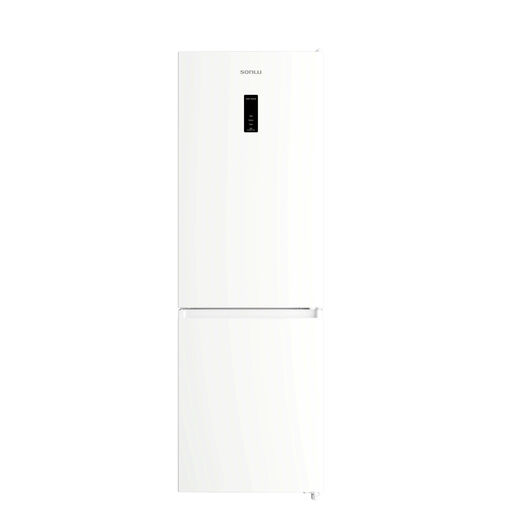
Sonlu CD-350RW 310 L fridge freezer

Sonlu CD-350RW 310 L, Full Frost-Free

A fridge freezer for households that need refrigeration and freezing every day.

211 L fridge, 99 L freezer, class E, 60 cm wide, with a reversible door and electronic controls. Check the kWh/year and noise level in dB(A) on the model’s product page before buying.

Joybuy
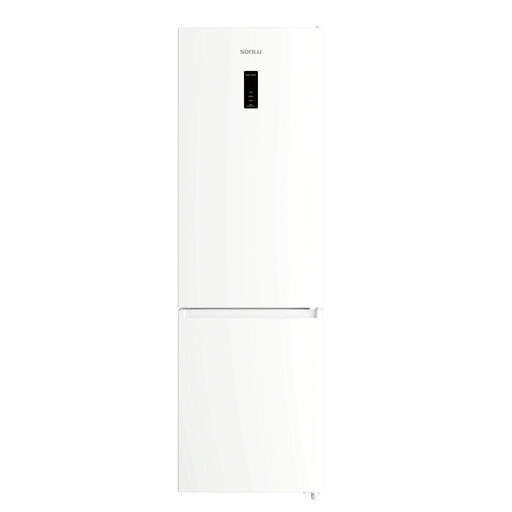
Sonlu CD-400RW 355 L fridge freezer

Sonlu CD-400RW 355 L, Frost-Free

This fridge freezer is designed for more generous everyday storage without moving to two separate appliances.

252 L fridge, 103 L freezer, class E, 60 cm wide, with a reversible door and fast freezing. Check the kWh/year and noise level in dB(A) if your kitchen opens onto the living area.

Joybuy

Frequently asked questions

Which energy-label details should you compare?

At a minimum, compare the energy class, annual consumption in kWh/year, the capacities of the fridge and freezer compartments, and the noise level. The European Commission says that these details are included in EPREL for the relevant appliances; kWh/year helps you compare specific products but cannot predict your home’s exact consumption.

Is the energy class enough to choose the model with the lowest running costs?

No. Compare the class with the kWh/year, then make sure the usable capacities and configuration match your needs. ADEME recommends using the energy label as a buying guide, but appliances with different sizes or layouts cannot be compared by the letter alone.

When should you choose a separate fridge and freezer?

This option makes sense when you have a lasting need for substantial frozen-food storage. Add together the annual consumption of both appliances, check the space available and compare the combined result with a fridge freezer offering sufficient capacity. LG presents separate appliances as practical for maximum storage, but this does not demonstrate a universal energy advantage.

Is the energy label regulated for appliances sold in France?

Yes. The relevant refrigeration appliances are covered by Delegated Regulation (EU) 2019/2016 on energy labelling, which applies across the European Union. Check the label and the exact model’s product information when buying.

How should repairability factor into your choice?

Check the durability index where it is displayed and applicable, then review the warranty terms, parts availability and after-sales service for the model you choose. According to ADEME, this index helps identify appliances that are easier to repair and designed to last; it complements the energy label but does not measure kWh/year.