Which features should you prioritise ?
Start with the space available and how much fresh and frozen food you usually store: a compact model takes up less room, while a fridge-freezer combines both compartments in one appliance. If freezing is your main priority, also compare a separate freezer; for a multi-door model, pay particular attention to the space needed for installation and opening the doors.
| What matters | What to check | Who it’s for |
|---|
| Capacity split |
Compare the usable litres in the fridge and freezer separately, then look at the drawer layout. |
If I prepare portions in advance, I want to store them with my frozen food without giving up space for fresh food. Around 33 % of consumers prioritise this balance of capacity. |
| Kitchen space |
Measure the space and access route, then check the depth, door-opening direction and access to the drawers. |
In a narrow kitchen, I need to be able to install the appliance and open its doors without obstructing the way. Available space comes before other considerations for around 25 % of consumers. |
| Keeping fresh food |
Find the coldest zone and plan to check its temperature after installation; Anses recommends 0 to +4 °C in this zone. |
When I store perishable foods or prepared meals, I mainly want to be able to put them in a suitably cold zone. Keeping fresh food organised is the priority for around 25 % of consumers. |
| Everyday use |
When comparing appliances of a similar size and capacity, check their kWh/year, noise level in dB and the model’s servicing information. |
If the appliance is near living areas, I want to consider its noise, ongoing energy consumption and repair options. Around 17 % of consumers put these factors at the top of their list. |
Fridge-freezer models on Joybuy
These models combine refrigeration and freezing in one appliance: fridge-freezers, multi-door and side-by-side models. Focus on comparing the capacity split and dimensions with your shopping habits and available space.
 Image unavailable
Candy CFQQ5T817EPS, 467 L multi-door fridge-freezer
Worth considering if you want to store your shopping and prepared portions in a four-door appliance.
Advertised total capacity: 467 L; Total No Frost, energy rating E.
Check the space needed for installation and the temperature of the coldest zone once the appliance is up and running.
View on Joybuy
 Image unavailable
Haier HTW5618ENMG, 360 L three-door fridge-freezer
Worth comparing if you shop regularly and need fresh and frozen storage in the same appliance.
Advertised total capacity: 360 L; Total No Frost, energy rating E, Wi-Fi and My Zone.
Check the full dimensions and clearance required, then check the temperature of the coldest zone.
View on Joybuy
 Image unavailable
CHiQ JR525WSE, 525 L side-by-side fridge-freezer
Worth considering if you store large shops and have enough room for a side-by-side appliance.
Advertised capacity: 333 L for the fridge and 192 L for the freezer; No Frost, energy rating E and an advertised noise level of 37 dB.
Check the installation dimensions, annual energy consumption on the energy label and the temperature of the coldest zone.
View on Joybuy
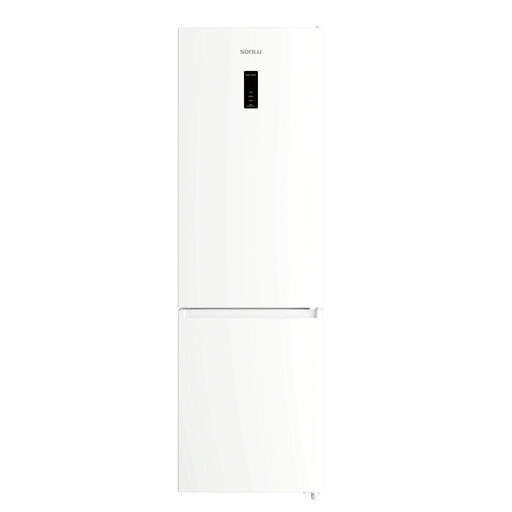 Image unavailable
Sonlu CD‑400RW, 355 L fridge-freezer
Worth comparing if you shop regularly and want an integrated freezer with its capacity listed separately.
Advertised capacity: 252 L for the fridge and 103 L for the freezer; 60 cm wide, reversible doors and energy rating E.
Check the height, depth and clearance required, as well as annual energy consumption, noise and the temperature of the coldest zone.
View on Joybuy
 Image unavailable
CHiQ JR227LSE, 227 L fridge-freezer
Worth considering for a kitchen where width is limited, while still giving you an integrated freezer compartment.
Advertised capacity: 153 L for the fridge and 74 L for the freezer; 54 cm wide, Low Frost and energy rating E.
Check the height and clearance required, annual energy consumption and the temperature of the coldest zone.
View on Joybuy
Frequently asked questions
Will the integrated freezer be big enough for my prepared meals ?
First, compare its usable capacity in litres and the drawer layout with the portions and frozen food you usually store. If you regularly keep large quantities, consider a fridge-freezer with more freezer space or a separate freezer instead of a small auxiliary freezer.
What temperature should I aim for when storing perishable foods ?
Anses recommends a temperature of 0 to +4 °C in the coldest part of the fridge. Put perishable foods there, following the appliance instructions, and check the temperature regularly, especially if the display doesn’t clearly show the temperature in this zone.
Is No Frost enough to keep food properly ?
No: No Frost reduces the need to defrost, but it doesn’t replace temperature checks or appropriate food storage. Anses also recommends limiting the time chilled and frozen food is in transit after shopping.
How can I compare energy consumption and noise ?
Compare annual energy consumption in kWh, usable capacity and noise level in dB between appliances of a similar size and capacity. The European Commission says that the energy label for fridges and freezers has used the A to G scale since 1 March 2021; the letter alone doesn’t sum up these factors.
How can I check repair options before buying ?
Ask for servicing and spare-parts information for the exact model. For appliances covered by European Regulation 2019/2019, some parts must be available for set periods, and the duration and eligible recipients vary by part. Check the applicable terms with the manufacturer.


