Households that shop for the week
You buy fresh food to last several days and keep a regular stock of frozen food. Compare the available capacity in each compartment: a large total volume doesn’t guarantee the right balance between the two.


For a weekly shop that includes fresh and frozen food, start by checking the usable capacity of each compartment, rather than the total volume. A fridge-freezer meets both needs in one space. A fridge with a small freezer compartment is best if you store very little frozen food, while separate appliances are worth considering if freezing is your priority and you have room for a second appliance. Then check the dimensions and installation requirements of your chosen model.
You buy fresh food to last several days and keep a regular stock of frozen food. Compare the available capacity in each compartment: a large total volume doesn’t guarantee the right balance between the two.
If you batch-cook or regularly buy food to freeze, freezer capacity could be the deciding factor. Compare the freezer in a fridge-freezer with the option of installing a separate appliance.
A narrow space or difficult access can rule out an appliance that seems spacious enough inside. Measure the available space, delivery route and door clearance before choosing a capacity.
The right format depends on how much room your fresh and frozen food actually needs, as well as the space available for your appliances.
Consider this if: you use both compartments regularly and only have space for one appliance.
The trade-off: freezer capacity is limited to the integrated compartment, even if the appliance’s total volume looks generous.
Consider this if: you mainly need space for fresh food and keep very little frozen food.
The trade-off: according to UFC-Que Choisir, a small freezer compartment is not enough if you eat a lot of frozen food.
Consider this if: your frozen-food stock exceeds what the fridge-freezer you’re considering can hold, and you have space for a second appliance.
The trade-off: you’ll need to make room for and install two appliances, then compare their respective annual energy consumption.
To compare formats, check the fridge and freezer capacities shown on the EU energy label, as explained by the European Commission. The questions below will help you decide what matters most.
| Criteria | What to check | Who this matters to |
|---|---|---|
| Balance between fresh and frozen food | Compare the usable fridge and freezer capacities separately with what you put away after your shop. | If I fill both compartments after every shop, I want to avoid running out of room in one while there’s still space in the other. Around 46% of consumers put this balance first. |
| Frozen-food stock | Check the freezer capacity and drawer layout. If frozen food makes up most of your stock, compare a fridge-freezer with a separate freezer. | When I batch-cook or buy large packs of food to freeze, I mainly need enough freezer space. This would be the top priority for around 27% of consumers. |
| Space required | Measure the height, width, depth, access route and door clearance; follow the clearances specified in the manual. | I need to be able to install the appliance without blocking access or preventing the doors from opening, even if I’d like more capacity. For around 27% of consumers, available space matters more than having a larger capacity. |
Two appliances with a similar total volume may divide the space differently between the fridge and freezer.
Note down how much space you need for each, then compare both figures on the model’s energy label.
Extra capacity is no use if the appliance won’t fit through the access points or its doors can’t open properly.
Check the space, delivery route and installation clearances given in the manual.
A feature designed to reduce frost says nothing, by itself, about the available capacity or the freezer layout.
Choose the capacity and format you need first, then check the maintenance features of the specific model.
Access to your home, installation of the new appliance and removal of the old one all need to be planned in advance.
Before ordering, confirm the delivery, installation and collection options offered by the retailer.
The range includes fridge-freezers, single-door fridges and freezers, so you can explore different ways to divide up your storage.
The brand’s fridge-freezers include high-capacity models to consider if you need plenty of space while still needing the appliance to fit your kitchen.
The range of fridge-freezers lets you compare different capacities when available space is a key factor in your choice.
Whirlpool offers both standalone appliances and fridge-freezers, including models in its No Frost ranges.
These appliances combine fridge and freezer storage in one unit. Compare their stated capacity with the amount of fresh and frozen food you usually keep, then check the space needed for installation.
 Image unavailable
Worth considering if you want one appliance for several days’ worth of shopping, as long as the freezer space suits the amount of frozen food you keep.
The model name indicates a total capacity of 360 L, three doors, Total No Frost and an energy rating of E. Check the capacity of each compartment and the clearances needed for installation.
 Image unavailable
Compare this model if you’re looking for more capacity in one appliance and have enough room for a four-door design.
The model name lists a total capacity of 467 L, Total No Frost and an energy rating of E. Check the separate compartment capacities, door clearance and available access for delivery.
 Image unavailable
Worth looking at for a narrow kitchen if your fresh and frozen food fits in its two compartments.
The model name lists 153 L of fridge space, 74 L of freezer space, a width of 54 cm, a reversible door and Low Frost. Check the height, depth and required clearances too. Low Frost doesn’t necessarily mean you’ll never need to defrost it.
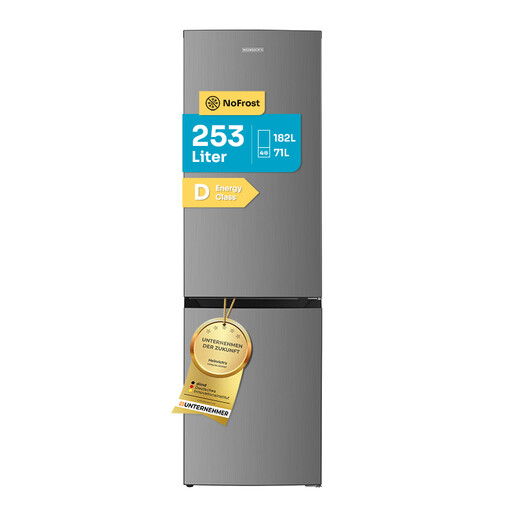 Image unavailable
Compare this model if you want one appliance for both types of storage and the freezer compartment can accommodate your frozen-food stock.
The product name lists 182 L of fridge space, 71 L of freezer space and No Frost. Check the width, depth and installation requirements before choosing this format.
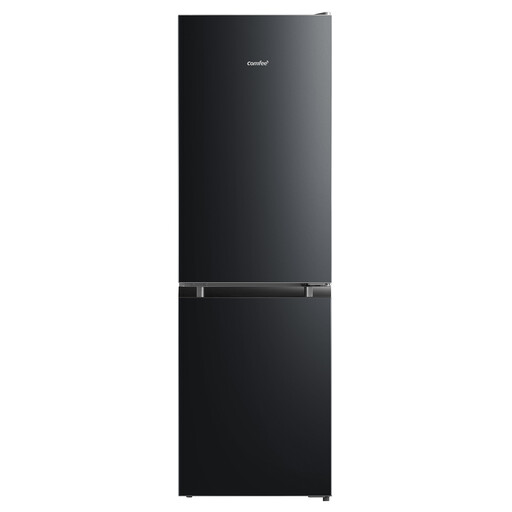 Image unavailable
Consider this model if you don’t need much storage and want to keep fresh and frozen food in one appliance.
The model name lists a total capacity of 174 L, Low Frost and a reversible door. Compare the capacity of each compartment with your usual shop and allow for periodic defrosting if needed.
No. Compare the fridge and freezer capacities separately. The EU energy label, as explained by the European Commission, lets you check these figures for the model you’re considering.
A small freezer compartment may not be suitable if frozen food makes up a significant part of your shopping, as UFC-Que Choisir points out. Check its freezer capacity and compare it with that of a fridge-freezer or a separate freezer.
Measure the space and access route, then follow the ventilation instructions in the model’s manual. If maintenance is an important factor, check which compartments actually have No Frost; the feature depends on the appliance.
When you place your order, say that you’d like your old appliance collected. Confirm with the retailer where and when it will be collected, and what arrangements apply at delivery.