Households doing one big shop each week
Assess how much space you need for fresh food, ready meals and frozen items before choosing the overall capacity. A larger appliance is only useful if the litres in each compartment match your shopping habits.


For most households that buy fresh food every week along with a few frozen items, a fridge-freezer is a well-balanced starting point. First compare the separate usable capacities for fresh and frozen food, then check access dimensions, noise levels and annual energy consumption. A compact model suits more limited needs, while a multi-door fridge-freezer requires a suitable kitchen and access route.
Assess how much space you need for fresh food, ready meals and frozen items before choosing the overall capacity. A larger appliance is only useful if the litres in each compartment match your shopping habits.
Capacity, access into the kitchen and everyday noise levels all need to be considered together. Que Choisir uses a level below 40 dBA as a guide for the quietest models. Also check the available space, door opening clearance and delivery route.
A large fridge-freezer or multi-door model can make it easier to organise provisions when storage needs increase. However, weigh the capacity against the appliance’s footprint, weight, any water connection and its stated annual energy consumption.
Choose the format based on your storage habits, then compare models with a similar size and capacity.
| Priority | What to check | Your needs |
|---|---|---|
| Fresh and frozen capacities | Compare the fridge and freezer capacities separately. Check whether the format you choose offers a proper freezer compartment rather than just a small freezer box. | I want to keep fresh food and ready meals until the next shop, without running out of space for the frozen items I usually buy. |
| Size and access | Measure the height, width and depth, including the door-opening clearance. Also check doors, hallways, lifts and stairs before delivery. | My fridge-freezer must fit into my home and be installed without obstructing movement around the kitchen. |
| Noise | Compare noise emissions in dB and the noise class on the energy label between models of a similar format. | In an open-plan kitchen or near a bedroom, I want an appliance that stays discreet day to day. |
| Energy consumption | Consider the A to G class, kWh/year, storage capacities and noise levels together. The European Commission states that this information appears on the energy label of the appliances concerned. | I want to compare the relative running cost without choosing based solely on an energy-efficiency letter. |
| Maintenance and food storage | Check for No Frost or Low Frost, as well as dedicated zones if they suit the food you buy. Also compare cooling distribution and settings when independent tests are available. | I want to minimise frost and organise fruit, vegetables, dairy products and frozen food properly between shops. |
An appliance may look spacious while offering too little room for frozen food, or devote too much space to freezing compared with fresh food.
Make a note of what you usually store in each area, then compare the stated fridge and freezer capacities on the energy label or product page.
Multi-door and American-style models can be wide and heavy. Que Choisir states that some American-style models are close to 1 m wide and can weigh more than 100 kg.
Measure the installation space, doors, hallways, lift and stairs, then confirm the delivery and installation arrangements with the retailer.
The energy-efficiency class alone does not tell you about capacity, noise or the split between compartments. Appliances in different formats cannot be compared by their class letter alone.
Compare the A to G class, kWh/year, fresh and freezer capacities, and noise emissions, preferably between models with a similar format and capacity.
Higher annual consumption can increase running costs over the time you own the appliance.
No Frost mainly concerns frost management. Specialised compartments and connectivity are only useful if they match the food you store and how you use the appliance every day.
Prioritise capacity, format, access, noise and energy consumption. Add convenience features when they support a specific storage habit.
Worth considering if you are looking for a freestanding fridge-freezer with food-preservation and frost-reduction features. The details below relate to the KGN39AIAU.
Worth considering for fridge-freezers or larger formats with dedicated zones, provided you can compare dimensions, capacity and noise levels accurately.
Worth considering for a multi-door or side-by-side model with a large capacity and several storage configurations.
Worth considering if you are looking for a multi-door model with generous storage space, a water dispenser or quick-access features.
Joybuy options including fridge-freezers and multi-door models for the weekly shop, with capacities suited to households of different sizes.
 Image unavailable
A fridge-freezer for regularly storing fresh and frozen food in one appliance.
235 L fridge capacity, 125 L freezer capacity, Total No Frost, a stated 35 dB(A) and 271 kWh/year. Dimensions: 185 × 59.5 × 66.7 cm; weight: 76 kg. Check the ventilation clearances and the route into your kitchen.
 Image unavailable
A high-capacity option for a household storing a large amount of fresh and frozen food.
330 L fridge capacity, 165 L freezer capacity, No Frost, Twin Cooling Plus, a stated 40 dB and 301 kWh/year. Dimensions: 177.6 × 81.7 × 71.5 cm; weight: 102.5 kg. Check access to your home and the distributor’s installation requirements before buying.
 Image unavailable
A fridge-freezer with separate compartments for a small household doing a weekly shop.
187 L fridge capacity, 75 L freezer capacity, Low Frost, a 4-star freezer, a stated 39 dB(A) and 215 kWh/year. Width: 54 cm; height: 176 cm; reversible door. Low Frost means periodic manual defrosting is required.
 Image unavailable
A compact format for a small household with a few frozen items to store.
153 L fridge capacity, 74 L freezer capacity, Low Frost, a 4-star compartment and a stated 39 dB. Width: 54 cm; reversible door and adjustable feet. Check that the capacity suits your usual ready meals and shopping habits.
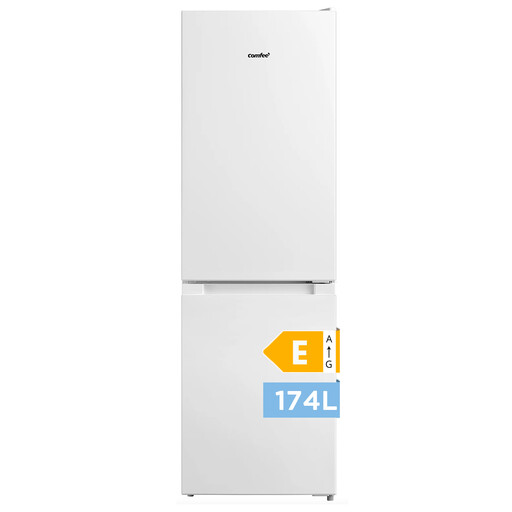 Image unavailable
A compact fridge-freezer for moderate use of fresh and frozen storage.
115 L fridge capacity, 59 L freezer capacity, Low Frost, a 4-star freezer and a stated 39 dB. Dimensions: 50 × 55 × 150 cm, with a reversible door. This capacity is less suitable if you store lots of ready meals or frozen food.
Use the Que Choisir guideline as a starting point: 100 to 150 L for one person, then 50 L for each additional person. Adjust this according to how often you shop, the number of ready meals and the amount of frozen food you buy, considering the fridge and freezer capacities separately.
A fridge-freezer is suitable when your shopping regularly includes frozen food, as it separates refrigeration and freezing. A fridge-only model may be enough if your household mainly buys fresh food or already has another freezer solution. A small freezer box is not always sufficient for a high consumption of frozen food.
Compare the A to G efficiency class, annual consumption in kWh, storage capacities and noise emissions. The European Commission explains that the label’s QR code provides access to EPREL, its database of models sold in the European Union.
The “one-for-one” collection of an appliance of the same type is available for electronic and household appliances, provided you purchase an equivalent appliance. The French Ministry for Ecological Transition specifies this condition. You should then check the practical arrangements with your chosen retailer, particularly for home collection.
Not necessarily. Que Choisir states that some multi-door models have a chilled-water dispenser and may therefore require a water connection. Check the exact model’s technical specifications: it may have a water tank or no dispenser at all.