Households that use both fresh and frozen food
If you prepare meals for several days at a time and regularly freeze portions, check how much space is available in each compartment, not just the total capacity.


If you regularly store fresh ingredients and frozen portions, start by comparing the usable capacity of both compartments. A fridge-freezer can meet both needs, while an additional freezer is worth considering if your current appliance has enough room for fresh food but not for your frozen supplies. A small freezer compartment is better suited to occasional use. With a multi-door model, you’ll need to check the available space carefully, as well as the route into your kitchen.
If you prepare meals for several days at a time and regularly freeze portions, check how much space is available in each compartment, not just the total capacity.
If storage space is already limited, compare the capacity you want with the appliance’s dimensions, the delivery route and the space needed to open the doors.
In an open-plan kitchen or one close to a living area, compare the noise emissions and annual energy consumption shown on the energy label, taking the appliance’s format and capacity into account.
First decide whether your batch cooking takes up more space in the fridge or the freezer. Then choose a format with dimensions, access and features that suit your kitchen.
Worth considering : when you regularly use both compartments for fresh ingredients and frozen portions.
The trade-off : the freezer shares the appliance’s overall size with the fridge, so compare their capacities separately.
Worth considering : if most of your prepared meals are kept chilled and you only occasionally store frozen food.
The trade-off : a small compartment may not have enough room for regular frozen storage, so check its type and capacity.
Worth considering : if you need extra storage for larger shops and your kitchen can accommodate this format.
The trade-off : check the width, depth, access route and door clearance before choosing a large model.
Worth considering : if your current fridge has enough room for fresh food, but you’re short of space for frozen supplies.
The trade-off : this appliance takes up extra space and uses electricity.
| Consideration | What to check | Who is it for ? |
|---|---|---|
| Fridge space | Usable fridge capacity and the layout of the shelves and drawers. Anses recommends avoiding overfilling the appliance so that air can circulate. | When ingredients and meal containers quickly fill the shelves, I want to be able to put everything away without cramming in fresh food : around 36 % of consumers make well-organised fridge space their top priority. |
| Frozen storage | Usable freezer capacity and drawer layout; check the freezing functions if you regularly add large quantities of food. | If I often freeze prepared portions, I need enough room to find and access them easily ; freezer capacity comes first for around 29 % of consumers. |
| Size and access | Appliance dimensions, the route into the kitchen, door clearance and the clearances specified in the instruction manual. | A spacious appliance is no use to me if it won’t fit through the door or gets in the way in my kitchen : around 21 % of consumers put a suitable size first. |
| Noise and energy use | Noise emissions in dB and annual energy consumption in kWh on the energy label; compare appliances with similar formats and capacities. | In an open-plan kitchen, I pay attention to everyday noise and the electricity used by an appliance that runs continuously ; this is the top priority for around 14 % of consumers. |
An appliance may offer plenty of litres overall without enough space in the compartment you need most. As a guide, Que Choisir describes a typical fridge-freezer of around 300 L, split approximately two-thirds for the fridge and one-third for the freezer.
Compare the litres available for fresh food separately from those for frozen portions.
Having space in your kitchen isn’t enough if the appliance won’t fit through the access points or its doors can’t open properly. For example, Samsung France lists one of its multi-door models as 817 mm wide and another as 912 mm wide. Measure the exact model you’re considering.
Check the doors and access routes all the way to the final position, then check the clearances required in the instruction manual.
Que Choisir warns that a basic freezer compartment won’t be enough if you eat a lot of frozen food. Its presence alone doesn’t tell you how much space there is for your portions.
If you regularly freeze prepared meals, check the compartment’s capacity and how easy it is to access the storage before choosing a format.
The European Commission explains that the label for refrigeration appliances also shows energy consumption, storage capacities and noise levels. The rating letter doesn’t replace this information when you’re comparing appliances with different capacities.
Check the annual kWh and dB figures, then compare appliances with similar formats and capacities.
These ranges offer formats to compare; features vary by model.
Bosch offers freestanding and integrated fridge-freezers, including models with a bottom freezer.
Samsung multi-door models may suit households looking for plenty of storage space and a kitchen that can accommodate their size.
Whirlpool offers freestanding and built-in fridge-freezers, including models advertised with the Total No Frost function.
These Joybuy models include fridge-freezers and multi-door appliances for storing fresh food and frozen portions. First choose the layout and capacity you need, then check that the appliance can be installed in your home.
 Image unavailable
Worth considering if you need a large appliance with separate access for your shopping and prepared meals. This four-door model is listed with a total capacity of 467 L, the Total No Frost function and an E energy rating. Check the capacity of each compartment, the dimensions and the door clearance for your kitchen.
 Image unavailable
This three-door fridge-freezer lets you store fresh and frozen food in one appliance. Its name indicates a total capacity of 360 L, the Total No Frost function, an E energy rating, as well as Wi-Fi and My Zone. Compare the compartment capacities and installation dimensions with your usual storage needs.
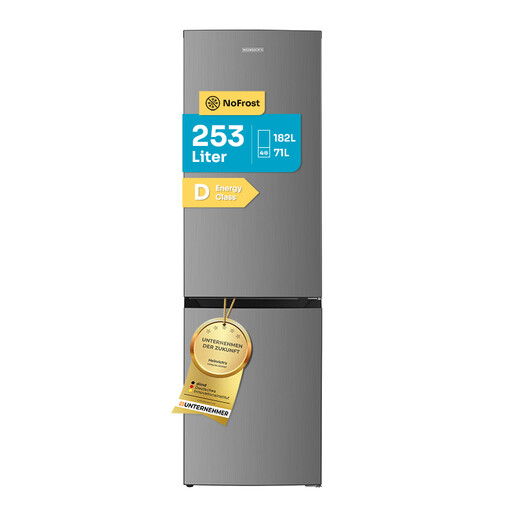 Image unavailable
If you need more space for fresh food than frozen supplies, this fridge-freezer lists 182 L for the fridge and 71 L for the freezer. The product name mentions No Frost, a reversible door and 39 dB. Check that 71 L is enough for the portions you plan to store, as well as the appliance’s width and depth.
 Image unavailable
If width is your main constraint, this model is listed as 54 cm wide. Its stated capacities are 153 L for the fridge and 74 L for the freezer; it has Low Frost rather than No Frost, as well as an E energy rating. Check the height, depth and maintenance requirements before choosing.
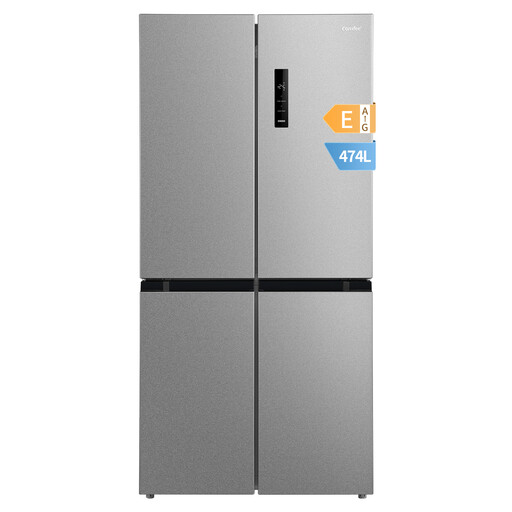 Image unavailable
This four-door model is worth considering if you’re looking for a large total capacity with multiple access points. Its name indicates 474 L, a three-temperature crisper drawer, the Flip Tray function and an E energy rating. Ask for the separate usable capacities of the fridge and freezer before deciding how much room there is for your portions; also check the available space and door clearance.
Start by estimating separately how much space your fresh meals and frozen portions will take up. Que Choisir suggests 100 to 150 L for one person, then an extra 50 L for each additional person. Use this as a starting point and compare it with the containers and shopping you actually plan to store.
It may be suitable for occasional use, but it’s less suited to regularly stocking up on frozen food. Que Choisir says that a basic freezer compartment isn’t enough if you eat a lot of frozen food, so compare its capacity and storage access before deciding.
Measure the space where it will go, every access point on the way to the kitchen and the room needed to open the doors. Also check the installation clearances in the instruction manual for your chosen model : the appliance’s width alone won’t tell you whether it can be installed.
Compare annual energy consumption in kWh, compartment capacities and noise emissions, as well as the energy rating. The European Commission says this information appears on the label for refrigeration appliances. Comparing models with similar formats and capacities will make it easier to choose the right one for you.