Households that shop once a week
You need to store fresh and frozen food until your next shop. Compare the usable capacity in litres of each compartment, rather than looking only at the total capacity.


If your food shop needs to last all week and regularly includes frozen food, start by comparing fridge freezers with separate compartments. This lets you choose how much space to allocate to fresh and frozen food. A compact model may suit you if space or your need for freezer storage is limited; a multi-door model is worth considering if its capacity matches your habits and you’ve checked that it will fit through all access points. Whatever you choose, compare the usable capacity, installation dimensions, noise level and energy consumption of the specific model.
You need to store fresh and frozen food until your next shop. Compare the usable capacity in litres of each compartment, rather than looking only at the total capacity.
Your appliance needs to fit its allocated space, while leaving room for the doors to open and meeting the ventilation requirements in the manual. For an integrated model, the cabinet space and door fitting are just as important as the appliance dimensions.
Your fridge will still be running when the room is quiet, so it’s worth comparing the stated noise level as well as annual energy consumption between models that offer similar storage capacity.
First, choose a format that suits your available space and how much frozen food you store. Then compare the capacities and energy-label details of models with similar features.
Consider this if : you want to store fresh and frozen food separately throughout the week, without needing a separate freezer.
Bear in mind : it will be taller than an under-counter model, and you’ll need to check the capacity of both compartments.
Consider this if : your kitchen is small and you only need to store modest quantities of food.
Bear in mind : there’ll be less room for your food shop, especially if you regularly buy frozen food.
Consider this if : you mainly store fresh food and only keep a small amount of frozen food.
Bear in mind : its freezer compartment will be smaller than that of a fridge freezer designed for regular storage.
Consider this if : your household will genuinely use the extra capacity and you have enough space for it.
Bear in mind : you’ll need to check that it can be delivered through your home and that the doors can open fully.
| Criterion | What to check | Who should consider it |
|---|---|---|
| Fresh and frozen capacity | Compare the usable capacity in litres of each compartment with the size of your household and how often you shop. UFC-Que Choisir suggests 100 to 150 L for one person, plus 50 L for each additional person, adjusted to suit your habits. | I want enough room to store fresh food and frozen food until my next shop, without relying on a small freezer compartment to hold everything. Around 31% of consumers would make this their priority. |
| Size and installation | Measure the space and access points. For an integrated model, check the cabinet space, hinges and ventilation against the model’s manual. | In a fitted kitchen or a home with restricted access, I need to be able to install the appliance and open its doors without changing the planned layout. This would be the top consideration for around 31% of consumers. |
| Noise | Check the stated dB(A) and noise class on the energy label, and consider where the appliance will be installed. | If my kitchen opens onto my living area, I pay attention to the noise from an appliance that runs at night too. Around 19% of consumers would put quiet operation ahead of other criteria. |
| Energy consumption and model support | Compare the kWh/year of appliances with similar capacities and features. Also check the warranty, service and spare-parts information for the exact model. | I want to compare the energy consumption of an appliance that runs all year round and find out what information will be useful for its maintenance. This would be the priority for around 19% of consumers. |
Two fridges with the same total capacity can have very different amounts of space for fresh and frozen food. A small internal freezer compartment isn’t the same as the freezer section of a fridge freezer.
Think about what you need to store between shops, then check the usable capacity in litres of each compartment separately.
An appliance may fit in the space you’ve measured, but its door, ventilation or integrated cabinet space may not be suitable. Doors and tight turns along the delivery route can also cause problems.
Check the installation instructions, the dimensions of the appliance and its packaging, and the entire route into your kitchen.
If the appliance isn’t compatible with your kitchen layout, you may need to adapt the cabinetry or you may not be able to install it.
The European Commission says the label also shows annual energy consumption, compartment volumes and noise levels. The letter alone won’t tell you whether two appliances offer the same storage capacity.
Compare the kWh/year and capacities of models with similar formats and storage space. You can scan the label’s QR code to view information about the model in EPREL.
The availability of service documents or spare parts doesn’t, on its own, predict how reliable a fridge will be in the future.
Check the warranty terms, repair information and spare-parts availability for the exact model, rather than assuming a brand claim means the appliance will last a certain length of time.
A brand to consider if you’re looking for an integrated fridge for a fitted kitchen.
Worth considering if an under-counter or integrated model suits your planned kitchen layout.
Worth considering when comparing freestanding and integrated fridge freezers.
Worth considering if you’re looking for a multi-door model and have a kitchen that can accommodate one.
These models include integrated and freestanding fridge freezers, as well as a multi-door option, for keeping fresh and frozen food separate. First, choose a format that suits your kitchen, then check the capacity and installation requirements of the model you’re considering.
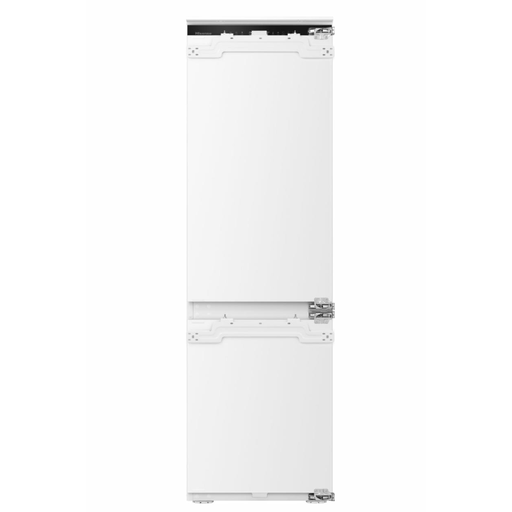 Image unavailable
Worth considering if you want separate fresh and frozen compartments in a fitted kitchen. The product title states No Frost and energy class C; check the manual for the required cabinet dimensions, ventilation and door fitting.
 Image unavailable
Worth considering if your household needs a large capacity and has room for a multi-door appliance. The product title mentions Total No Frost and energy class E. Check the dimensions, clearance for all four doors and delivery route before choosing this format.
 Image unavailable
An option for a fitted kitchen that needs separate fresh and frozen compartments. The product title states TwinTech No Frost and energy class E; check the model documentation for the usable capacity of each compartment, cabinet dimensions and annual energy consumption.
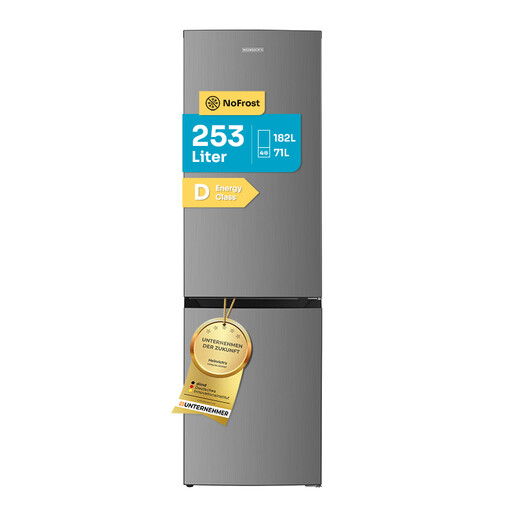 Image unavailable
Worth comparing if you’re looking for a fridge freezer with a stated 182 L of fresh-food capacity and 71 L of freezer capacity. The product title mentions No Frost and 39 dB; check the full dimensions, installation instructions and kWh/year on the model’s energy label.
 Image unavailable
Worth considering if space is limited but you want two compartments: the product title states a width of 54 cm, with 153 L for fresh food and 74 L for frozen food. It also mentions Low Frost, which doesn’t mean you’ll never need to defrost it. Check the height, depth and kWh/year too.
For the domestic refrigeration appliances covered, the European energy label shows the class from A to G, annual energy consumption in kWh, compartment volumes and noise emissions. The European Commission says its QR code links to further information in EPREL. Compare the kWh/year of models that offer similar storage capacity.
No. The cabinet space, hinges and ventilation must match the instructions for your chosen model. Bosch generally recommends a 5 cm gap at the sides and back in its installation advice, but this isn’t a universal rule for every model.
Check both the stated dB(A) and the noise class shown on the energy label. UFC-Que Choisir uses below 40 dB(A) as a guide to quieter models; how noticeable the noise is will also depend on the room and installation.
Electrolux recommends 4 °C or below in the fridge and −18 °C in the freezer. Check your appliance manual too, and review the settings after putting away a large food shop.
No. Fridges aren’t among the product categories covered by the list published by the French Ministry for the Ecological Transition on 8 July 2025. To compare two models, check their spare-parts information, warranty terms and service details instead, but don’t treat these as a prediction of how long an appliance will last.