Someone living alone with a very limited kitchenette
You mainly need fresh food for a few days, do little cooking or shop frequently, while keeping your worktop and walkways clear. A table-top fridge is the first format to consider.


Start by choosing according to the space genuinely available, including the required ventilation clearances. Then consider how often you shop and how much room you need for frozen food. A table-top fridge is best suited to one person who does little cooking; a compact model with a freezer compartment meets occasional needs, while a slim fridge freezer is more suitable for weekly shops and regular freezing, provided its dimensions are compatible with the studio flat.
You mainly need fresh food for a few days, do little cooking or shop frequently, while keeping your worktop and walkways clear. A table-top fridge is the first format to consider.
You want a compact appliance without giving up ice cubes, ice cream or frozen portions. Check that the exact model has a freezer compartment and that its capacity suits this type of use.
You do a weekly shop, keep more fresh food and genuinely use the freezer. A slim fridge freezer could be suitable if the height, depth, access and ventilation requirements allow for it.
Best for: one person who does little cooking, shops frequently and has limited space under or near a worktop.
Bear in mind: the smaller footprint also means less capacity for large shops and frozen food.
Best for: when space calls for a small appliance but you still want to keep a few frozen items or ice cubes occasionally.
Bear in mind: check the compartment’s capacity and classification, as it may not replace a proper freezer section.
Best for: less frequent shopping, regular cooking and a genuine need for freezing in a limited-width space.
Bear in mind: its height and depth, the delivery route and the door swing are all crucial considerations.
Start by measuring the space and access points, then match the capacity to your shopping habits. Que Choisir recommends an average usable capacity of 100 to 150 litres for one person, but this should be adjusted according to how much frozen food you buy and how often you shop.
| Priority | What to check | Your needs |
|---|---|---|
| Usable capacity | Compare the total capacity in litres, the split between fridge and freezer space, and how often you shop. | I want to store my shopping without installing an unnecessarily large appliance. A small format is better suited to frequent shopping; a fridge freezer makes more sense for weekly storage. |
| Size and door | Measure the height, width and depth, as well as skirting boards, sockets and delivery access. Check the opening direction and door swing in the manual. | In a small kitchen, the appliance must fit through the access points and allow the door to open without blocking a unit or walkway. |
| Ventilation and room temperature | Follow the clearances specified for the model and check its climate class. Keep the appliance away from heat sources when instructed to do so in the manual. | I want to install the fridge in a restricted space without preventing the airflow needed around the appliance. |
| Noise and energy consumption | Compare the declared noise level in dB(A), the energy label and annual consumption between models with a similar capacity and format. | The fridge operates in the same room as the sleeping area. Que Choisir ranks appliances advertised below 40 dBA among the quietest. |
An appliance measuring 55 cm wide may still be too tall, too deep or unsuitable for the access route and door swing. The Liebherr CUe331-26, for example, measures 181.2 × 55 × 63 cm.
Measure the installation space and delivery route in three dimensions, then compare them with the external dimensions and clearances specified in the manual for your chosen model.
A table-top fridge may suit a studio flat, but a small integrated compartment may not be sufficient if frozen food is part of your regular shop.
Check the freezer compartment’s capacity and classification separately. If freezing is an essential requirement, consider a slim fridge freezer instead.
Ventilation around the appliance and keeping it away from heat sources are part of the installation requirements. Beko’s documentation states that, for the model concerned, insufficient rear clearance may increase energy consumption.
Allow the exact clearances prescribed in your model’s manual, rather than automatically applying the 50 mm figure to another fridge.
Reduced ventilation may increase electricity consumption where the model’s manual warns of this.
In a studio flat, the compressor operates in the same room as the sleeping area. The appliance’s size alone does not indicate its noise level.
Compare the declared noise levels of appliances with similar capacities and technologies, without judging noise from the price or format alone.
A useful benchmark for comparing a 125 L table-top fridge with a slim fridge freezer measuring 55 cm wide for studio flat requirements.
A retailer’s own brand available on top-mounted fridges for one person, as well as larger-capacity fridge freezers.
A useful documentary reference for checking the installation, ventilation and clearance requirements specific to a model.
Joybuy options for equipping a studio flat, including compact formats and fridge freezers to compare footprint, refrigerated capacity and space for frozen food.
 Image unavailable
Worth considering for less frequent shopping and regular frozen food: 153 L is advertised for the fridge and 74 L for the freezer. The stated width is 54 cm, with a reversible door, adjustable feet, Low Frost and 4-star freezing; check the height, depth and ventilation clearances before ordering.
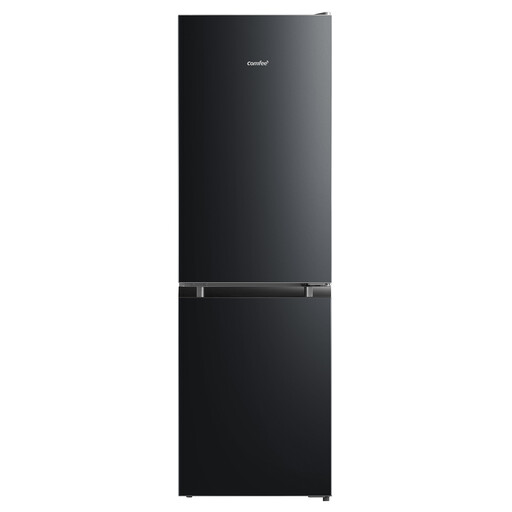 Image unavailable
This 174 L fridge freezer could suit someone who cooks regularly in a limited space. It features Low Frost, an adjustable thermostat, LED lighting and a reversible door; check the energy information, ventilation clearances and door swing for the model.
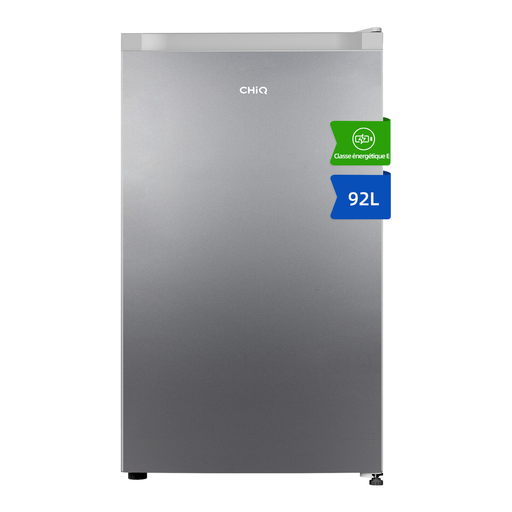 Image unavailable
An option for a very limited kitchenette and modest fresh-food shopping, with a compact freezer section, reversible door, adjustable feet and adjustable shelf. Its 92 L capacity means storage needs to be limited; check the full dimensions, capacity and classification of the freezer compartment before buying.
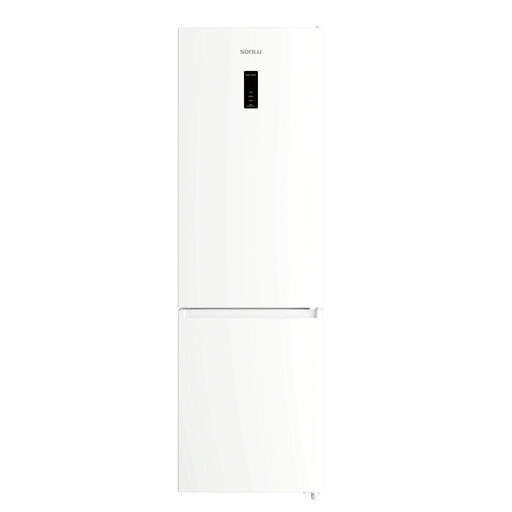 Image unavailable
This model advertises 252 L of fridge space and 103 L of freezer space, with reversible doors, electronic controls and a fast-freeze function. Its 60 cm width and 355 L capacity may be disproportionate for a very small studio flat: check the full dimensions, noise level and required ventilation.
Measure the width, height and depth of the space, as well as the doors, corridors and stairs required for delivery. Add the ventilation clearances specified in the model’s manual and check the door swing: a width of 55 cm alone does not confirm that a slim fridge freezer can be installed.
Not without following the model’s manual. Electrolux recommends allowing air to circulate around the appliance; the Beko documentation specifically asks for a rear clearance of at least 50 mm for the model it describes and states that a smaller distance may increase consumption. Ventilation requirements vary by product.
It may suit occasional use if its capacity and classification match the food you need to store. For large weekly shops involving frozen food or meals prepared in advance, a fridge freezer with a separate freezer section is generally more suitable.
The European Commission recommends keeping your fridge between 1 °C and 5 °C, while following the storage instructions on food packaging. Also follow the settings specified in your appliance’s manual.
A household appliance can be taken back by the retailer. According to the French Ministry for Ecological Transition, the “1-for-1” take-back scheme is linked to buying an appliance of the same type; a “1-for-0” take-back service is also available in retail shops of at least 400 m² that sell this type of product.