When choosing an appliance for your new home, first check that the fridge will fit and that its doors can open properly. Then work out how much space you need for fresh and frozen food. Once you’ve found appliances that suit both requirements, compare their stated annual energy consumption. The energy rating can’t replace checking the capacity or following the installation instructions in the manual.
Who are these criteria for?
Households with limited space
Whether you’re fitting out a kitchen, studio flat or alcove, measure the available space and check that the doors can open. The manual for each model sets out its ventilation requirements and the clearances you’ll need, as shown in Electrolux’s installation guidance.
Households storing fresh and frozen food
If you use both compartments, compare the capacity allocated to each in litres rather than looking only at the total capacity. Refrigeration appliance information lists these compartments separately, including in the European Commission’s EPREL database.
Shoppers mindful of energy use
Once you’ve chosen the size and capacity, the energy label can help you compare stated annual energy consumption. The ADEME presents it as a useful guide when choosing, but it can’t tell you on its own whether the appliance will fit your space.
What should you check before choosing?
First rule out any appliances that won’t fit the space, then work out how much room you need in each compartment. After that, it’s easier to compare appliance types and energy labels.
Single door, no freezer
Worth considering: if you store fresh food but don’t need to keep frozen food in this appliance.
Trade-off: you’ll need another solution if you later need freezer space.
With a freezer compartment
Worth considering: if most of your food storage is fresh and you only freeze food occasionally.
Trade-off: check how much space is actually allocated to frozen food before relying on this compartment.
Fridge freezer
Worth considering: if you regularly store both fresh and frozen food.
Trade-off: make sure its dimensions and door opening clearance are suitable for your kitchen.
| Criteria |
What to check |
Who is it for? |
| Space and ventilation |
Measure the space and check the doorways; consult the model’s manual for door clearance and the required ventilation gaps. |
In a narrow kitchen, I need to be able to install the appliance and open its doors without anything getting in the way. Around 33% of consumers prioritise this physical fit. |
| Capacity in each compartment |
Compare the capacity in litres for fresh and frozen food separately. |
If I regularly store both, a sufficient total capacity doesn’t tell me how the space is divided. This is the priority for around 27% of consumers. |
| Stated energy consumption |
Among appliances that meet your size and capacity needs, check the energy rating and annual consumption in kWh. |
Once I’ve sorted out space and storage, I want to compare models based on their stated energy consumption. It’s the first comparison point for around 20% of consumers. |
| Everyday storage |
Choose between fresh-food-only storage, occasional freezing and a separate compartment, depending on your habits. |
When I put my shopping away, I mainly want spaces that suit the food I usually buy. Around 20% of consumers prioritise this everyday layout. |
What mistakes should you avoid?
-
Looking only at the total capacity
This figure can hide a split between compartments that doesn’t suit the fresh and frozen food you buy. The European Commission’s EPREL database lists compartment capacities separately.
Compare the capacity of each section with what you plan to store in it.
-
Ordering before checking the installation requirements
An appliance may fit in the space you’ve measured but still lack the clearance or ventilation specified for that model.
Measure the space and check the model’s manual, including the door clearance.
If the appliance can’t be installed as intended, you may need to change your kitchen layout or choose a different model.
-
Choosing based on the energy rating alone
The energy label gives you information about consumption, but it doesn’t tell you whether the compartments have the capacity you need or whether the appliance can be installed in your space.
Check the dimensions and capacities first, then compare stated annual energy consumption across appliances that meet your needs.
-
Ignoring the instructions for first use
Instructions can vary depending on the model and how it was transported.
Follow your appliance’s manual before plugging it in for the first time and loading it with food. For some of its appliances, Whirlpool advises waiting 24 hours after delivery before plugging in for the first time. This guidance shouldn’t be applied to every model.
Brands to know
There are no brand introductions to display in this section.
Fridges available on Joybuy
These models include options for fresh-food storage with a small freezer compartment, as well as fridge freezers for households that regularly store frozen food. Before choosing, compare their dimensions and installation requirements with the space in your new home.
 Image unavailable
Haier HTW5618ENMG, 3 doors, 360 L
Worth considering if you want one appliance for both refrigeration and freezing in your new home. The title lists a capacity of 360 L and an E energy rating. Check the manual for ventilation clearances and the space needed to open the doors.
View on Joybuy
 Image unavailable
Samsung RF50C530EB1 multi-door fridge, 495 L
Worth considering if your household needs 495 L of storage space. The stated energy rating is E. Measure the route into your home and the installation space, then check the manual for the required clearances and door opening space.
View on Joybuy
 Image unavailable
Candy CFQQ5T817EPS, 4 doors, 467 L
Worth considering if you want separate spaces for fresh and frozen food. This model has a total capacity of 467 L and an E energy rating. Its doors are listed as non-reversible, so check how they open and the ventilation clearances in the manual.
View on Joybuy
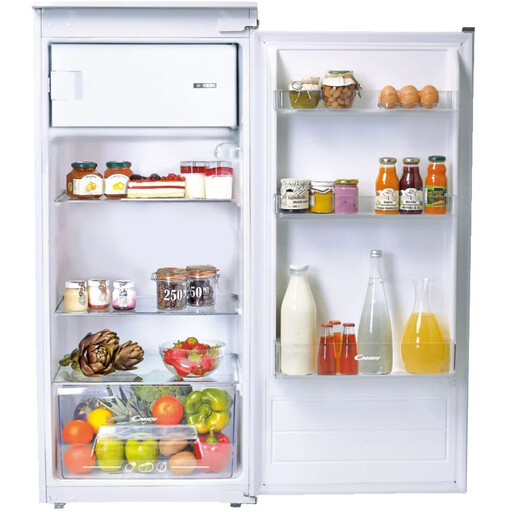 Image unavailable
Candy CIO 225 EE/N, single door, 179 L
Worth considering if you mainly store fresh food and only need a small amount of freezer space. The stated total capacity is 179 L, with a 16 L freezer compartment. The product description and installation information differ on whether it is freestanding or built-in. Check the installation type, dimensions and clearances in the manual for this model.
View on Joybuy
 Image unavailable
CHiQ JR227LSE, 227 L
Worth considering if you’re looking for a fridge freezer with a stated width of 54 cm. The title lists 153 L of fridge space, 74 L of freezer space, a reversible door and an E energy rating. Check the height, clearances and annual energy consumption too before deciding whether it suits your space and energy comparisons.
View on Joybuy
Frequently asked questions
Is the energy label enough to compare two fridges?
No. It helps you compare stated energy consumption, but it can’t tell you on its own whether the size and capacity suit your needs. The ADEME presents it as a useful guide. Check the available space and the capacity you need for each type of food first.
Can you allow the same clearance behind every model?
No. Ventilation requirements and clearances depend on the model and how it’s installed. Check the manual for the fridge you’ve chosen rather than using measurements given for a different model.
Which capacity should you check if you buy frozen food?
Check the capacity in litres for the freezer compartment separately from the fridge compartments. The European Commission’s EPREL database lists these capacities separately, so how the space is divided is more useful when choosing than the total figure alone.
Should you wait before plugging in a new fridge?
Follow the waiting time given in your model’s manual before plugging it in for the first time. Whirlpool advises waiting 24 hours after delivery for some of its appliances, but this manufacturer recommendation isn’t a universal instruction.


