How do the different formats compare?
First choose the compartments and capacity you need, then compare the kWh/year figures for appliances that fit your space.
Fridge without a freezer compartment
Consider this if: fresh food makes up most of what you store and you don’t need to freeze food regularly.
Bear in mind: there’s no capacity for frozen food unless you already have another suitable compartment.
Fridge-freezer
Consider this if: you regularly use both fresh and frozen food compartments and want them in one appliance.
Bear in mind: the total capacity doesn’t tell you how many litres are available in each compartment.
Separate freezer
Consider this if: your regular freezing needs exceed the capacity of a suitable fridge-freezer.
Bear in mind: you’ll need space for an additional appliance and it will run continuously.
No additional appliance
Consider this if: your current appliance meets your usual storage needs and any extra freezer space is only needed occasionally.
Bear in mind: you’ll have less spare capacity when buying or preparing food in larger quantities.
| Criterion | What to check | Who is it for? |
|---|
| Annual energy consumption |
Check the model’s kWh/year figure on the label and compare appliances that meet the same storage needs. |
If my priority is the energy use of an appliance that stays plugged in all the time, I want to compare models by their annual figure. Around 36% of consumers put this consumption first. |
| Capacity in each compartment |
Check the litres available for fresh and frozen food separately, rather than looking only at the total capacity. |
If I store fresh and frozen food every week, the space in each compartment matters more to me than the overall capacity. Around 29% of consumers would make this their priority. |
| Installation |
Check the dimensions and door opening; for a built-in appliance, also check the housing and fixing type. |
In a fitted or narrow kitchen, being able to install and open the appliance is my first concern. Around 21% of consumers would put whether it fits their space first. |
| Frost and maintenance |
Check the frost-management system and maintenance instructions, without confusing them with the kWh/year figure. |
If defrosting is a major concern for me, I mainly want an appliance whose maintenance suits the way I use it. Around 14% of consumers would make this their priority. |
Fridge-freezers available on Joybuy
These models combine fridge and freezer compartments. First choose the capacity and installation type that suit you; to compare models, check their energy labels and dimensions.
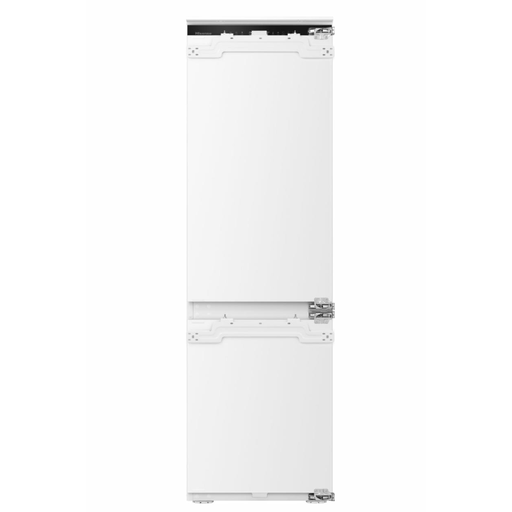 Image unavailable
Hisense RB3B250SAWC, 252 L built-in fridge-freezer
For a fitted kitchen where both types of storage need to fit into one built-in appliance. The model name specifies No Frost and an energy rating of C; check the housing dimensions and installation instructions before buying.
View on Joybuy
 Image unavailable
Candy CFQQ5T817EPS, 467 L four-door fridge-freezer
Worth considering if you regularly need plenty of space for fresh and frozen food. This model is listed with an E energy rating and Total No Frost; make sure its 467 L capacity and dimensions suit your needs and available space.
View on Joybuy
 Image unavailable
Haier HTW5618ENMG, 360 L three-door fridge-freezer
Combines fresh and frozen food storage in a 360 L fridge-freezer. The model name specifies an E energy rating, Total No Frost, Wi-Fi and My Zone; compare the model’s kWh/year figure and check the clearance needed in your kitchen.
View on Joybuy
 Image unavailable
LG GBBSJ1CCSW, 333 L fridge-freezer
Worth considering if a 333 L fridge-freezer meets your storage needs. The model name specifies an energy rating of C; check the capacity of each compartment, the dimensions and the clearance required for installation.
View on Joybuy
 Image unavailable
AEG NSC6M18FES, 249 L built-in fridge-freezer
For a fitted kitchen that needs a 249 L built-in fridge-freezer. The model name specifies TwinTech No Frost and an E energy rating; check the label for its kWh/year figure and make sure the housing and door fixings are suitable before choosing.
View on Joybuy
Frequently asked questions
How do I compare a fridge, fridge-freezer and freezer?
First compare appliances that meet your storage needs: a separate freezer doesn’t do the same job as a fridge. For suitable models, the European Commission says the energy label shows information including annual energy consumption and compartment volumes. Look at these figures together rather than relying on the energy rating alone.
Can ADEME’s guidance help me predict how much I’ll save?
Not for a specific model and household. ADEME’s guidance covers appliance types; to estimate the running cost of a model you’re considering, use its stated kWh/year figure and your own electricity tariff. Don’t assume your current appliance uses the same amount of energy as an average model.
Does No Frost or Low Frost mean lower energy consumption?
Not on its own. These terms relate to frost management; to compare stated energy consumption, check the kWh/year figures for the specific models. Electrolux notes that excess frost can make the compressor run for longer, but this doesn’t quantify the difference between two appliances.
What should I look for on a new appliance’s energy label?
For a household fridge or freezer covered by EU energy labelling, check the A to G rating, annual energy consumption, capacity and noise level. The European Commission explains that the label’s QR code gives access to further information in EPREL. Always compare these details with the format and compartments you need.


