What should you compare before choosing?
First decide whether your current appliance still meets your needs. If a replacement makes sense, choose the type and capacity before comparing energy labels.
Keep or repair
Consider this if: the appliance works and its capacity is still right for you. Check whether it needs maintenance and whether it can be repaired before replacing it.
What to bear in mind: keeping it won’t, by itself, reduce high energy consumption. Compare the appliance’s figures with the alternatives.
Fridge only
Consider this if: you store fresh food and don’t need a new freezer compartment.
What to bear in mind: it won’t replace the freezer space your household needs.
Fridge-freezer
Consider this if: you need fresh and frozen storage in one appliance.
What to bear in mind: the total capacity doesn’t tell you whether each compartment suits your habits.
Separate freezer
Consider this if: you regularly need more freezer space than a suitable fridge-freezer can provide.
What to bear in mind: this additional appliance also runs continuously. As ADEME advises, avoid choosing a capacity you’ll consistently leave unused.
| Priority | What to check | What I need |
|---|
| Energy consumption |
If possible, note the energy consumption of your current appliance. The European Commission says the labels on new appliances show kWh/year. Compare models of the same type and with similar capacities, rather than focusing on their A-to-G rating alone. |
I want to know whether replacing my appliance makes sense for my situation, rather than assuming a new one will automatically use less energy. |
| Capacity |
Compare fresh and frozen storage capacity separately. Choose between a fridge, fridge-freezer and freezer based on the food you regularly store. |
Freezer space matters to me; a large total capacity isn’t enough to help me choose between appliances. |
| Repair |
Check the appliance’s model number, which part is needed and whether it’s available. In France, the Ministry of the Economy says the repair bonus may apply to an out-of-warranty fridge or freezer repaired by an approved professional, subject to the scheme’s conditions. |
Before buying, I want to find out whether my current appliance can still be repaired on terms that work for me. |
| Noise and installation |
Check the noise level shown on the energy label, then check the dimensions, installation type and clearance requirements in the model’s manual. |
My appliance will be close to a living area, or its position has specific requirements for dimensions and ventilation. |
Which manufacturers should you consider?
These ranges are a useful starting point when comparing formats. Always check the documents and specifications for the specific model you’re interested in.
Bosch
Bosch’s French catalogue includes single-door fridges, fridge-freezers, multi-door models and freezers.
- Bosch recommends checking the energy label and provides energy consumption information on its product pages.
- An estimate for one model can’t tell you about the brand as a whole or how much energy your current appliance uses.
Liebherr
Liebherr offers fridges, fridge-freezers and freezers, as well as technical documents for individual appliances.
- You can download energy labels and technical data sheets to check the details of a specific model.
- Check the capacity, kWh/year and installation requirements of the model on sale, rather than generalising from claims about the range.
Whirlpool
Whirlpool’s French catalogue includes fridges, multi-door models, chest freezers and upright freezers.
- These formats let you explore different fresh and frozen food storage needs.
- The manufacturer’s advice and claims don’t replace comparing energy labels, capacities and spare-part information for the model you choose.
Fridge-freezers to consider on Joybuy
The appliances below are fridge-freezers. They’re worth considering if you decide to replace your current appliance and need space for both fresh and frozen food. Their inclusion doesn’t determine whether you should keep or repair your current appliance.
 Image unavailable
Candy CFQQ5T817EPS, 467 L four-door fridge-freezer
This multi-door fridge-freezer offers fresh and frozen storage in one appliance. The product name lists a capacity of 467 L, an E energy rating and a Total No Frost system. Check how the capacity is split between compartments, the kWh/year on the exact model’s energy label and the space needed for installation.
View on Joybuy
 Image unavailable
CHiQ JR263LGE, 262 L Low Frost fridge-freezer
If you’re looking for a fridge-freezer that’s 54 cm wide, compare its 262 L capacity with your storage needs. The product name lists a height of 176 cm and Low Frost technology. Check the manual for installation clearances and freezer maintenance, then check the kWh/year on the exact model’s energy label.
View on Joybuy
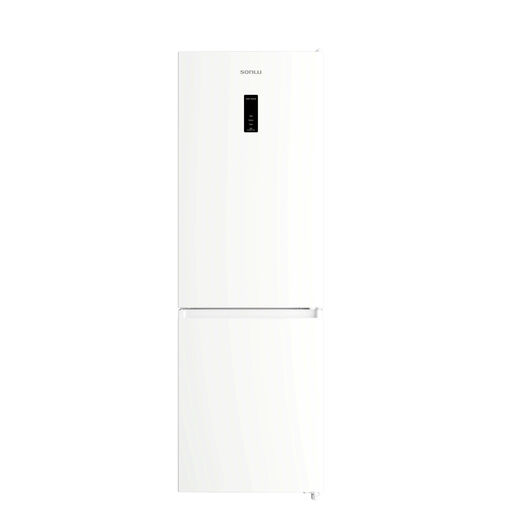 Image unavailable
Sonlu CD‑350RW, 310 L fridge-freezer
This model has 211 L of fridge space and 99 L of freezer space, making it easier to assess each compartment against your habits. The product name lists a width of 60 cm and an E energy rating. Check the energy label for kWh/year and the manual for the full dimensions and ventilation requirements.
View on Joybuy
 Image unavailable
Sonlu CC-520WE, 444 L fridge-freezer
With a stated capacity of 444 L, this fridge-freezer is best compared with the amount of space you’ll actually use. The product name lists an E energy rating, frost-free operation and a noise level of 40 dB. Check the split between fridge and freezer space, the dimensions and the figures on the exact model’s energy label before comparing it with other appliances.
View on Joybuy
 Image unavailable
CHiQ JR227LSE, 227 L Low Frost fridge-freezer
This fridge-freezer has a stated 153 L of fridge space and 74 L of freezer space, and is 54 cm wide. If those capacities suit your needs, check the kWh/year on the energy label, the full dimensions in the manual and the maintenance required by the Low Frost system.
View on Joybuy
Frequently asked questions
Is the energy rating enough to compare two refrigeration appliances?
No. The European Commission says the energy label for a household fridge or freezer also shows annual energy consumption in kWh, capacity and noise levels. Start by comparing appliances of the same type and with a similar capacity, then consider these figures together.
Should I look for a durability index when buying a fridge?
For a fridge or freezer, focus on information about spare parts and the model’s documentation. ADEME provides a durability index for televisions and washing machines, not as a comparison criterion for these refrigeration appliances.
How can I check whether a refrigeration appliance can be repaired?
Find the model number and identify the part in question, then ask whether it’s available and request a quote. France’s DGCCRF refers to requirements for the availability of certain spare parts for household refrigeration appliances, with different timeframes for some items, including seals. This doesn’t guarantee that a particular repair will be possible.
Can the repair bonus apply to a fridge or freezer?
Yes. In France, the Ministry of the Economy lists both appliances among those that may be covered by the scheme. Among other conditions, the appliance must be out of warranty and the repair must be carried out by an approved repairer. Check the other requirements before arranging the work.
How can I arrange for my old appliance to be taken away?
When buying a new appliance in France, ask the seller how to arrange free take-back of an equivalent old appliance. The DGCCRF describes this as one-for-one take-back. Check how it works for your order, especially if your new appliance is being delivered to your home.


