What to look for
Start by working out the useful split between fresh and frozen food, then compare the label data for similar formats and capacities.
| Priority |
What to check |
Your needs |
| Comparable consumption |
Compare the kWh/year, the litres in each compartment and the A–G rating between appliances of a similar format. |
I want to estimate the relative consumption of appliances that provide the same service, without comparing capacities that are not like-for-like. |
| Capacity and format |
Check the usable litres for fresh and frozen food separately. Match the capacity to the number of occupants and how often you shop. |
My appliance should match my usual supplies, without adding a large freezer compartment that I would rarely use. |
| Temperature retention |
Where independent tests are available, check temperature stability, consumption under real-use conditions and storage time during a power cut. |
I want the appliance to remain suitable when the door is opened frequently, after a big shop and in a warm kitchen. |
| Useful features |
Assess door alarms, holiday mode, dedicated compartments and connected features separately. Keep kWh/year and capacities as your main criteria. |
A feature should meet a specific everyday need, rather than simply make the product page look more appealing. |
Joybuy products
Joybuy options including fridge freezers and multi-door models, allowing you to compare fresh and frozen capacities as well as stated annual consumption.
 Image unavailable
LG GBBSJ1CCSW 333 L fridge freezer, rating C
For a household using both the fridge and freezer areas every day, with a stated 183 L fridge compartment, 113 L freezer compartment and 37 L fresh-food zone.
Stated consumption: 169 kWh/year; stated noise level: 34 dB. Check that the capacity split suits your habits and consult independent tests if your kitchen is often warm.
Joybuy
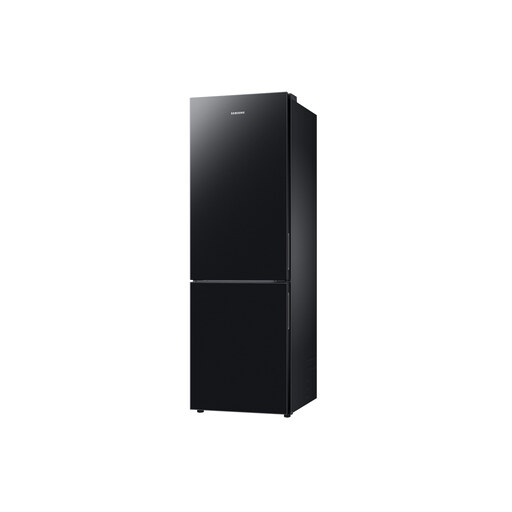 Image unavailable
Samsung RB33B612EBN 344 L fridge freezer, rating E
Suitable for a household that needs two full-size compartments, with a stated 230 L fridge compartment and 114 L freezer compartment.
Stated consumption: 254 kWh/year; stated noise level: 35 dB. Consider the E rating alongside the capacities and kWh/year, then check the clearance required for installation.
Joybuy
 Image unavailable
CHiQ JR263LGE 262 L fridge freezer, Low Frost
A compact option for moderate frozen-food needs, with a stated 187 L fridge compartment and 75 L freezer compartment.
Stated consumption: 215 kWh/year. The Low Frost system requires manual defrosting of the freezer; the stated ambient temperature range is 16 to 38 °C.
Joybuy
 Image unavailable
Candy CFQQ5T817EPS 467 L multi-door fridge freezer, rating E
Designed for greater storage needs, with a stated 311 L fridge compartment and 156 L freezer compartment.
Stated consumption: 290 kWh/year. Its stated width of 83,3 cm and non-reversible doors require careful checks before choosing a location.
Joybuy
 Image unavailable
Samsung RF50C530EB1 495 L multi-door fridge freezer, rating E
Only consider this if you genuinely need substantial capacity, with a stated 330 L fridge compartment and 165 L freezer compartment.
Stated consumption: 301 kWh/year; stated noise level: 40 dB. The water and ice dispenser is a convenience feature, and the water connection requirements should be confirmed before purchase.
Joybuy
Frequently asked questions
Is the A–G energy rating enough to choose the appliance that costs the least to run?
No. The label also shows annual consumption in kWh, the capacities of the fresh and frozen compartments, and the noise level. Compare these details between appliances with the same format and similar capacities; the old A+, A++ and A+++ ratings cannot be converted directly to the current A–G scale.
What fridge capacity should you choose to avoid buying an oversized appliance?
Que Choisir suggests 100 to 150 litres for one person, followed by around 50 litres for each additional person. Adjust this starting point to your shopping habits, available space and the amount of frozen food you actually store.
Will a separate freezer automatically reduce your energy bill?
No. It provides additional freezer capacity, but it also adds another appliance that runs continuously. Choose one if your long-term frozen-storage needs exceed those of a fridge freezer, then compare its annual kWh consumption with alternatives of a similar capacity.
What should you do with your old fridge or freezer in France when replacing it?
According to the French Ministry for Ecological Transition, the “1-for-1” take-back scheme for household appliances applies with no minimum shop-floor area when buying equipment of the same type. The “1-for-0” scheme, without a purchase, applies to retail shops with at least 400 m² of sales area dedicated to this category. A collection point or recycling centre is another option.
How can you check that a fridge freezer will perform well in a warm kitchen?
Consult the model documentation and independent test results where available. Que Choisir’s testing protocol examines factors including temperature stability at 35 °C, door openings, the addition of food and the associated energy consumption.


