Households replacing their fridge
If your appliance runs continuously, compare its annual energy consumption with the capacity you actually need. ADEME recommends using the energy label when choosing a household appliance.


First, choose the capacity you need for fresh and frozen food, then compare the kWh/year figures of models with a similar size and capacity. A single-door fridge may be suitable if you freeze very little or already have a freezer. A fridge-freezer combines both compartments, while a separate freezer takes up space and adds another appliance’s energy consumption. Before ordering, also check the noise level, dimensions, door clearance and the model’s ventilation requirements.
If your appliance runs continuously, compare its annual energy consumption with the capacity you actually need. ADEME recommends using the energy label when choosing a household appliance.
The space you need for frozen food will help you decide between a fridge-freezer and a separate freezer. Compare the capacity of each compartment, rather than looking only at the total capacity.
Measure the space, the delivery route and the clearance needed to open the doors. For ventilation, follow the instructions for your chosen model rather than using a clearance measurement intended for a different appliance.
First, work out how much freezer space you need. Then compare the energy labels and dimensions of models suited to your requirements.
Worth considering: if you freeze very little or already have a freezer.
Bear in mind: without a suitable freezer compartment, you’ll need another way to store frozen food.
Worth considering: if you regularly use frozen food and want to keep fresh and frozen items in one appliance.
Bear in mind: the available capacity is split between two compartments, so check that each one suits your needs.
Worth considering: if you need more freezer space than a fridge-freezer can provide.
Bear in mind: you’ll need space for a second appliance, as well as factoring in its annual energy consumption.
| Criteria | What to check | My needs |
|---|---|---|
| Energy consumption | Check the energy efficiency class and kWh/year figure. Compare appliances of a similar size and capacity, as shown by the information on the label described by Gifam. | I want to take account of the electricity used throughout the year, rather than choosing on the basis of the class letter alone. |
| Capacity | Check the capacity in litres of the fridge and freezer compartments separately. Also look at the internal layout of the model. | Space for fresh food matters just as much as space for frozen food. A large total capacity doesn’t tell me how that space is divided. |
| Installation and noise | Measure the height, width and depth, access routes and door clearance. Check the instructions for ventilation requirements and compare the stated noise level. | In my kitchen, the appliance needs to be delivered, installed and used without obstructing the walkway or the doors. |
| Cooling system | Check which compartments have fan-assisted cooling or No Frost, and how food should be stored in them. Gifam recommends covering food exposed to fan-assisted cooling to help prevent it from drying out. | I want to keep frost-related maintenance to a minimum while ensuring the storage layout suits the food I keep. |
A class letter on its own tells you neither the annual energy consumption nor the capacity. Gifam shows these details separately on fridge energy labels.
Compare the class, kWh/year and capacity in litres of models that meet similar storage needs.
The depth, door clearance or ventilation requirements could make installation difficult, even if the width seems suitable.
Measure your kitchen and the delivery route, then check the installation instructions for the model you’ve chosen. Bosch advises that its appliances should be installed in line with the instructions provided.
A fridge-freezer splits its capacity between the fridge and freezer compartments. The space that suits one of your needs may be too small or unnecessarily large for the other.
Estimate your storage needs separately. Consider a single-door fridge if you already have enough freezer space, or a separate freezer if you need more.
Fan-assisted cooling helps limit frost, but Gifam says food should be covered to prevent it from drying out.
Check which compartments are covered and how they’re laid out, then use suitable containers for delicate foods.
The range includes fridges and freezers in several formats, so you can compare models based on the capacity and configuration you need.
Some of the brand’s fridge-freezers feature BioFresh and NoFrost. Check these features for each model.
The brand offers, among other options, multi-door fridges with Total No Frost.
These models combine refrigeration and freezing in one appliance. Compare their capacities and overall dimensions to suit your kitchen. To assess energy consumption, check the kWh/year figure for each model.
 Image unavailable
A fridge-freezer to consider if you want to keep fresh and frozen food in one appliance. The product title lists a 360 L capacity, Total No Frost, an E class rating, Wi-Fi and My Zone. Check how the capacity is divided, the kWh/year figure and the dimensions before comparing it with another model.
 Image unavailable
If kitchen width is a consideration, the product title lists a width of 54 cm and a height of 176 cm, with the capacity divided 70/30 between the compartments. Low Frost doesn’t mean you’ll never need to defrost it: check the maintenance requirements and clearances in the instructions.
 Image unavailable
Its listed total capacity of 444 L is worth comparing with the space you need for fresh and frozen food. The product title lists a 40 dB noise level and an E class rating. Check the separate compartment capacities, dimensions and kWh/year figure to see if it’s right for your kitchen.
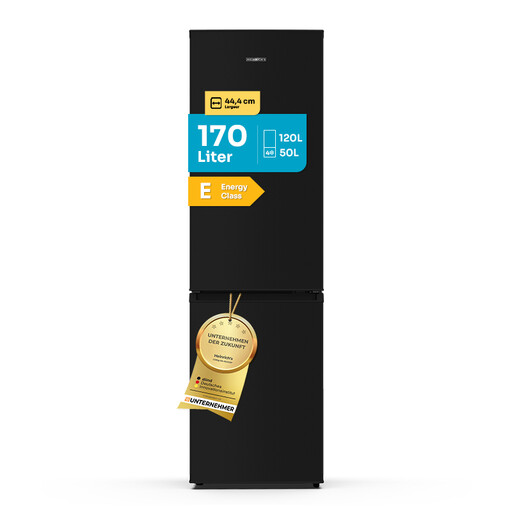 Image unavailable
The product title lists a capacity split of 120 L for the fridge and 50 L for the freezer. Check that this suits your storage needs. Before choosing, check the energy label, including the kWh/year figure and class, as well as the full dimensions.
 Image unavailable
This fridge-freezer is listed as 54 cm wide, with its 227 L capacity split between 153 L of fridge space and 74 L of freezer space. The product title mentions Low Frost, a reversible door and an E class rating. Check the height, kWh/year figure and the clearance needed for the door and ventilation.
Compare models designed for similar uses and with similar capacities, checking their kWh/year figures, the capacity in litres of each compartment and their noise levels. As Gifam points out, these details appear alongside the class on the energy label. A letter on its own doesn’t tell you how much storage space you’re getting.
No. This feature alone doesn’t mean an appliance uses less energy: compare the kWh/year figures for the specific models you’re interested in. Gifam says fan-assisted cooling prevents frost, but also recommends covering food to help prevent it from drying out.
Measure the available height, width and depth, the route into your kitchen and the space needed to open the doors. Then check the model’s instructions for ventilation requirements. The guidance Bosch provides for its appliances isn’t a universal set of measurements.
Anses recommends a storage temperature between 0 and +4 °C at the coldest point in the fridge. Check the temperature after installation and adjust the appliance settings as needed. Choosing the right model doesn’t replace this check.