Which configuration suits your household?

Households short on space for their shopping

Compare the usable capacity for fresh food and, if needed, frozen food. Que Choisir and Gifam present compartment capacities as useful guides when choosing an appliance that suits your food storage habits.

Households that regularly freeze food

Check whether a fridge-freezer has enough capacity, or whether a separate freezer would better suit your storage needs. A small freezer compartment is not the same as a dedicated freezer.

Households replacing a bulky appliance

Measure the space and the route to it, then compare the configuration and kWh/year stated for the model. ADEME recommends checking the energy label as one of the points to consider when choosing a household appliance.

What should you compare?

Fridge only

Choose this if: you mainly store fresh food and don’t need this appliance to provide regular freezing capacity.

Bear in mind: check whether it has a small freezer compartment, but don’t mistake this for a freezer suitable for storing larger quantities.

Fridge-freezer

Choose this if: you want to keep fresh and frozen food in one appliance.

Bear in mind: the total capacity is shared between the two uses, so compare the capacity in litres of each compartment separately.

Separate freezer

Choose this if: storing frozen food is a priority or your existing freezing capacity isn’t enough.

Bear in mind: an additional appliance needs its own space and has its own electricity consumption.

What matters What to check Who cares about it most?
Usable capacity to suit your shopping Compare fridge and freezer capacity in litres separately, and measure the space available. If I want the appliance to suit my usual shopping, I check how much space is actually available for each type of food. Around 33% of consumers prioritise usable capacity.
Freezing capacity Check the usable capacity in litres, the type of compartment and, for an unheated room, the temperature range the model can operate in. If I regularly store frozen food, I check whether a fridge-freezer compartment will meet my needs or whether I need a separate freezer. Around 27% of consumers prioritise frozen food storage.
Electricity consumption Check the kWh/year and energy rating on the label for the exact model; compare appliances that meet similar needs. When replacing an appliance that runs every day, I consider its annual consumption as well as its usable capacity. Around 20% of consumers put kWh/year first.
Installation and replacement Measure the space and access route, consult the model’s instructions, and confirm the delivery, installation and old-appliance collection arrangements. If access to my kitchen or the space available is restricted, I check the dimensions and installation requirements before ordering. Around 20% of consumers prioritise compatibility with their home and delivery.

Things to avoid

  • Choosing based on total capacity alone

    A large total capacity doesn’t tell you how much space is available for fresh and frozen food. For relevant appliances, these capacities are listed separately.

    Start with your shopping habits and compare the capacity in litres of each compartment before choosing a configuration.

  • Comparing only the energy rating letter

    The rating doesn’t replace comparing kWh/year and usable capacity. Appliances with different configurations won’t necessarily meet the same needs.

    Check the kWh/year on the label for the exact model, then compare appliances with similar uses and capacities.

  • Measuring the space without checking installation requirements

    Dimensions, climate class and installation instructions vary by model. An unheated room or a built-in appliance calls for specific checks.

    Also measure the route to the space and consult the product details and instructions for the model you’ve chosen.

  • Confusing old-appliance collection with installation

    Collecting used equipment and installing a new appliance are separate services. The DGCCRF describes ‘one-for-one’ collection, which does not, in itself, define what an installation service includes.

    Before ordering, ask for clear details of the delivery, collection and installation arrangements offered for your appliance.

Brands to know when comparing configurations

Bosch

Freestanding fridge-freezers to compare by the capacity of each compartment, dimensions and maintenance features.

  • For the KGN39VLCT, Bosch lists 260 L of fridge capacity, 103 L of freezer capacity, a C rating and Total NoFrost.
  • These specifications apply to this model only; check that its dimensions and configuration suit your kitchen.

Liebherr

The range mentioned includes single-door fridges and freestanding freezers. Compare these with fridge-freezers based on how you plan to use them.

  • Liebherr describes the Rd 5220 Plus as a 399 L single-door fridge and the Fd 1404 Pure as a 107 L freezer.
  • Their capacities and installation requirements are not interchangeable. The brand’s guidance on certain unheated rooms does not apply to all its models.

Beko

The BRCNE50140ZXBN fridge-freezer is worth considering if you’re looking for substantial fridge and freezer capacity.

  • Beko France lists 356 L of fridge capacity, 158 L of freezer capacity, 304,05 kWh/year and an E rating for this model.
  • These stated figures apply to the BRCNE50140ZXBN and do not describe the entire range.

Whirlpool

The French range shown includes freestanding and built-in fridge-freezers, with several cooling configurations.

  • The Whirlpool range page features models with NoFrost and StopFrost.
  • The availability of these features depends on the model; check the details of the one you’re considering.

Fridge-freezers at Joybuy

These Joybuy models combine refrigeration and freezing. Compare how their capacity is divided, their stated energy consumption and the space needed for installation.

Samsung RB33B612EBN fridge-freezer, 344 L, E rating

Samsung RB33B612EBN, 344 L

Worth considering if you’re looking for one appliance to store fresh and frozen food.

Total capacity: 344 L, split between 230 L of fridge capacity and 114 L of freezer capacity. Stated consumption: 254 kWh/year; E rating. Freestanding, with a stated width of 59,5 cm and a reversible door.

View on Joybuy
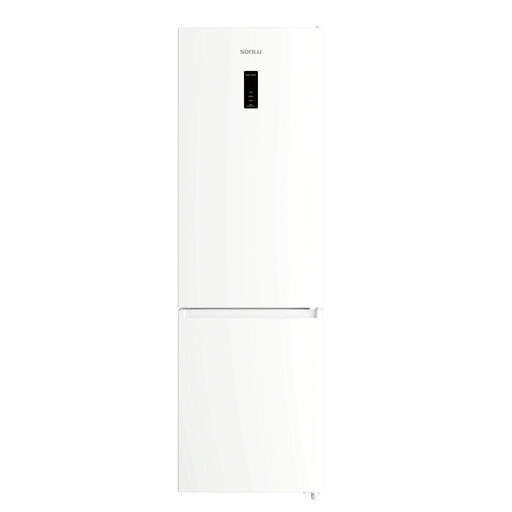
Sonlu CD-400RW fridge-freezer, 355 L, E rating

Sonlu CD-400RW, 355 L

Worth considering if you’d like a stated capacity of 355 L split between the fridge and freezer in one appliance.

Stated capacities: 252 L for the fridge and 103 L for the freezer. Stated width: 60 cm. The product details list an E rating, a frost-free system, an inverter compressor and a reversible door.

View on Joybuy

Samsung RF50C530EB1 multi-door fridge-freezer, 495 L, E rating

Samsung RF50C530EB1, 495 L

Worth considering if you need plenty of space for fresh and frozen food and have room for a larger appliance.

Stated capacity: 495 L, with 330 L for the fridge and 165 L for the freezer. Stated consumption: 301 kWh/year; E rating. Stated dimensions: 177,6 × 81,7 × 71,5 cm; check the space and access route.

View on Joybuy

CHiQ JR525WSE American-style fridge-freezer, 525 L, E rating

CHiQ JR525WSE, 525 L

Worth considering if you’re looking for plenty of space for fresh and frozen food; check that the side-by-side design suits your kitchen.

Stated capacity: 525 L, split between 333 L of fridge capacity and 192 L of freezer capacity. The product details list an E rating and a No Frost function.

View on Joybuy

CHiQ JR227LSE fridge-freezer, 227 L, E rating

CHiQ JR227LSE, 227 L

Worth considering if you’re looking for a more compact fridge-freezer and its compartment layout meets your needs.

Stated capacity: 227 L, with 153 L of fridge capacity and 74 L of freezer capacity. Stated width: 54 cm; E rating and 4-star freezer rating. Low Frost technology reduces frost build-up but doesn’t eliminate it, so you’ll still need to defrost the appliance.

View on Joybuy

Frequently asked questions

How do I compare the energy labels of two fridges?

When comparing domestic refrigeration appliances, look at the energy rating, kWh/year and the fridge and freezer capacities in litres. Gifam includes these details among the information on the label, and ADEME recommends using the energy label as a guide when choosing an appliance. Compare models that meet similar needs rather than looking at the rating letter alone.

Can I install a freezer in an unheated garage?

That depends on the model and the actual temperature in the garage. Check the product details for the ambient temperature range indicated by its climate class. Liebherr describes some FrostProtect chest freezers as suitable for unheated rooms, but this does not apply to all freezers.

What settings should I use after my fridge is delivered?

In its guidance dated 3 October 2024, the French Ministry of Agriculture recommends setting the fridge to +4 °C and the freezer to −18 °C. Also follow the instructions for your model when setting it up, maintaining it and defrosting it when necessary.

Does collection of my old appliance include installation of the new one?

No. Collection and installation are separate services. The DGCCRF describes ‘one-for-one’ collection of used equipment when you buy a new appliance; this doesn’t mean connecting or installing the new appliance is included. Check the arrangements stated for your order separately.

What statutory guarantee applies to a new appliance bought from a business in France?

The statutory guarantee of conformity applies when a business sells a new product to a consumer. The French Ministry of the Economy states that the period for a new product is two years, and consumers do not have to prove that the defect existed on the date of sale. Any additional commercial guarantee offered does not replace it.