Households planning meals several days ahead
If you do a big shop and keep leftovers, consider the usable capacity and how easy it is to store fresh food, without overlooking the space available in the freezer.


Start by choosing a capacity that suits the number of people in your household and how often you shop. Then check separately that there’s enough room for fresh food and frozen food. A fridge-freezer can suit mixed needs if both compartments are large enough; a tabletop model takes up less space, while a multi-door fridge or separate freezer needs to justify the extra room based on how much you actually store.
If you do a big shop and keep leftovers, consider the usable capacity and how easy it is to store fresh food, without overlooking the space available in the freezer.
If you prepare portions in advance or stock up on frozen food, the freezer’s net capacity matters more than the appliance’s total capacity alone.
A compact model is worth considering if it fits the space available and has enough capacity for your shopping and freezing habits.
Start with how much you need to store, then compare the different styles against the space you have available. A large total capacity doesn’t guarantee enough freezer space or that the appliance will fit in your kitchen.
Consider it if: you want one appliance for fresh food, leftovers and a moderate amount of frozen food.
Keep in mind: the fixed split between the two compartments may not suit you if you freeze a lot of food.
Consider it if: you live alone, store only a little food at a time and have limited space.
Keep in mind: its smaller capacity leaves less room for a big shop and leftovers.
Consider it if: you need a large capacity and have enough room in your kitchen for this style of appliance.
Keep in mind: check the space available, the route into your kitchen and the clearance needed to open the doors.
Consider it if: regularly freezing batch-cooked meals or stocking up is your main priority.
Keep in mind: two appliances take up more space, and you’ll need to check each one carefully before buying.
| What to consider | What to check | Who this matters to |
|---|---|---|
| Space for groceries and leftovers | Compare the net usable capacity with how much you buy between shops. | When I need groceries to last several days, I want to store leftovers without hiding the food I’ll need to use soon. Around 36% of consumers prioritise this fresh-food storage capacity. |
| Freezer capacity | Check the freezer’s net capacity separately from the fridge’s. | If I prepare portions in advance or keep frozen food in stock, freezer space becomes a deciding factor. This is the main priority for around 29% of consumers. |
| Space required | Measure the space where the appliance will go, the delivery route and the clearance needed to open the doors. | In a small kitchen, I can manage with less storage, but I don’t want an appliance that blocks the way. For around 21% of consumers, fitting the available space matters more than capacity. |
| Food storage and maintenance | Check the temperature settings and cooling features in each compartment. | When I regularly store fresh food, I want to be able to monitor its temperature and organise it properly. Around 14% of consumers put control over food storage and maintenance first. |
As a starting point for choosing a suitable capacity, UFC-Que Choisir recommends 100 to 150 L for one person, then an extra 50 L for each additional person. Adjust this to suit your actual shopping habits and how you want to divide the space between the fridge and freezer.
According to UFC-Que Choisir, a typical fridge-freezer of around 300 L may allocate roughly two-thirds of its capacity to fresh food and one-third to frozen food. This split may not work for you if you freeze lots of portions.
Look at what fills each compartment between shops, then compare their net capacities separately.
An appliance with the capacity you need may still be too wide for your kitchen or difficult to get into position.
Measure the delivery route, the available space and the clearance needed to open the doors on the model you’re considering.
No Frost or a dedicated compartment won’t replace keeping track of what you have in stock. ADEME highlights the importance of planning your shopping and keeping food you need to use in plain sight.
Rotate your food and check the temperature: Anses recommends setting your fridge below 4 °C.
In France, the authorities state that fridges must carry an energy label. If you’re replacing an appliance, it’s also worth planning what to do with the old one.
Compare the model’s annual energy consumption and noise level, then check with the retailer how they’ll take away your old fridge.
Worth considering for fridge-freezers and single-door models that, depending on the model, offer dedicated storage compartments.
Worth considering if you’re looking for a built-in fridge-freezer to fit an existing space.
Worth considering among the W7 fridge-freezers if you’re looking for dedicated compartments and a No Frost feature.
These fridge-freezers and multi-door models give you a chance to compare different fresh and frozen food storage capacities. Choose based on your usual shopping and the dimensions of your kitchen, rather than looking at total capacity alone.
 Image unavailable
Worth considering if you shop regularly and want one appliance for both fresh and frozen food. The model name lists a capacity of 360 L, Total No Frost, Wi-Fi and My Zone. It has an E energy rating; compare its annual energy consumption and check that its dimensions and compartment capacities suit your needs.
 Image unavailable
Worth considering if you do a big shop, provided you have enough room for this multi-door model. The model name lists a capacity of 467 L, Total No Frost and an E energy rating. Measure the route into your kitchen and check that the doors can open fully, then compare each compartment’s capacity with your needs.
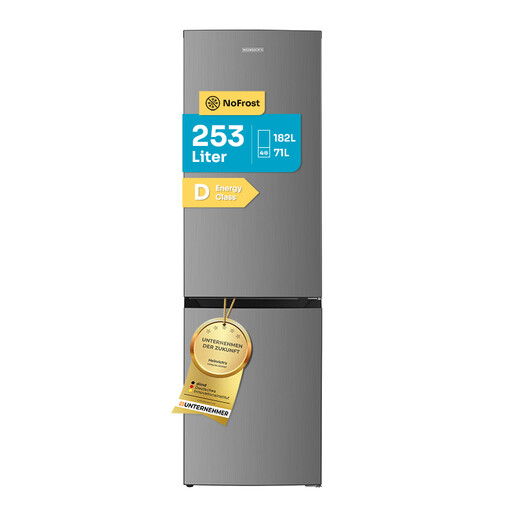 Image unavailable
If you need space for groceries and leftovers, with a moderate amount of freezer space, the listed capacities make it easy to assess each use separately. The product name also lists No Frost, LED lighting and a noise level of 39 dB. Check the width and depth before choosing this fridge-freezer for a specific space.
 Image unavailable
Worth considering if kitchen width is an issue and these capacities are enough for your shopping. The model name lists a width of 54 cm, a reversible door, Low Frost and an E energy rating. Low Frost may not eliminate the need to defrost; also check the height and clearance needed for installation.
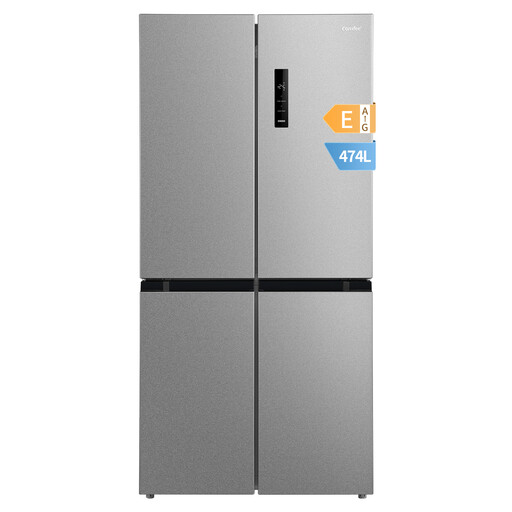 Image unavailable
Worth comparing if you need plenty of storage and your kitchen can accommodate a four-door appliance. The model name lists a total capacity of 474 L, a Vario Box configuration and an E energy rating. Ask for the net capacities of the fridge and freezer before deciding whether it has enough room for your frozen food.
UFC-Que Choisir suggests starting with 100 to 150 L for one person, then adding 50 L for each additional person. Adjust this to suit how often you shop and how many leftovers you keep, and compare the net capacities of the fridge and freezer separately.
No. The right capacity makes food easier to store, but it doesn’t replace planning meals and keeping track of what you already have. ADEME recommends doing this to avoid buying duplicates and forgetting about food.
Anses recommends setting it below 4 °C. Check the actual temperature inside the appliance regularly and follow the storage advice for the food you keep in it.
For a fridge sold in France, check the energy label required by the French authorities. Compare the energy rating and annual consumption of the exact model, as well as its compartment capacities and noise level.
Before ordering a replacement, check with the retailer whether they’ll take away your old appliance when you buy it or, if needed, when it’s delivered. Also make sure the old fridge can be moved out through the available doors and access routes.