Which criteria should you consider first?
When you shop less often, your choice of appliance mainly depends on how much space you need for fresh and frozen food, and for the appliance itself.
Fridge freezer
Consider this if: you want to store fresh and frozen food in one appliance, without needing more freezer space than fridge space.
Limitation: the freezer compartment may be too small if you store lots of frozen food or batch cook.
Tall fridge with a small freezer compartment
Consider this if: most of your shopping is fresh food and you only buy frozen food occasionally.
Limitation: check the freezer compartment’s capacity and features. Its name alone won’t tell you what you’ll be able to store in it.
Multi-door fridge
Consider this if: you want plenty of storage in one appliance and have a kitchen that can accommodate its size.
Limitation: check its width, the access routes and door clearance before you buy.
Separate freezer
Consider this if: your priority is plenty of freezer storage, separate from the space you need for fresh food.
Limitation: you’ll need to allow for the space and energy use of a second appliance, as well as a room with suitable operating conditions.
| Criterion | What to check | Who this matters to |
|---|
| Fresh food capacity |
Compare the usable fridge capacity and the space available for your containers. UFC-Que Choisir suggests allowing 100 to 150 l for one person, plus 50 l for each additional person, as a starting point. |
When I buy enough fresh food to last several days, I want to be able to put everything away without cramming the food in. Around 31% of consumers prioritise having enough fridge space. |
| Freezer storage |
Check the freezer compartment’s capacity in litres and its layout, rather than relying on the appliance’s total capacity alone. |
If my frozen food needs to last until my next shop, I want a separate compartment that’s big enough for what I buy. This is the top priority for around 25% of consumers. |
| Kitchen space |
Measure the space, access routes and door clearance. For a built-in model, check the housing dimensions in the model’s instructions. |
In a narrow kitchen or one with existing cabinets, I need to make sure I can fit the appliance in and open it. For around 25% of consumers, finding a suitable spot for the appliance is a priority. |
| Everyday use |
For appliances of a similar size and capacity, compare their kWh/year and noise levels. Check the climate class against the room’s temperature. |
If the appliance is near a living area or in a room where temperatures vary, I want to consider its noise level and operating conditions. These factors are the main priority for around 19% of consumers. |
Brands to know
There are no brands to feature in this section.
Appliances for your storage needs
This selection includes large-capacity multi-door models and fridge freezers, including a built-in model. If you shop less often, start by working out how much space you need for fresh and frozen food, then check that your chosen format will fit in your kitchen.
 Image unavailable
Candy CFQQ5T817EPS, 467 L four-door multi-door fridge
Worth considering if you want to store a large shop in a multi-door appliance.
Advertised total capacity of 467 L, with Total No Frost technology and an E energy rating listed in the product title. Check the usable fridge and freezer capacities, as well as the clearance needed for the doors.
View on Joybuy
 Image unavailable
Samsung RF50C530EB1, 495 L fridge
Worth considering if you’re looking for plenty of capacity to shop less often and have enough space for it.
Advertised total capacity of 495 L and an E energy rating. Check the door configuration, fridge and freezer capacities, and the model’s dimensions before deciding where to put it.
View on Joybuy
 Image unavailable
AEG NSC6M18FES, 249 L built-in fridge freezer
Worth considering if you want to keep fresh and frozen food in one built-in appliance.
Advertised total capacity of 249 L, with TwinTech No Frost technology and an E energy rating. Before buying, check the housing dimensions, clearances and fixing system against the instructions for the exact model.
View on Joybuy
 Image unavailable
CHiQ JR227LSE, 227 L fridge freezer, 54 cm wide
Worth considering if width is a key factor and the capacity suits your shopping needs.
The product title lists 153 L for the fridge and 74 L for the freezer, a reversible door, Low Frost technology and an E energy rating. Also check the height, depth and clearance required.
View on Joybuy
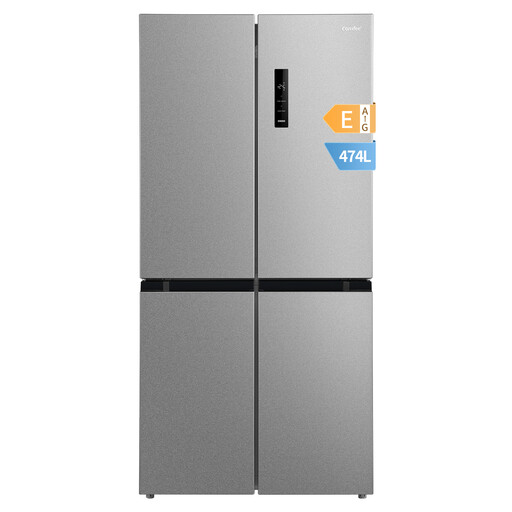 Image unavailable
COMFEE' RCF470LS2EU(E), 474 L four-door fridge
Worth considering if you’re looking for a large four-door appliance to organise your shopping.
Advertised total capacity of 474 L, with a Vario Box drawer and an E energy rating. Check the usable capacity of each compartment to see how much room there is for frozen food.
View on Joybuy
Frequently asked questions
How much capacity do I need for one to two weeks’ worth of shopping?
It depends on the size of your household and what you buy, not just how long you leave between shops. UFC-Que Choisir suggests allowing 100 to 150 l for one person, plus 50 l for each additional person, as a starting point. Adjust this if you store lots of bulky fresh food, and check the freezer capacity separately.
Is the energy rating enough to compare two appliances?
No. Also compare their annual energy use in kWh/year, choosing models of a similar size and capacity. The space available for fresh and frozen food, as well as the noise level, also matters if you store frozen food or plan to put the appliance near a living area.
Can I put a fridge freezer in a garage or utility room?
Yes, provided the model’s recommended ambient temperature range covers the actual temperatures in the room. Bosch Home Appliances explains that this range depends on the climate class. Check the appliance’s rating plate and instructions before choosing an unheated or very warm location.
What should I check about my old appliance when buying in France?
Check the collection options for your old appliance and the practical arrangements for delivery. The DGCCRF states that when you buy a new appliance, the retailer must offer free take-back of an equivalent used appliance under the ‘one-for-one’ scheme. Ask the retailer how to arrange this for your order.


