If you shop frequently and don’t store much food, start by looking at compact models. If you prepare meals to keep for several days or store lots of frozen food, compare the usable capacity of the fridge and freezer compartments separately before choosing a fridge-freezer or a larger model. Whatever you choose, make sure it can be installed, opened and used easily in your kitchen.
Which households are these options suited to?
Households that shop frequently
You buy a little at a time, so you need enough room to keep fresh food between shops without taking up unnecessary space in your kitchen. Que Choisir lists under-counter fridges among the formats designed for smaller spaces and lighter storage needs.
Households that prepare meals for several days
Ingredients, leftovers and meal-prep containers need fridge space that’s easy to organise. Check the fridge compartment’s usable capacity and layout, then make sure the appliance will fit in its intended space.
Households that store lots of frozen food
If frozen shopping or home-frozen portions take up a large part of your storage, freezer capacity matters just as much as the advertised total capacity. Also check how much room will be left for fresh food.
Which criteria should you check first?
First decide how much space you need for fresh and frozen food, then check that the format you choose will suit your kitchen. Que Choisir distinguishes between several formats to suit different lifestyles. Total capacity alone doesn’t tell you how the space is divided, or whether that split will work for your household.
Single-door or under-counter fridge
Worth considering: if you shop frequently, keep few reserves and have limited space.
Bear in mind: storage space is limited. Check whether the model has a freezer compartment that suits your needs.
Fridge-freezer
Worth considering: if you store both fresh and frozen food but don’t need a particularly large appliance.
Bear in mind: the split between the two compartments varies by model. A suitable total capacity could still mean the freezer is too small for your needs.
Multi-door or large-capacity fridge
Worth considering: if you regularly stock up on fresh and frozen food, need more capacity and have room for the appliance.
Bear in mind: measure carefully, as these models take up more space. Que Choisir also notes that American-style models use more energy than standard fridges.
| Criterion |
What to check |
Households concerned |
| Everyday fresh food |
Usable fridge capacity and external dimensions. |
If I shop little and often, I want to keep fresh food without taking up too much kitchen space. Around 25% of consumers would prioritise this need for compact storage. |
| Meals and food stored for several days |
Fridge capacity, shelf layout and space for meal-prep containers. |
When I prepare several meals in advance, I need room for ingredients and portions to keep chilled. This would be the main priority for around 31% of consumers. |
| Frozen food storage |
Usable freezer capacity, compared separately with fridge capacity. |
If I freeze portions or regularly buy frozen food, I don’t want to choose based on total capacity alone. Freezer capacity would be the top priority for around 25% of consumers. |
| Installation and noise |
Dimensions, door clearance, ventilation requirements in the manual and stated noise level. |
In a small kitchen or an open-plan living space, I need to be able to open the appliance easily and take its noise level into account. Around 19% of consumers would put these practical considerations ahead of storage capacity. |
Mistakes to avoid
-
Looking only at total capacity
An appliance may have plenty of overall capacity without enough room in the compartment you use most.
Compare the usable capacity of the fridge and freezer compartments separately, based on what you usually store.
-
Ordering before measuring your kitchen
An appliance may fit in its allotted space but still be difficult to use if the door hits a cupboard. You’ll also need to follow the ventilation guidance for that particular model.
Measure the space and delivery routes, then check the door clearance and installation instructions for the model you’re considering. Bosch recommends checking the appliance manual before installation.
-
Choosing a large model without needing the extra capacity
The extra capacity may not be worth the space it takes up in a small kitchen. Que Choisir also notes that American-style fridges use more energy than standard fridges.
Think about what you regularly store, then compare the size and energy information for the models you’re considering.
-
Comparing an old A+++ rating directly with a current one
The European Commission says that, since 1 March 2021, the energy label for the refrigeration appliances concerned has used a scale from A to G. An old rating with ‘+’ signs isn’t directly comparable with the current scale.
When comparing new appliances covered by this labelling, check their current energy labels and the information for each model.
Brands to know
There are no brands to feature in this section.
Fridges to explore on Joybuy
These models include fridge-freezers and larger appliances to consider based on how much space you need for fresh and frozen food, and how much room you have in your kitchen. Compare the exact variants before choosing an appliance.
 Image unavailable
CHiQ JR227LSE, 227 L silver fridge-freezer
Worth considering if you’re looking for a fridge-freezer for a mix of fresh and frozen food, and width is a key consideration in your kitchen. The product name lists 153 L for the fridge, 74 L for the freezer and a width of 54 cm.
It also mentions a reversible door, 39 dB and energy class E. Check the height, door clearance and ventilation requirements for your space.
View on Joybuy
 Image unavailable
Samsung RF50C530EB1, 495 L black multi-door fridge
Worth considering if you need a large model for regularly storing fresh and frozen food. The product name states a total capacity of 495 L and energy class E, but doesn’t specify how the capacity is divided between compartments.
Before choosing this model, check the separate compartment capacities, its dimensions, delivery access and the clearance needed to open the doors.
View on Joybuy
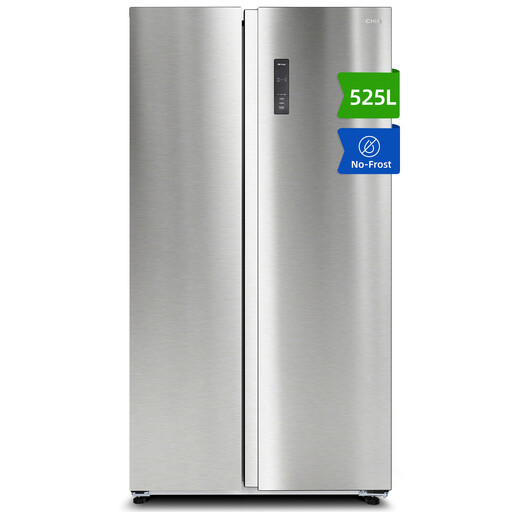 Image unavailable
CHiQ JR525WSE, 525 L side-by-side fridge-freezer in stainless steel
Worth considering if freezer capacity is a major factor in your decision. The product name breaks down the stated 525 L capacity into 333 L for the fridge and 192 L for the freezer.
It also mentions No Frost, 37 dB and energy class E. Check the external dimensions, delivery access and installation requirements before choosing this size.
View on Joybuy
 Image unavailable
Bosch KGN33NLEB, 282 L fridge-freezer in stainless steel
Worth considering if you store both fresh and frozen food and a fridge-freezer suits the way you shop. The product name lists a total capacity of 282 L, a bottom freezer and energy class E.
Compare the capacity of each compartment and check the dimensions, door clearance and noise level if your kitchen is open-plan or space is limited.
View on Joybuy
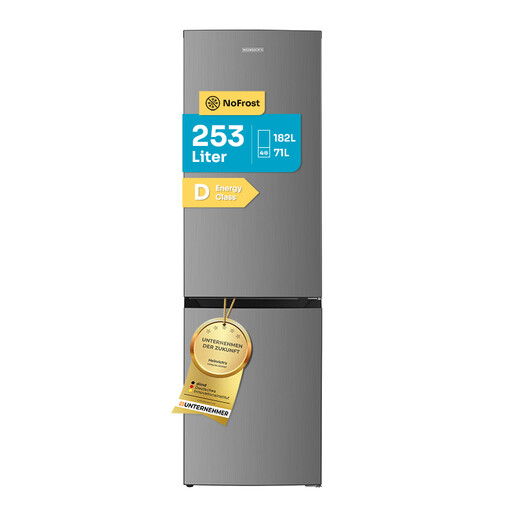 Image unavailable
Heinrich´s, 253 L fridge-freezer in a stainless steel finish
Worth considering if you mainly store fresh food, with some frozen items too. The product name lists 182 L for the fridge and 71 L for the freezer.
It also mentions No Frost and 39 dB. Check the model’s width, depth and installation requirements to make sure it will suit your kitchen.
View on Joybuy
Frequently asked questions
Which energy label should I check for a new fridge sold in France?
Check the current A to G label for the refrigeration appliances concerned. The European Commission says this scale has applied since 1 March 2021, so the old A+, A++ and A+++ ratings aren’t directly comparable with the current letters. The European Union also says that the label must be displayed when the relevant products are sold online.
Do all fridges need the same ventilation space?
No. Check the installation instructions for the exact model, whether it’s freestanding or built-in. Bosch refers customers to each appliance’s manual for its warnings and instructions; the space allowed for another model doesn’t mean your installation will be suitable.
Can I assume a door is reversible without checking the model?
No. If a wall or cupboard means the door needs to open in a particular direction, check that the door on your chosen model is reversible and consult its installation instructions. Bosch notes that the work and tools required can vary depending on the appliance and its installation.
How should I take noise into account in an open-plan kitchen?
Compare the stated noise levels of the models you’re considering, bearing in mind how close they’ll be to your living room or a quiet area. Consider this figure alongside the dimensions and installation requirements: noise level alone won’t tell you whether an appliance will suit your kitchen.


