What should you compare before buying?
For your main household appliance, choose a format based on the space available and the amount of fresh and frozen food you usually store.
Tabletop
Consider it: if you live alone, have limited space and store small quantities of food.
Limitation: its compact size leaves less room for a large shop or frozen food.
Single-door
Consider it: if fresh food is your priority and you freeze very little, or have another way to store frozen food.
Limitation: depending on the model, the freezer compartment may be small or not included.
Fridge freezer
Consider it: if fresh and frozen food are regular parts of your household shop.
Limitation: the amount of space in each compartment varies from model to model.
Multi-door or large-capacity
Consider it: if the amount of food you store justifies a large capacity and your home can accommodate the appliance.
Limitation: check the dimensions and energy consumption of the specific model; UFC-Que Choisir highlights these considerations for American-style fridges.
| Criteria | What to check | Who this matters to |
|---|
| Space and access |
Measure the space, the delivery route and the clearance specified in the manual. |
If the access route or kitchen is narrow, I need to be able to get the appliance in and open its doors once it’s installed. Around 27% of consumers put this first. |
| Fresh and frozen food |
Compare the usable capacity of each compartment separately and check the type of freezer space. |
If I regularly buy frozen food, a small freezer compartment may not meet my storage needs. Around 33% of consumers prioritise this balance. |
| Size of your shop |
Match the usable capacity to the number of people in your household and the amount you buy between shops. |
When I do a full weekly shop, I want to put away my fresh food without choosing a capacity I won’t use. Around 27% of consumers put shopping capacity first. |
| Operating conditions |
Check the model’s climate class, annual energy consumption and noise level. |
If the room temperature varies, or the appliance is in an open-plan living space, I pay particular attention to operating conditions and noise. Around 13% of consumers prioritise these factors. |
Fridges for different storage needs
These Joybuy models include fridge freezers with different capacities, as well as a multi-door model. Compare the space for fresh and frozen food before checking whether the dimensions suit your home.
 Image unavailable
Haier HTW5618ENMG, 360 L three-door fridge freezer
Worth considering if your household regularly stores fresh and frozen food, provided you have enough space.
Stated total capacity: 360 L. The product name lists Total No Frost, an E energy rating and Wi-Fi.
Check the delivery route and the clearances specified in the manual before installation.
View on Joybuy
 Image unavailable
Candy CFQQ5T817EPS, 467 L four-door multi-door fridge freezer
Worth considering if your household genuinely needs a large storage capacity and has suitable access for the appliance.
Stated total capacity: 467 L. The product name lists four doors, Total No Frost and an E energy rating.
Check the delivery route, door clearance and required ventilation space.
View on Joybuy
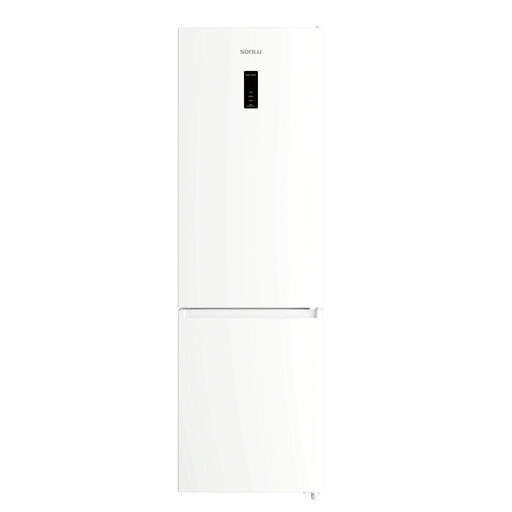 Image unavailable
Sonlu CD‑400RW, 355 L fridge freezer
Worth comparing if you want separate space for fresh and frozen food.
The product name lists 252 L of fridge capacity and 103 L of freezer capacity, giving 355 L in total, as well as a 60 cm width and a reversible door.
Also check the full dimensions, climate class, annual energy consumption and installation clearances.
View on Joybuy
 Image unavailable
CHiQ JR227LSE, 227 L fridge freezer
Worth considering for a narrow kitchen if you still need a separate freezer compartment.
The product name lists 153 L of fridge capacity, 74 L of freezer capacity, a width of 54 cm and a reversible door.
Low Frost doesn’t mean you’ll never need to defrost it manually. Check the full height and installation clearances.
View on Joybuy
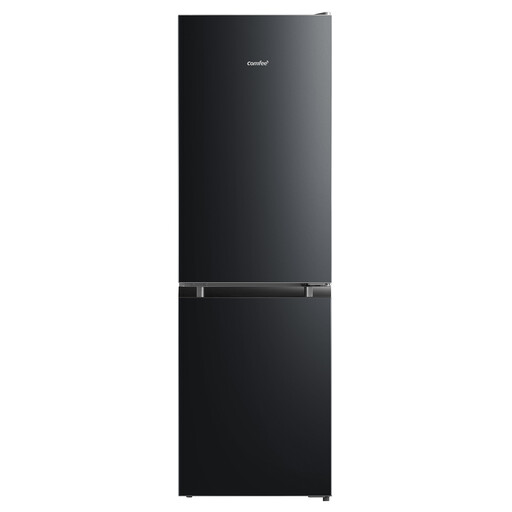 Image unavailable
Comfee' by Midea RCB230BL2EU(E), 174 L fridge freezer
Worth comparing for moderate storage needs, once you’ve checked how much room you need for each type of food.
The product name lists a total capacity of 174 L, Low Frost, an adjustable thermostat and a reversible door.
Low Frost doesn’t guarantee that you’ll never need to defrost it manually. Check the capacity of each compartment, the climate class and the model’s annual energy consumption.
View on Joybuy
Frequently asked questions
What capacity should you allow for one person?
UFC-Que Choisir recommends 100 to 150 L of usable capacity as a starting point for one person, then 50 L for each additional person. Adjust this guide to how often you shop and how much space you need for frozen food.
Can a fridge be used in a garage or conservatory?
It depends on the ambient temperature range the model is designed for and the temperatures the room actually reaches. Bosch lists a range of 10 to 32 °C for climate class SN and 16 to 32 °C for class N; check the appliance’s climate class before choosing this location.
How much space should you leave around a fridge?
Always follow the clearances specified in the model’s manual. As general guidance, UFC-Que Choisir recommends leaving at least 10 cm above and behind the appliance to help air circulate.
What should you compare on the energy label?
For fridges covered by EU energy-labelling rules, compare the energy class and annual consumption shown for each specific model. These details complement, but don’t replace, comparing usable capacity and dimensions.
What if the fridge delivered doesn’t match its description?
In France, the statutory guarantee of conformity applies, among other things, to goods sold by a business to a consumer, as the Ministry of the Economy explains. If the appliance doesn’t match the seller’s description, keep a copy of that description and your delivery documents to support your claim with the seller.


