Households that regularly buy frozen food
If you do a weekly shop that includes fresh and frozen food, start by looking at a fridge-freezer. Compare the usable capacity of each compartment, not just the total capacity.


First, measure the space and the route into your kitchen. Then work out separately how much room you need for fresh food and frozen food. A table-top or single-door fridge is better suited to smaller shops or limited freezer needs; a fridge-freezer works when you need both compartments, while a multi-door model needs more space. Then compare models of a similar size by their kWh/year, noise level and installation requirements.
If you do a weekly shop that includes fresh and frozen food, start by looking at a fridge-freezer. Compare the usable capacity of each compartment, not just the total capacity.
If limited height beneath the worktop or a lack of floor space narrows your options, consider table-top and single-door models. Be sure to check how much room they offer for your shopping and whether they have a freezer compartment.
A multi-door or side-by-side model can meet your need for more storage, provided it can be brought into the kitchen, its doors can open fully and its installation requirements can be met.
Consider it: if your kitchen has limited headroom or you don’t need much storage for your shopping.
Be prepared for: limited storage space and, depending on the model, little or no room for frozen food.
Consider it: if fresh food is your priority and you only freeze food occasionally, or have a separate freezer.
Be prepared for: a small freezer compartment may not meet your need for a separate freezer.
Consider it: if you need to store fresh and frozen food in one appliance.
Be prepared for: the freezer takes up space that could otherwise be used for fresh food. Compare the balance between the compartments against your shopping habits.
Consider it: if you buy large shops and have a spacious enough kitchen.
Be prepared for: a larger footprint. Check the energy use of the specific model rather than assuming it from its format.
Once you’ve chosen a format, match your storage needs to the space available, then check the practicalities of everyday use.
| Factor | What to check | Who is it for? |
|---|---|---|
| Capacity and how often you shop | Compare the usable capacity of the fridge and freezer separately. UFC-Que Choisir suggests 100 to 150 L as a starting point for one person, plus 50 L for each additional person. Adjust this to suit your shopping habits. | If I shop less often, I want to be able to store fresh food until my next shop without relying on a misleading total capacity figure. Around 33% of consumers would put storage capacity first. |
| Size and installation | Measure the delivery route, the space needed for the doors to open and the final position. For a built-in model, also check the housing and installation requirements in the manual. | In a narrow kitchen or one with a fitted housing, I need to be able to install and use the appliance without blocking access. This would be a priority for around 27% of consumers. |
| Freezing and maintenance | Check the freezer compartment’s capacity and cooling system. Low Frost does not mean No Frost. | If I keep frozen food between shops, I need enough freezer space and must be prepared to carry out any required maintenance. Around 20% of consumers would prioritise this need. |
| Noise and electricity use | Check the stated noise level and kWh/year. Compare energy use between appliances with similar functions and capacities, rather than looking only at the energy rating. | If the fridge is near my living area, its noise and continuous operation are important factors in my choice. Around 20% of consumers would put these factors first. |
A large total capacity can hide a freezer compartment that’s too small for regular frozen-food shops, or leave you with less room for fresh food than you expected.
Think about what you buy in a typical week and compare the usable capacity of each compartment separately.
An appliance may fit in the space you’ve set aside but still be too large to get through a doorway, or block access to cupboards once installed.
Measure the route from the entrance, then check the model’s manual for door-opening space and ventilation clearances.
A difficult route may also mean you need to make special arrangements for delivery and installation.
According to ADEME, a fridge runs continuously, so it’s worth considering its annual energy use alongside the capacity you need.
Compare the kWh/year of appliances with similar functions and capacities, while also taking noise and installation space into account.
Used fridges are covered by the waste electrical and electronic equipment scheme, as described by the Ministry for Ecological Transition.
When replacing a fridge in France, ask the retailer how to arrange for your old one to be taken away when you buy an appliance of the same type.
Worth considering if you want to compare freestanding and built-in fridge-freezers.
A range to explore if you want to compare different fridge-freezer configurations and freshness compartments.
A range that includes table-top models, fridge-freezers and built-in appliances.
Worth exploring for multi-door and side-by-side models if your household needs plenty of storage.
This selection includes multi-door models for storing larger shops, fridge-freezers combining fresh and frozen storage, and a built-in model with a small freezer compartment, best suited to occasional or limited use.
 Image unavailable
Worth considering if you store plenty of fresh and frozen food between shops.
Stated capacity of 467 L, Total No Frost system and E energy rating.
Measure the route into your kitchen and check door clearance and installation requirements.
 Image unavailable
Worth comparing if your priority is storing a large shop in a multi-door appliance.
Stated capacity of 495 L and E energy rating.
Check the delivery route, door clearance and installation requirements for this model.
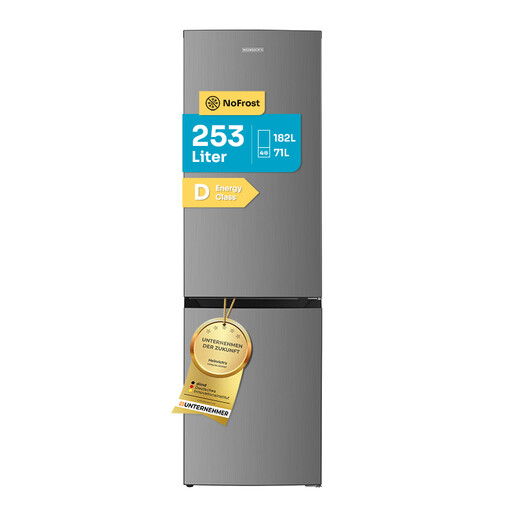 Image unavailable
If you want to store fresh and frozen food in one appliance, compare how much space each compartment offers.
Stated capacity of 182 L for the fridge and 71 L for the freezer; No Frost and a stated noise level of 39 dB.
Check the width, depth, installation clearances and kWh/year before deciding. This model is not designed to be built in.
 Image unavailable
Its stated width of 54 cm is worth considering if your kitchen is narrow and you also need a freezer.
Stated capacity of 153 L for the fridge and 74 L for the freezer; reversible door, Low Frost and E energy rating.
Low Frost does not mean you won’t need to defrost it. Also check the height, depth, clearances and kWh/year.
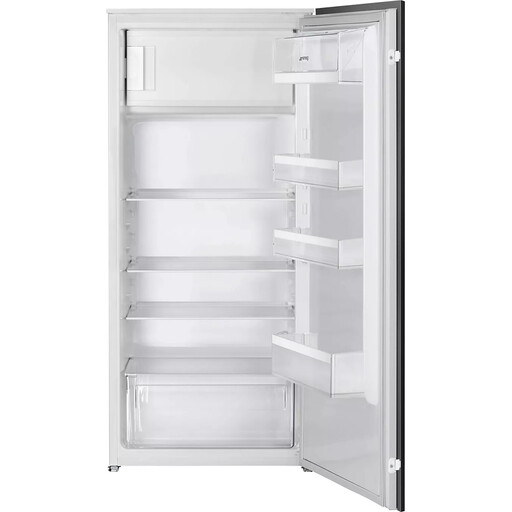 Image unavailable
Worth considering for a fitted kitchen if you prioritise fresh food and have limited need for a freezer.
Stated total capacity of 188 L, top-mounted freezer and E energy rating.
The small freezer needs to be defrosted manually. Check that the housing is compatible and confirm the sliding-rail installation requirements; the furniture door is not included.
UFC-Que Choisir suggests 100 to 150 L of usable capacity as a starting point for one person, plus 50 L for each additional person. Adjust this guideline to your shopping habits and compare the fridge and freezer capacities separately.
Yes, if its freezer compartment has enough space for the amount you keep between shops. Check this capacity separately: two fridge-freezers with a similar total capacity may divide the space differently between fresh and frozen food.
Measure the space and the entire route into your kitchen, then allow room for the doors to open. Check the manual for the chosen model’s ventilation clearances. If it’s a built-in appliance, also check the housing and installation system.
The energy label used in the European Union has a scale from A to G. When comparing two fridges, also check their kWh/year and compare appliances with similar functions and capacities.
Check which compartment the feature applies to. On a model whose freezer is listed as No Frost, it is designed to prevent that compartment from needing to be defrosted. Low Frost is a different feature and does not mean that defrosting is no longer needed.