Parents of children who are sensitive to strong flavours
You want to introduce a new flavour without turning mealtimes into a battle. Manger Bouger advises offering a very small amount without pressuring your child to eat more.


To start, choose a mild-tasting plain fresh cheese in a form your child already accepts, and offer a very small amount without pressuring them. Ricotta can be mixed into a dish, while spreadable cheese offers a different texture. If you’re looking for a stronger flavour, matured cheese is a separate category, and your choice should take your child’s age and the type of milk into account.
You want to introduce a new flavour without turning mealtimes into a battle. Manger Bouger advises offering a very small amount without pressuring your child to eat more.
You’re thinking of pasta, a filling or toast rather than serving cheese on its own. In this case, texture matters just as much as flavour: Galbani describes its ricotta as slightly grainy, while Philadelphia Original is spreadable.
You need to check the ingredients and type of milk before serving the product. If your child has a diagnosed food allergy and eats at school, their medical guidance and school meal arrangements should take priority over your usual shopping habits.
First decide how you plan to serve the cheese, then compare products intended for that use. French decree no. 2007-628, published on Légifrance, defines fromage blanc as unmatured. So, looking for a matured cheese means considering a different category, not a more mature version of the same product.
Choose it when: you want to offer a mild flavour, on its own or mixed into a dish your child already enjoys.
Bear in mind: its subtle flavour may not be the best fit if your child wants to discover a more pronounced cheesy taste.
Choose it when: you want to mix cheese into a filling or cooked dish; Galbani suggests using its ricotta in both cooked and uncooked dishes.
Bear in mind: the slightly grainy texture described by Galbani may not appeal to a child who is sensitive to lumps.
Choose it when: a smooth, spreadable texture is a better fit for toast or the dish you have in mind.
Bear in mind: it isn’t necessarily nutritionally equivalent to plain fresh cheese; compare the values per 100 g.
Consider it when: your child already accepts mild flavours and would like to try something different, with no pressure to finish the portion.
Check: the flavour depends on the cheese you choose. Anses advises against giving young children cheeses made from raw milk.
| Criteria | What to check | Who is it for? |
|---|---|---|
| Trying new flavours | Plain or lightly flavoured; a familiar texture. | If my child refuses new flavours, I’d rather offer a small bite without insisting. Around 36% of consumers would prioritise this gradual introduction. |
| Nutritional values | Fat, saturated fat and salt per 100 g; the product description. | For toast served regularly, I want to compare recipes rather than rely on the word ‘fresh’ alone. This would be the priority for around 29% of consumers. |
| Cooking uses | Smooth or grainy texture; whether it’s intended for toast, a filling or a dish. | When my child won’t eat cheese on its own, I look for a form that can be added to a familiar meal. Around 21% of consumers would put this cooking use first. |
| Milk and allergens | Ingredients and milk allergen; type of milk used, especially for a young child. | If my child’s age or diagnosed allergy means we need to take precautions, I check the product before thinking about its flavour. This would be the priority for around 14% of consumers. |
Under French decree no. 2007-628, published on Légifrance, fromage blanc is defined as unmatured. So matured cheese isn’t simply fromage blanc that has been left to mature and develop a stronger flavour.
Decide whether you want to start with a mild option or introduce a different type of cheese, then check the product description on the packaging.
Texture doesn’t tell you what’s in a product. According to the Courses U product listing, Philadelphia Original contains 21 g of fat and 0.75 g of salt per 100 g; the Auchan Bio plain fresh cheese 4 × 100 g listing gives 3.6 g and 0.11 g per 100 g respectively. These products aren’t intended for exactly the same use.
Compare the nutritional information per 100 g and choose a portion to suit the meal you have planned.
One refusal doesn’t tell you which cheese your child might accept later. Manger Bouger recommends offering a very small amount without pressuring them to eat more.
Serve the cheese alongside a food your child likes and let them say no; you can offer it again another time.
Milk is an allergen to look out for in the ingredients list. The type of milk is also worth checking for a young child: Anses advises against giving young children cheeses made from raw milk.
Check the ingredients, storage instructions and date on the packaging. If your child has a diagnosed allergy, follow their medical guidance and, for school meals, the arrangements in place for them.
These products illustrate different textures and recipes. The details given relate to the products named, not to each brand’s entire range.
According to Carrefour’s product listing, Carrefour Classic’ plain fresh cheese 3.8% fat is an example of a plain option sold in small 60 g pots.
Auchan Bio plain fresh cheese 4 × 100 g is a pot option to consider if you’re looking for a plain recipe.
Galbani describes its Ricotta as a mild fresh cheese that can be eaten as it is or cooked, including in a family dish.
Philadelphia Original is a pasteurised spreadable processed cheese product, as described on the French Courses U listing.
This selection features a plain fromage blanc dairy dessert, which could be a good option if you want to offer this flavour in an individual pot. It isn’t plain fresh cheese sold on its own or matured cheese.
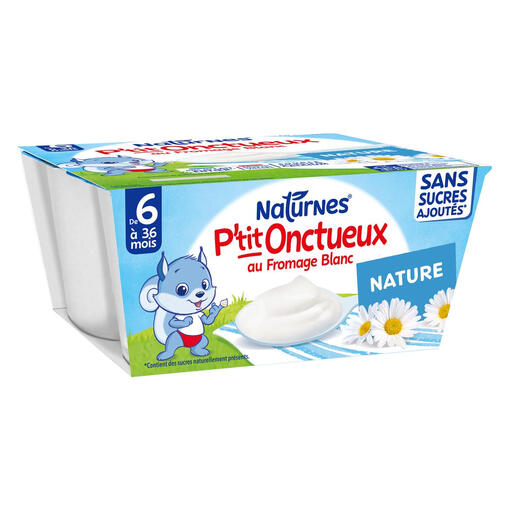 Image unavailable
This plain dairy dessert offers the flavour of fromage blanc in an individual pot, rather than serving fresh cheese on its own.
The pack contains four 90 g pots; the product is labelled ‘from 6 months’. It contains milk, so check the label if you need to take an allergen into account.
If salt or fat content is important to your choice, compare the values per 100 g on the packaging.
No. French decree no. 2007-628, published on Légifrance, defines fromage blanc as unmatured. If you want to offer a different flavour, choose a product that matches what you have in mind rather than assuming fromage blanc comes in a matured version.
Offer a very small amount without expecting them to finish it. Manger Bouger advises against pressuring children to eat; you can offer the product again at another meal without turning tasting it into a reward or an obligation.
Make sure you check the type of milk used. Anses advises that young children should avoid cheeses made from raw milk, so read the label of the specific product before serving it.
Follow the medical guidance in place for your child and check the allergens listed on each product, rather than relying on its name or a previous purchase. According to the French Ministry of National Education, an individual care plan (PAI) can arrange the necessary adjustments at school, including for school meals.