For a toddler who has started weaning, first compare plain, unflavoured fresh cheeses and check that the product is suitable for their age; a spreadable cheese is not automatically a suitable substitute. Individual pots make it easy to serve small portions, while a family-size pack means following the storage instructions once opened and keeping an eye on the use-by date.
Who is this option for?
Parents of a child who has started weaning
You’re looking for a plain dairy product with a texture and quantity that can be gradually adapted to your child. Manger Bouger, the Santé publique France website, lists plain yoghurt, fromage blanc and petits-suisses among the products to offer without flavourings.
Households keen to avoid leftovers
You’re choosing between individual pots, multipacks and a large tub. The right size depends on how much is actually eaten, the use-by date and the storage instructions once the product has been opened.
Parents comparing fresh cheese with spreadable cheese
You want to distinguish a plain recipe from a spreadable cheese, which may contain different ingredients or seasonings. The product’s exact name and ingredients matter more than the word “fresh” alone.
What should you check?
For a child who has started weaning, begin by checking the age guidance and ingredients. Then choose a quantity and pack size to suit how often your household will eat it.
| Criteria |
What to check |
Who it matters to |
| Age and type of milk |
Weaning stage, type of milk and pasteurisation information. For children under 3, avoid 0%, skimmed or semi-skimmed products, in line with Manger Bouger guidance. |
If my child is starting weaning, I want to check that the product is suitable for their age before choosing a pack size; around 36% of consumers would make this their top priority. |
| Plain recipe |
Product name and ingredients: distinguish a plain recipe from fruit, sweetened or seasoned versions. |
For a simple dairy snack, I don’t want to mistake “plain” for a flavoured variety; nearly 29% of consumers would put this distinction first. |
| Portion and texture |
Amount per pot and a texture suited to your child’s abilities and appetite. Don’t assume that the contents of a pot are a set portion. |
When my child’s appetite varies, I’d rather be able to serve a small amount without being tied to the pack size; around 21% of consumers would prioritise portioning. |
| Pack size and storage |
Number of pots, total weight, use-by date and storage instructions after opening. |
If my household doesn’t eat it regularly, I want to avoid leaving a large tub open for too long; around 14% of consumers would prioritise managing leftovers. |
The packs of 6 or 12 pots at 60 g each listed for some products don’t tell you what a pack labelled “6 pint” or a 3-litre bottle contains. If either of these descriptions appears on the product you’re considering, check its exact capacity and product name before comparing it with the pots.
Mistakes to avoid
-
Assuming plain fresh cheese and spreadable cheese are the same
A spreadable cheese may have different ingredients and seasonings from plain fresh cheese. Carrefour’s product listing for Boursin Garlic & Fine Herbs includes garlic, herbs, salt and pepper.
For the snack you’re looking for, compare the exact product name, ingredients and nutritional information rather than relying on the brand alone.
-
Mistaking a fruit variety for a plain recipe
The ingredients list for Carrefour’s strawberry fresh cheese variety includes sugar. Manger Bouger recommends offering plain, unflavoured dairy products during weaning.
Read the full product name and ingredients list: “with fruit” or “flavoured” does not mean “plain”.
-
Choosing 0%, skimmed or semi-skimmed products for a child under 3
Manger Bouger’s weaning guidance says these products are not suitable for children under 3. So the word “plain” alone isn’t enough to choose a product.
For this age group, check the type of milk on the label before comparing pack sizes, too.
-
Buying a large tub without planning how quickly you’ll use it
An opened fresh product should be stored according to the instructions on its packaging. The DGCCRF says that use-by dates must not be exceeded; once opened, you should also follow the product-specific instructions.
Choose a quantity that suits your household’s consumption and check the storage conditions before opening the tub.
Brands and ranges to know
These ranges show how products and pack sizes can differ. Always check the exact product before choosing one for a toddler.
Carrefour Classic'
Carrefour offers plain fresh cheese with 3.8% fat in packs of 6 × 60 g and 12 × 60 g.
- The listing for the 12-pack states that it contains pasteurised skimmed milk, pasteurised cream, skimmed milk powder and lactic cultures.
- For a child under 3, the presence of skimmed milk calls for careful checking against Manger Bouger guidance. The pack size and “plain” label alone don’t establish whether the product is suitable.
Auchan Bio
Auchan offers organic plain fresh cheese in a pack of 12 × 60 g.
- Auchan’s listing states that it contains pasteurised organic semi-skimmed milk and lactic cultures.
- Semi-skimmed milk doesn’t meet Manger Bouger guidance for children under 3. The “organic” label doesn’t change this age-related guidance.
E.Leclerc / Marque Repère
The E.Leclerc range includes Délisse plain yoghurts in packs of 4, 8, 12 or 16 pots.
- These pack sizes make it easy to compare how much to buy for your household.
- Plain yoghurt and plain fresh cheese are different product categories. Check the product name and label of the one you’re considering.
Philadelphia
Philadelphia is included here as a plain spreadable cheese; Carrefour offers 150 g, 300 g and 500 g packs.
- You can compare the different pack sizes for spreading or cooking at home.
- Spreadable cheese shouldn’t be treated as the same as plain fresh cheese in individual portions for a toddler. Check the ingredients and nutritional information for the exact pack.
Boursin
Boursin Garlic & Fine Herbs is a flavoured spreadable cheese.
- Carrefour’s listing names the ingredients that define this variety, including garlic and herbs.
- It also contains salt and pepper, so it isn’t a plain, unflavoured fresh cheese for a snack.
Galbani
Galbani’s range includes ricotta and mascarpone, both fresh cheeses intended for use in cooking.
- According to Galbani, its mascarpone is made with cream and milk.
- Neither ricotta nor mascarpone should automatically be treated as equivalent to plain fresh cheese in individual pots for this snack.
Product available on Joybuy
This option in individual pots lets you compare a fromage blanc dessert for snack time. Don’t confuse its product name with that of plain fresh cheese: check its ingredients and any age guidance for your child.
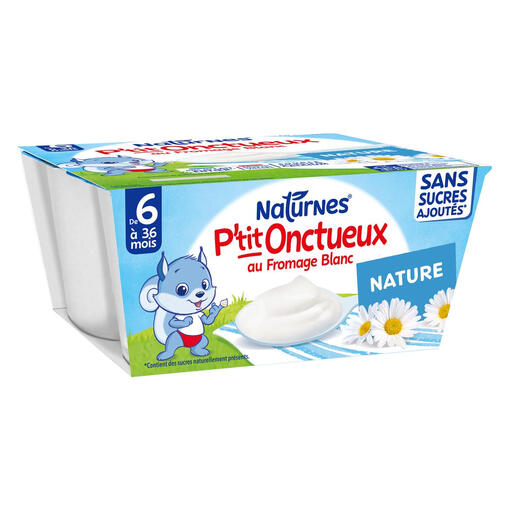 Image unavailable
Nestlé P'Tit Smooth with plain fromage blanc, from 6 months, 4 × 90 g
This fromage blanc dessert comes in four pots, so it’s worth comparing if you’re looking to serve snacks in separate portions.
Before offering it to a child, check the full ingredients list, type of milk and fat content on the label. The age guidance on the product doesn’t replace these checks.
View on Joybuy
Frequently asked questions
Is fresh cheese suitable for all toddlers?
No. The right choice depends, among other things, on your child’s age and stage of weaning. Manger Bouger recommends plain, unflavoured dairy products and says that 0%, skimmed and semi-skimmed products are not suitable for children under 3. If your child has a milk allergy or specific medical needs, seek advice tailored to them.
Can you give a young child cheese made with raw milk?
For children under 5, Santé publique France recommends avoiding raw milk and cheeses made with raw milk, except Emmental and Comté. Check the type of milk listed for the exact product rather than relying on its name alone.
How should you store a large tub of fresh cheese once it’s opened?
Follow the temperature and storage time after opening shown on the packaging, as well as the use-by date. The DGCCRF says a use-by date must not be exceeded; you can’t assume that an opened product will keep for the same length of time as a different product.


