Parents of a child under 5
You’re looking for a cheese whose label confirms it is made with pasteurised milk, and a texture that suits how you plan to serve it. Manger Bouger recommends checking this for children under 5.


For your first shop for a child, choose plain fresh cheese in a pot if you want to serve it by the spoonful; opt for a spread for bread or ricotta if you plan to cook with it. For a child under 5, check the packaging to make sure it is made with pasteurised milk, then compare the ingredients list and nutritional values per 100 g: a mild taste doesn’t tell you how much fat or salt it contains.
You’re looking for a cheese whose label confirms it is made with pasteurised milk, and a texture that suits how you plan to serve it. Manger Bouger recommends checking this for children under 5.
You’re looking for plain fresh cheese in small pots. The format makes it easier to choose how much to serve; when comparing two products, check the fat and salt content per 100 g in particular.
You want to use the same type of product in savoury or sweet recipes. Ricotta is a different option from smooth fresh cheese in a pot or spreadable cheese: Galbani describes its Ricotta as suitable for eating uncooked or cooked, with a slightly grainy texture.
For your first shop, start with how you plan to use it — by the spoonful, on toast or in cooking — then check the details for the specific product you choose.
Choose this if: you want to serve a plain portion by the spoonful.
Bear in mind: a texture designed for eating by the spoonful isn’t suited to the same uses as a spreadable cheese.
Choose this if: you’re mainly planning to make toast or sandwiches.
Bear in mind: the Philadelphia and Auchan products mentioned contain more fat and salt per 100 g than the Auchan plain fresh cheese mentioned; compare the exact products rather than just their categories.
Choose this if: you also want to make savoury or sweet recipes, whether cooked or uncooked.
Bear in mind: Galbani Ricotta has a slightly grainy texture, unlike smooth fresh cheese in a pot.
| What to consider | What to check | Who is this for? |
|---|---|---|
| Pasteurisation | For a child under 5, look for a statement that the milk is pasteurised and read the allergen information. | For a child under 5, I want to confirm the milk is pasteurised before choosing their cheese. Around 42% of consumers prioritise this check. |
| Plain portion | Check the product name, ingredients list and format; compare the nutritional values per 100 g. | If I’m looking for a plain portion to serve by the spoonful, the texture and format influence my choice. Around 33% of consumers prioritise this kind of plain portion. |
| Cooking | Choose according to the texture and how you plan to use it, cooked or uncooked; follow the storage instructions for the product. | When I’m also planning savoury or sweet recipes, I want a product that’s suitable for that use, even if its texture differs from plain cheese in a pot. Around 25% of consumers prioritise this versatility. |
They’re not always suited to the same uses. Auchan product listings show 3.6 g of fat per 100 g for its Bio plain fresh cheese, compared with 22 g for its plain spread; the Philadelphia Original listing shows 21 g per 100 g.
First decide whether you’ll serve it by the spoonful or spread it, then compare the fat and salt content per 100 g on the relevant packaging.
For children under 5, Manger Bouger recommends checking that the cheese is made with pasteurised milk.
Look for this information on the packaging of the product you choose or ask the retailer to confirm.
Ingredients and allergen information depend on the exact recipe. The DGCCRF states that allergenic ingredients must be highlighted in the ingredients list on pre-packed products.
Check the packaging each time you shop, especially if you switch to a different product or format.
Instructions for after opening vary by product. Auchan says its plain spreadable fresh cheese should be eaten within 7 days of opening.
Choose a pack size that suits the portions you plan to serve, and follow the storage instructions for the product you buy.
A pack that’s too large for the portions you have in mind could lead to waste.
The products mentioned include Bio plain fresh cheese in four 100 g pots and a 150 g pack of plain spreadable fresh cheese.
The plain fresh cheese mentioned comes in six 60 g pots, for serving by the spoonful.
Galbani Ricotta, in a 250 g pack, is designed for savoury or sweet recipes, both cooked and uncooked.
The Original product mentioned is a pasteurised spreadable cheese speciality, suitable for toast and creamy recipes.
The French product listing for Boursin Nature cited by Bel Foodservice France refers to a 16 g portion intended for food service.
For serving by the spoonful, this plain fromage blanc dairy dessert comes in small pots and is suitable from 6 months. If you’re specifically looking for classic plain fresh cheese, check the product name before choosing.
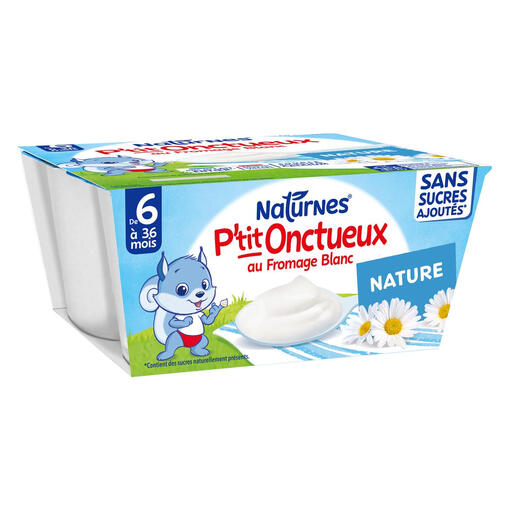 Image unavailable
These small pots are suitable for serving by the spoonful to a child from 6 months.
This is a dairy dessert: check the product name and ingredients if you’re looking for classic plain fresh cheese. For a child under 5, check the packaging to confirm that the dairy ingredients are pasteurised; also compare the nutritional values per 100 g.
Check that the cheese is made with pasteurised milk, as Manger Bouger recommends for children under 5. Plain cheese in a pot, a spread and ricotta are suited to different uses, so choose according to how you plan to serve it.
No. The word “mild” doesn’t tell you how much fat or salt a product contains. Compare the values per 100 g for the products you’re interested in; the DGCCRF says that presenting nutritional information in this standard format makes it easier to compare.
Check the ingredients list and allergen information for the exact product every time you shop. The DGCCRF states that allergenic ingredients must be highlighted on pre-packed products; also check the packaging for any precautionary statements about traces.
Follow the storage temperature, use-by date and after-opening instructions shown on the product you buy. For the specific products mentioned, Auchan’s listings state that Philadelphia Original and Auchan’s spread should be stored between +2 °C and +6 °C; the spread should be eaten within 7 days of opening. Galbani recommends storing its Ricotta between +4 °C and +8 °C.