Parents of children who are sensitive to strong flavours
If your child prefers mild flavours, look for a plain recipe and distinguish it from a garlic or herb-flavoured spreadable cheese.


For a typical post-sport snack, a pot of plain fresh cheese is a good starting point if your child likes the taste and texture. Add fruit or bread to round out the snack, rather than looking for a specialist ‘recovery’ product. Ricotta and spreadable cheeses are suited to different uses, so compare the recipe, nutritional values per 100 g and pack size of the product you choose. For children under 5, check that the fresh cheese is made with pasteurised milk.
If your child prefers mild flavours, look for a plain recipe and distinguish it from a garlic or herb-flavoured spreadable cheese.
A dairy product can be part of a varied snack. Manger Bouger suggests snack ideas that include fruit, bread or a dairy product, for example, without presenting fresh cheese as a sports recovery food.
For fresh cheese intended for this age group, check that it is made with pasteurised milk. The French Ministry of Agriculture advises that children under 5 should not consume raw milk or cheese made with raw milk.
First decide whether you want a product to eat with a spoon or a spreadable cheese, then check the exact recipe. Ricotta in a pot can also work in a homemade dish, but its pack size and ingredients differ from those of an individual pot of plain fresh cheese.
| Criterion | What to check | Who is it for? |
|---|---|---|
| Mild flavour | Look for the word ‘plain’ and check whether the ingredients include garlic, herbs or other flavourings. | If my child dislikes strong flavours, I look for a plain recipe rather than an herb-flavoured version; around 31% of consumers would make this their top priority. |
| Ingredients | The product name, ingredients and nutritional values per 100 g, particularly fat and salt. | When choosing between plain fresh cheese, ricotta and a spread, I want to compare the recipes rather than rely on the word ‘mild’ alone; around 31% of consumers would make this their top priority. |
| Pack size | The weight of each pot and how you plan to use it: by the spoonful, on bread or in a recipe. | After an activity, I’d prefer to serve a portion easily without scooping it out of a large pot; around 23% of consumers would prioritise pack size. |
| Pasteurisation and storage | Check for a pasteurised milk label if serving to a child under 5, then check the use-by date and storage instructions on the pack. | For a young child, I need to confirm that the milk is pasteurised and be able to follow the storage instructions; around 15% of consumers would prioritise food safety. |
These names cover different recipes and uses. According to Auchan and Carrefour product pages, the Auchan plain fresh cheese cited contains 3.8 g of fat per 100 g, compared with 21 g for the Philadelphia Nature product cited.
Compare the product name, ingredients and nutritional information per 100 g on the packaging of the products you’re considering.
An flavoured recipe may not suit this preference. Carrefour’s product page for Boursin Herbes et Sel de mer lists 1 g of salt per 100 g.
Start by checking whether the recipe is plain; save herb flavours for children who enjoy them.
Taste tells you nothing about how the milk has been treated. The French Ministry of Agriculture advises that children under 5 should not consume raw milk or cheese made with raw milk.
For fresh cheese intended for a child in this age group, check the packaging for a pasteurised milk label or ask the retailer to confirm.
The French Directorate-General for Competition Policy, Consumer Affairs and Fraud Control reminds shoppers that the use-by date is a strict deadline for the foods it applies to.
Follow the use-by date and storage conditions shown on the product, as well as any instructions for after opening.
The retailer offers plain fresh cheeses in packs of four 100 g pots, which are suited to serving by the spoonful.
Philadelphia Nature is a spreadable cheese, intended in particular for toast, rather than plain fresh cheese to eat by the spoonful.
Galbani ricotta is an option for a homemade recipe or for serving from a pot.
The range includes plain and flavoured spreadable cheeses, so choose according to the flavour you’re looking for.
Carrefour Classic' Ricotta is a fresh cheese made with pasteurised whey and cream, sold in a 250 g pot.
The Nos Régions ont du Talent fromage frais cited by E.Leclerc comes in a 1 kg family-size tub and is better suited to serving at home.
This product, made with plain fromage blanc and sold in small pots, is presented as suitable for children from 6 months. It’s a product intended for young children, so check that the recipe and pack size suit your child’s age and the snack you have in mind.
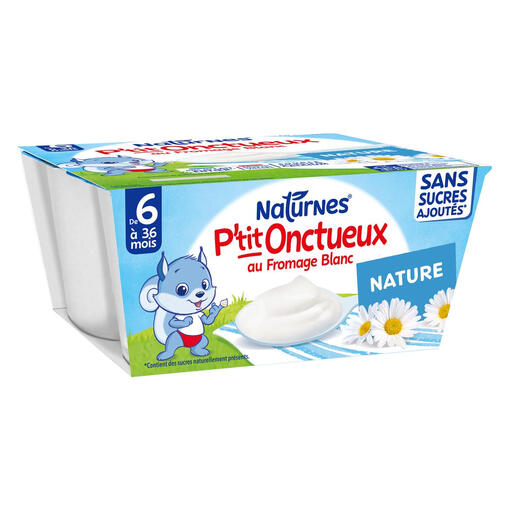 Image unavailable
Small pots of plain fromage blanc for a snack intended for young children.
For a child under 5, check the packaging to make sure the cheese is made with pasteurised milk. Also check the nutritional information for this product if it informs your choice.
Not necessarily. Choose according to whether your child will eat it by the spoonful or on bread, then compare the recipes. Auchan and Carrefour’s product pages list 3.8 g of fat per 100 g for the Auchan plain fresh cheese cited, compared with 21 g for the Philadelphia Nature product cited.
For a typical snack, there’s no need to choose fresh cheese marketed as a recovery product. Manger Bouger instead suggests ideas for varied snacks that might include fruit, bread or a dairy product.
When choosing fresh cheese, check that it’s made with pasteurised milk. The French Ministry of Agriculture advises that children under 5 should not consume raw milk or cheese made with raw milk.
Read the ingredients list on each pre-packed product: allergens must be highlighted, as the French Directorate-General for Competition Policy, Consumer Affairs and Fraud Control reminds shoppers. The words ‘plain’ or ‘mild’ don’t tell you whether a product contains allergens.
Don’t eat food past its use-by date: the French Directorate-General for Competition Policy, Consumer Affairs and Fraud Control reminds shoppers that this is a strict deadline. After opening, also follow the storage time and temperature shown on the packaging.