
Livraison le jour même ou le lendemain

Qualité garantie

Débloquez vos offres de bienvenue: Livraison GRATUITE | Jusqu'à -80 % | 30 jours d'essai gratuits à JoyPlus
Téléchargez l'application
A French press coffee maker lets you prepare rich, aromatic coffee without filling your kitchen with equipment. However, not all models are created equal or suited to the same needs. Choosing the wrong capacity, dealing with a filter that is awkward to clean or ending up with a fragile carafe can quickly turn an appealing purchase into an impractical everyday accessory.
The French press method remains wonderfully simple: coarsely ground coffee, hot water, a few minutes of brewing, then slowly press down on the plunger. However, to find the French press coffee maker that best suits your kitchen, office or luggage, there are several criteria worth examining carefully.
Labels such as “3 cups”, “4 cups” or “8 cups” generally refer to small coffee cups, not large mugs. A 1 L French press coffee maker is suitable for several people or for brewing a generous amount, while a 350 ml model is better suited to one or two servings.
Before placing your order, always check the capacity given in millilitres or litres. For one person, 350 ml may be more than enough. For a couple or a small household, a 500 ml French press coffee maker offers more flexibility. And if you have guests, the 1 L size saves you from having to brew several batches.
A transparent glass coffee maker lets you watch the coffee brew, but it is still vulnerable to knocks and sudden changes in temperature. Borosilicate glass withstands high temperatures better than standard glass, but it is not unbreakable.
Also check the stability of the frame, how comfortable the handle is to hold and the quality of the mechanism. An attractive coloured finish may look great on a shelf, but it will never make up for a poorly fitted plunger or a filter that does not stay securely in place.
The reusable metal filter is one of the French press’s main advantages: it eliminates disposable paper filters and allows more aromatic oils to pass into your cup. In return, its mesh must be rinsed thoroughly after every use.
A reusable coffee filter that is not cleaned properly traps residue and can affect the flavour of subsequent brews. It is best to choose a model that can be dismantled, with every component easy to access. You should also check the manufacturer’s dishwasher guidance, particularly for the carafe and plastic parts.
Here is a simple guide to choosing the right size:
The usable volume may be slightly lower than the total capacity. You need to leave enough room for the ground coffee and prevent spills when the plunger is pressed down.
A borosilicate glass coffee maker gives you a clear view of the brewing process and does not impart any particular taste to the coffee. Depending on the model, the outer frame in plastic or stainless steel improves stability and protects the carafe.
The plunger should generally have a rigid rod and a fine-mesh stainless steel filter. Press it down slowly and without forcing it: unusual resistance may indicate that the grind is too fine or that the filter is clogged with coffee grounds.
After each brew, empty the grounds, rinse the filter and dry the various parts before reassembling the coffee maker. Even when a model is advertised as dishwasher-safe, washing it by hand often allows you to clean the mesh more thoroughly.
Never use a glass carafe on a hob, in contact with a flame or in a microwave. You should also avoid pouring very hot water into a carafe that is still cold. Inspect the glass regularly: any crack or chip means you must stop using it immediately.
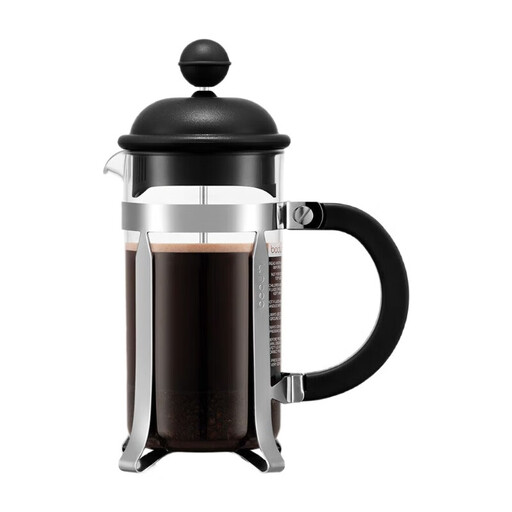
Why this choice suits this profile : Its compact size is ideal for one person or a smaller space, without requiring you to brew a large quantity of coffee every time.
With its 350 ml capacity, this coffee maker reduces the risk of choosing an oversized model. Its permanent filter also means you do not have to keep buying paper filters.
Borosilicate glass carafe, stainless steel plunger and stated capacity of 350 ml.
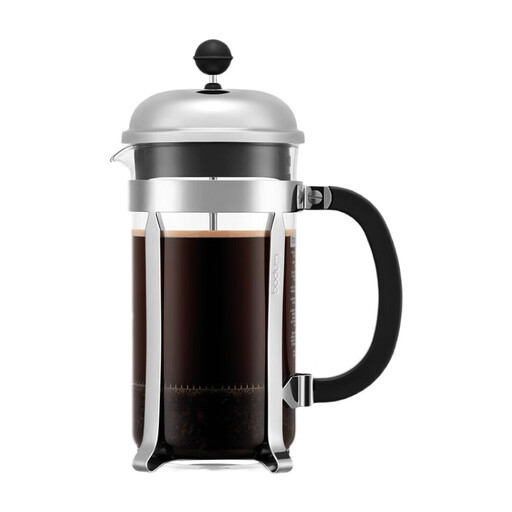
Why this choice suits this profile : Its one-litre capacity is ideal for family breakfasts or serving several guests, while its stainless steel frame provides added structural strength.
The clearly stated capacity reduces the risk of choosing the wrong size. The metal frame holds the carafe more securely than a simple lightweight support.
Borosilicate glass carafe, stainless steel frame and parts stated to be dishwasher-safe.
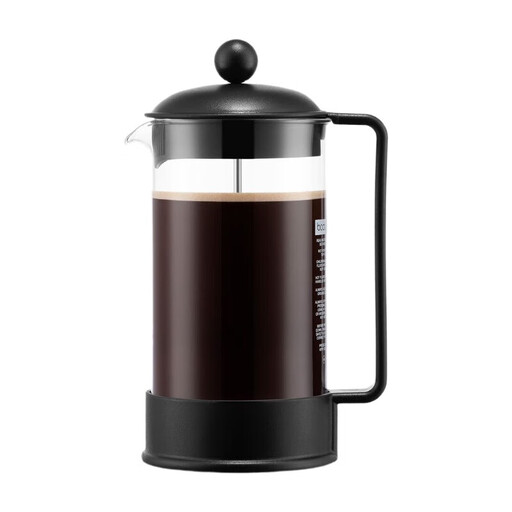
Why this choice suits this profile : Its generous capacity and manual operation are well suited to repeated brewing, whether at home or in the office.
Its dismantlable design makes it easier to rinse the filter after every use. The BPA-free plastic frame, separate from the glass carafe, also makes it easier to hold.
One-litre capacity, stainless steel filter and plunger, with cleaning stated to be suitable by hand or in the dishwasher.
The coffee maker is only part of the equipment you need. A measuring spoon or graduated cup helps you recreate a recipe consistently. For travelling, a 350 ml insulated travel mug, such as the Bodum Nomad, features a double stainless steel wall and vacuum insulation. However, it must be kept upright: the manufacturer specifies that it is not completely leakproof in every situation.
To prepare milk-based drinks from an espresso, a 400 or 500 ml stainless steel milk jug gives you better control over pouring. MHW-3BOMBER models feature a dual-channel spout and an ergonomic handle. A latte art milk jug or a barista milk frother can complete your set-up, but none of these accessories can replace an espresso machine equipped with a steam wand.
We have put together a complete, real-time updated list of products that meet these demanding selection criteria and European safety requirements.
Choose a coarse grind, similar to the one used for a French press coffee maker. A grind that is too fine passes more easily through the mesh and can make the plunger difficult to press down. Pour in the hot water, leave it to brew for around four minutes, then press down slowly.
It depends on how often it is used, how well it is maintained and how the carafe is handled. The plunger and filter can remain in good working order for a long time if they are rinsed after every brew. Glass, even borosilicate glass, must be replaced as soon as the slightest chip or crack appears.
It does not require capsules or paper filters. Ongoing costs are mainly limited to coffee and hot water. The reusable filter reduces consumables, but you still need to factor in cleaning and the possible replacement of the carafe when calculating the cost of use.