What should you check before choosing?
Start by considering how much frozen food you need to store and how often you’ll need to get it out. Then check that the type you’ve chosen is suitable for the conditions where it will be installed.
| Factor |
What to check |
What I need |
| Capacity and access |
Compare freezer capacity, access from the top of a chest freezer and the drawer layout of an upright model. Que Choisir distinguishes chest freezers by their storage capacity and upright freezers by their format. |
I store larger quantities and can organise a chest freezer using baskets, or I’d rather have drawers to find smaller portions quickly. |
| Available space |
Measure the width, depth and height, as well as the clearance needed to open the door. For an under-counter model, also check the space, ventilation and door fixing requirements in the manual. For a fridge freezer, check the freezer compartment capacity separately. |
I want the appliance to fit in its space, the door to open without obstruction and the freezer to have enough room for the food I need to store. |
| Room temperature |
Compare the room’s seasonal temperatures with the climate class or temperature range specified for the exact model. Electrolux recommends checking that the ambient temperature is suitable for the appliance’s climate class. |
My garage, cellar or pantry could get cold in winter or hot in summer, so I need to choose based on these extremes, not just the type of appliance. |
| Power cuts and monitoring |
Compare the stated power-cut storage time in hours on a like-for-like basis and, if needed, look for a door or temperature alarm. How long food stays frozen depends on the model, not just its type. |
If the appliance is in a room I don’t visit often, I want to know if the door has been left open and how long the food is stated to stay frozen. |
| Energy consumption |
Check the kWh/year on the energy label and compare appliances with similar capacities and formats. ADEME points out that fridges and freezers run continuously. |
I need extra storage, but I don’t want to choose a larger capacity or more features than necessary without comparing annual energy consumption. |
Appliances to consider on Joybuy
This selection includes a fridge freezer for increasing fresh food storage as well as freezer space, upright freezers for organising frozen food and two small chest freezers for extra capacity. Compare each model’s capacity with your needs, then check that the one you choose is suitable for its installation space.
 Image unavailable
Haier HTW5618ENMG, 3-door fridge freezer, 360 L
Worth considering if you want more space for both fresh and frozen food, rather than adding a separate freezer. The model name lists Total No Frost, an E rating, Wi-Fi and My Zone. Check the capacity of the freezer compartment and the ambient temperature range suitable for your room.
View on Joybuy
 Image unavailable
Heinrich´s, 161 L upright freezer, C rated
A freestanding appliance to consider if you want to keep your frozen food separate and prefer compartmentalised storage. The model name lists No Frost protection, an LED display, an alarm and an adjustable temperature range of −14 °C to −22 °C. Before deciding where to put it, check its dimensions, ambient temperature range, power-cut storage time and kWh/year.
View on Joybuy
 Image unavailable
COMFEE' RCU60WH2(E), 60 L upright freezer
This capacity is better suited to extra storage than to stocking up for a large family. The model name lists a reversible door, adjustable temperature and an E rating. Check the space needed for installation, the ambient temperature range and the defrosting requirements.
View on Joybuy
 Image unavailable
CHiQ JR99DWE, 99 L chest freezer
A small chest freezer to consider for extra storage if you have clear access from above. The model name lists a removable basket, adjustable thermostat and an E rating. Organising your food will make it easier to find items at the bottom. The model description states that it requires manual defrosting. Also check the ambient temperature range and stated power-cut storage time.
View on Joybuy
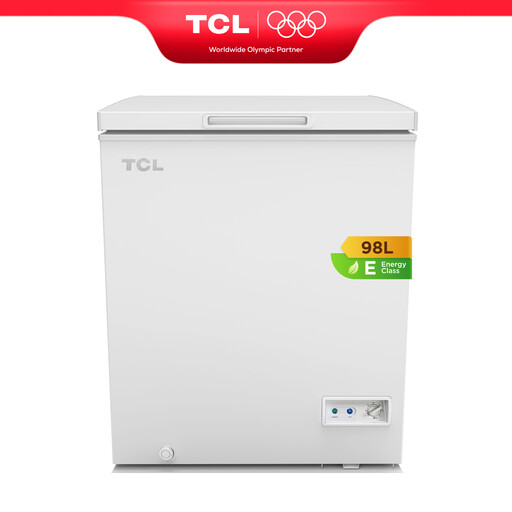 Image unavailable
TCL CF126EWE0FR, 98 L chest freezer
Worth considering for extra storage with easy access from above. The model name lists a storage basket, a counterbalanced lid, adjustable temperature and an E rating. Measure the clearance needed to open the lid, and check the ambient temperature range, power-cut storage time and kWh/year.
View on Joybuy
Frequently asked questions
Can you install any freezer in a garage?
No. Compare the garage’s minimum and maximum temperatures with the range specified in the model’s manual. Electrolux recommends checking that the appliance is suitable for its climate class. For example, Beko gives the CF200EWN an SN-T climate class for temperatures between 10 and 43 °C, so it’s not suitable for a room that drops below 10 °C.
Chest or upright freezer: what’s the difference day to day?
A chest freezer is a good option if you have floor space and want to store larger quantities, but you’ll need to organise the food you access from above. An upright freezer with drawers makes it easier to find different portions. However, check the size of the compartments and the usable capacity.
How do you compare appliances in the event of a power cut?
Check the stated storage time in hours in the product details or manual for each model, and compare figures measured on the same basis. Don’t assume how long food will stay frozen based on whether it’s a chest or upright model. If the appliance is in a room you don’t check often, also look for an alarm.
Should you check the energy rating or the kWh/year?
Check both, then use the kWh/year figure to compare appliances with similar capacities and formats. ADEME points out that cooling appliances run continuously, so annual energy consumption is an important factor when choosing the right capacity.
What should you measure before installing an under-counter freezer?
Measure the height, width and depth of the space, then check the manual for ventilation and door-fixing requirements. Also compare the capacity with the amount of food you plan to store. For example, Liebherr gives the SUFd 3603 Pure a capacity of 87 L and specifies a niche size of 82 to 88 × 60 × 56 cm.


