Households that prepare meals in advance
If you freeze portions or meals for several days, think about the size of your containers and how easy it will be to find each meal.


To store prepared meals and groceries for a large household, start by considering the space you have and how you like to access your food. A chest freezer is ideal for storing larger quantities, while an upright freezer makes it easier to organise food into compartments. An under-counter model is better suited to adding extra storage; a large fridge-freezer is only an alternative if its freezer compartment is big enough. Whichever type you choose, check the net freezer capacity, the clearance required and the ambient temperature range allowed for the intended location.
If you freeze portions or meals for several days, think about the size of your containers and how easy it will be to find each meal.
If you stock up on frozen food or do a big grocery shop, freezer capacity matters, as does the space the appliance will take up in your home.
Whether you’re putting it in a kitchen, utility room, cellar or garage, check the dimensions, how it opens and the permitted ambient temperature range for your chosen model before deciding on its capacity.
Start by working out how much freezer space you need, then make sure the design will be practical to open and organise in the room you have in mind. UFC-Que Choisir highlights capacity and access to food as key considerations when choosing between an upright and a chest freezer.
Consider it: if you need plenty of space for meals and groceries and have enough floor space and clearance above the appliance.
Bear in mind: food at the bottom can be harder to reach, so you’ll need to organise it carefully. Baskets can help keep different types of food separate.
Consider it: if you regularly take out portions and want to organise them in drawers or compartments.
Bear in mind: check the model’s capacity and make sure there’s enough room to open the door and pull the drawers all the way out.
Consider it: if limited height means you need this type of freezer and you’re only looking for extra storage.
Bear in mind: compare its freezer capacity with the number of portions you plan to store, rather than relying on its external dimensions alone.
Consider it: if you also need to replace or expand your fridge space.
Bear in mind: the total capacity won’t tell you how much room there is for frozen food. Compare the freezer compartment separately.
| Criteria | What to check | Who it matters to |
|---|---|---|
| Freezer capacity | Compare the net freezer capacity in litres and the freezing capacity in kg/24 h if you often add large quantities of unfrozen food. | To shop less often and keep several meals in reserve, I need enough space for the things I actually store. Around 31% of consumers would make capacity their top priority. |
| Storage and access | Try opening the appliance and removing the drawers or baskets. Check that there’s room for your largest containers. | When I regularly take out portions, I want to find them without moving everything else around. Around 31% of consumers would put ease of access first. |
| Location | Measure the route in, the space for the appliance and the clearance needed for opening and ventilation. Check the ambient temperature range for the exact model. | If the appliance has to fit in a small or unheated room, I need to be able to install and use it in the conditions specified for that model. Around 23% of consumers would prioritise this compatibility. |
| Everyday use | Compare kWh/year and noise levels between appliances of similar capacity. Check the stated power-cut storage time and any available alerts. | For an appliance that runs all the time, I consider its energy use and what happens if the power is interrupted. These factors would be a priority for around 15% of consumers. |
Food at the bottom of a large chest freezer can be harder to reach. An upright freezer makes it easier to organise everything, but you’ll also need enough room to open the door and remove the drawers where you plan to install it.
Measure your largest containers and think about where you’ll store the meals you use most often. For a chest freezer, use zones or baskets to make food easier to find.
Whether an appliance can be used in an unheated room depends on the specific model. Compatibility advertised for some Liebherr or Beko appliances doesn’t apply to every freezer from those brands.
Check the temperatures the room may reach, then compare them with the ambient temperature range listed in the product details and manual for the model you’re considering.
Two appliances with different capacities won’t necessarily meet the same storage needs. The European energy label also shows annual energy consumption and the capacity of the freezer compartments.
Compare kWh/year for appliances with similar capacities and designs, while making sure there’s enough usable space for your meals and groceries.
How long food stays frozen during a power cut and which alerts are available vary by model. These features are particularly worth considering if you keep a large stock of food or the appliance is far from your living areas.
Check the stated storage time during a power cut and, if it matters for your setup, whether the appliance has an open-door or high-temperature alarm.
These ranges offer a starting point for comparing designs and features. Check the details for the specific model you’re interested in.
Bosch’s range of upright freezers may suit households that want to store meals in easily accessible compartments.
Liebherr chest freezers are worth considering if you need plenty of storage and have enough room to open a lid from above.
Beko’s chest freezer range offers different capacities and layouts to compare across models.
These chest freezers offer different options for adding extra frozen storage. The AUCMA models featured can also be switched to fridge mode. When choosing a place to store meals, focus on net freezer capacity, the space available and installation requirements.
 Image unavailable
Worth considering if you want to stock up on meals and groceries in a chest freezer with a top-opening lid.
Stated capacity of 291 L, removable basket, built-in LED light and 5-setting digital control; fridge and freezer modes.
Check the net freezer capacity and the permitted ambient temperature range for the room where it will be kept.
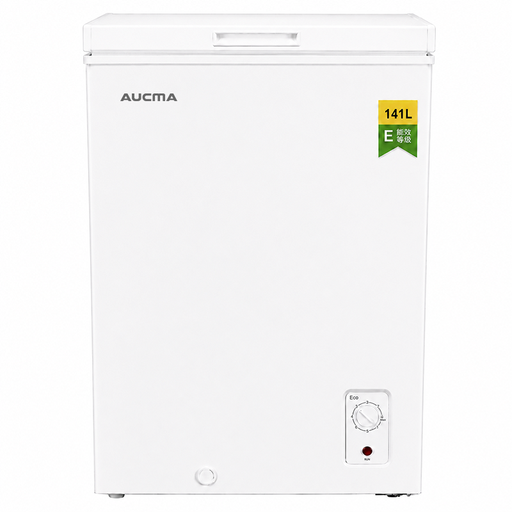 Image unavailable
Consider it if you want extra storage with the option to switch to fridge mode.
Stated capacity of 141 L, removable basket, 7-setting thermostat and a defrost drain.
Compare the net freezer capacity with your needs and check the permitted ambient temperature before choosing where to put it.
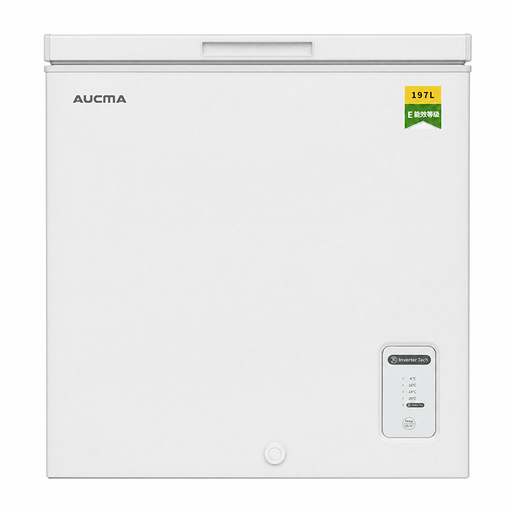 Image unavailable
Worth considering if you want a chest freezer for prepared meals and bulk shopping, with two operating modes.
Stated capacity of 197 L, removable basket, 5-setting digital control and fridge and freezer modes.
Check the net freezer capacity and the ambient temperature range for your room.
 Image unavailable
Consider it for extra storage when space is limited.
Stated capacity of 99 L, removable basket, adjustable thermostat and sliding lid.
Allow for manual defrosting and check the net capacity and permitted ambient temperature range.
 Image unavailable
Consider it if you need extra storage rather than a large freezer for the whole family.
Stated capacity of 95 L, removable basket, 7-setting control and fridge and freezer modes.
Check that the net freezer capacity is enough for your portions and that the permitted ambient temperature range suits the chosen location.
Check their European energy labels. These show, among other details, the capacity of the freezer compartments, annual energy consumption in kWh, energy efficiency class and noise level. According to the European Commission, the QR code on the label links to information about the model in EPREL. For a fridge-freezer, check the freezer compartment rather than the total capacity.
No. The ambient temperature range specified for the model must cover the conditions in your garage. Some Liebherr and Beko appliances are advertised as suitable for temperatures as low as −15 °C, but this applies only to the models concerned. Check the product details and manual for the one you’re considering.
Measure the route the appliance will take during delivery, the space where it will go and the clearance needed to open the lid or door. Allow for the ventilation clearances specified in the manual. For an upright freezer, also check that the drawers can be pulled all the way out.
Check the defrosting system on the model you’ve chosen and the maintenance instructions in its manual. Bosch says that No Frost on some models removes the need for manual defrosting. Other appliances, including chest freezers that need defrosting by hand, require you to plan for this task.