Households building up a large stock
If you buy in bulk, batch-cook or store bulky food, start by working out how much freezer space you need. The layout matters too: a large chest and a set of drawers won’t hold food in the same way.


If you’re building up a large stock of frozen food, choose a chest freezer if capacity and bulky items are your priorities, or an upright freezer if you often take out different portions and want to find them easily. A large fridge-freezer is better suited to replacing your main fridge as well: check the capacity of its freezer compartment alone before deciding against a separate appliance. For each option, consider the space available, room temperature, stated power-cut storage time and annual energy consumption.
If you buy in bulk, batch-cook or store bulky food, start by working out how much freezer space you need. The layout matters too: a large chest and a set of drawers won’t hold food in the same way.
If you regularly take out meals, vegetables or individual portions, ease of access and organisation may matter more than maximum capacity. Darty points out that food stored at the bottom of a chest freezer can be harder to reach.
A cellar, utility room or garage may offer the space you need, but the room temperature must fall within the range specified for the model. Whirlpool explains that this information is included in the appliance’s climate class.
First decide whether you’re adding extra freezer space or replacing your fridge as well. Then compare how you’ll store and take out your food.
Worth considering: if you need extra capacity and space for bulky items in a freezer you can load from the top.
Bear in mind: food at the bottom is harder to reach, as Darty notes.
Worth considering: if you open the appliance often and want to organise food in drawers.
Bear in mind: the compartments may make it harder to store very bulky items.
Worth considering: if you also need to replace your main fridge and its freezer compartment offers enough space for your stock.
Bear in mind: the stated total capacity includes the fridge section too.
| Factor | What to check | Who should consider it? |
|---|---|---|
| Storage capacity | Compare freezer capacity in litres, then check the space available for large packs. With a fridge-freezer, distinguish freezer capacity from the total capacity. | When bulk buys or prepared meals start to pile up, I want to store them without adding several appliances. Around 31 % of consumers prioritise this extra storage capacity. |
| Access to food | Look at the drawers or baskets and consider how easy it is to retrieve food stored at the bottom. | If I take out different portions every day, I want to find them without rummaging through the whole freezer. Ease of daily access is the top priority for around 25 % of consumers. |
| Installation location | Compare the room temperature with the range specified for the model, and measure the space needed to open the door or lid. | In a cellar, utility room or garage, I need to know whether the appliance can cope with the actual room temperature. This compatibility comes before other factors for around 25 % of consumers. |
| Energy use and power cuts | Compare kWh/year for similar capacities and check the stated storage time during a power cut separately. | With an appliance that runs continuously and food supplies to protect, I keep an eye on both electricity use and storage time during a power cut. Around 19 % of consumers put these considerations first. |
Its large compartment can hold bulky items, but access becomes less straightforward when food is stacked up. Darty highlights the difficulty of reaching products stored at the bottom.
Keep frequently used food in the baskets and organise the rest by type or date. If you often take out a variety of items, consider an upright freezer with drawers too.
Whether an appliance can operate in a cold or warm room depends on the model, not its format. Beko, for example, states that its HSM14540 can operate at ambient temperatures as low as −15 °C; this does not apply to the whole range.
Check the room’s minimum and maximum temperatures, then compare them with the climate class and instructions for the appliance you’re considering.
The rating alone doesn’t tell you the annual energy consumption or how much food you’ll be able to store. ADEME points out that a freezer runs continuously, so it’s worth paying close attention to its kWh/year figure.
Compare kWh/year for models with capacities suited to your needs, then check power-cut storage time and defrosting type separately.
Total capacity combines the fridge and freezer sections. For these specific models, Whirlpool lists a total capacity of 355 L, including a 106 L freezer, for the WHK 26404 XP7E, and 404 L for its WHFF 6403 W4E upright freezer.
Before replacing your main fridge, compare your storage needs with the capacity of the fridge-freezer’s freezer compartment alone.
Beko’s range in France includes upright and chest freezers, which you can compare based on your preferred layout and where you plan to install the appliance.
The range lets you compare both upright freezers and large freestanding fridge-freezers.
Liebherr offers chest freezers for storing extra supplies, with features that vary by model.
Haier’s French catalogue includes upright and chest freezers, offering several storage layouts to compare.
These products show three ways to add freezer space: an upright model for organised storage, two chest freezers with different capacities, and a fridge-freezer to consider if you also need to replace your fridge. If you’re looking for substantial extra storage, check carefully whether the capacity of the model you’re considering suits your usual shopping and storage habits.
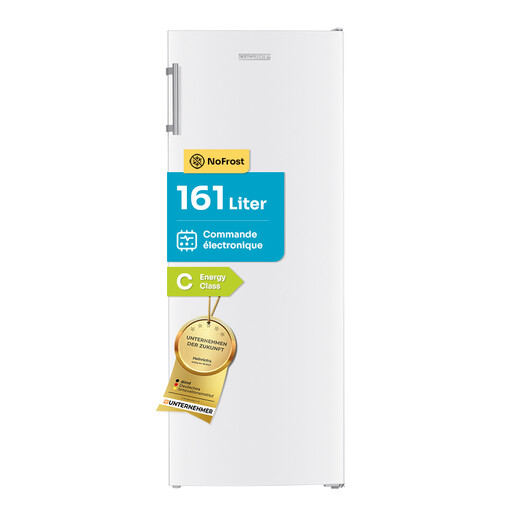 Image unavailable
Worth considering if you’d rather organise frozen food separately than stack it in a chest freezer. The product name lists three drawers, No Frost technology, an LED display and an alarm.
If you’re looking for a very large freezer, check whether 161 L will be enough. If you plan to install it outside the kitchen, also check its dimensions and ambient temperature range. Compare kWh/year and power-cut storage time before looking at other models.
 Image unavailable
An option for adding separate freezer space if a top-opening lid suits you. The product name mentions a storage basket, counterbalanced lid, temperature control and an E energy rating.
The basket won’t give you direct access to everything in the compartment, so think about how you’ll organise food underneath it. If the appliance is going in an unheated room, check its kWh/year, power-cut storage time and ambient temperature range.
 Image unavailable
Worth considering if you need to replace your main fridge while reviewing how much frozen food you keep in stock. The stated capacity of 467 L is for the whole appliance; the product name also mentions Total No Frost and an E energy rating.
This fridge-freezer won’t automatically replace a large separate freezer. Check the capacity of its freezer compartment and its dimensions before deciding whether one appliance will be enough.
 Image unavailable
Worth considering if you’re after a small chest freezer rather than a large one. The product name lists a fridge-to-freezer conversion function, a removable basket, a seven-level thermostat and an E energy rating.
The 95 L capacity may limit bulk shopping or storing lots of prepared meals. If you plan to put it in a cellar or garage, check the model’s ambient temperature range and its power-cut storage time.
No. Installation depends on the ambient temperature range specified for the model. Check its climate class on the rating plate, product details or in the manual, then compare it with the room temperature. Beko states that the HSM14540 can operate at temperatures as low as −15 °C, but this doesn’t apply to other models.
An upright freezer with drawers makes it easier to organise food and take out different portions. If you prefer a chest freezer for its loading capacity, organise food in the baskets and keep an eye on items at the bottom, which Darty says are harder to reach.
Check the kWh/year figures for each model, ideally comparing appliances with freezer capacities suited to similar needs. The energy-efficiency rating adds to the comparison but doesn’t replace the annual consumption figure. ADEME points out that a freezer runs continuously.
Yes. The French Ministry for the Ecological Transition lists freezers among the refrigeration appliances that must carry an energy label. Check the label for your chosen model to see its rating and annual energy consumption.