What should you compare?
Start by considering how much food you want to freeze and how often you’ll need to take it out. Then see how each format fits the space you have in mind.
| Consideration | What to check | Your needs |
|---|
| Freezer capacity |
Compare the litres allocated to freezing, rather than just the total capacity of a fridge freezer. According to UFC-Que Choisir, chest freezers can hold up to 600 litres, while upright models generally have a capacity of around 200 litres. Check the capacity of the specific model you’re considering. |
I want to store more meals and frozen food than a small compartment can hold, without choosing an appliance that still doesn’t offer enough freezer space. |
| Access to food |
Look at the drawers in an upright freezer or fridge freezer, and any baskets in a chest freezer. Check that the door, drawers or lid can open fully in the space you have available. |
For portions I use often, I’d prefer to be able to organise them and find them easily. For larger containers, I might prefer a more open compartment. |
| Space and installation |
Measure the floor space, height, access routes and clearances specified in the instructions. An under-counter model can work well when height is restricted, but make sure its capacity is still enough for what you need to store. |
In a small kitchen, I need to work out whether there’s room for a second appliance that will still be easy to access, or whether a fridge freezer would better meet both needs. |
| Room temperature |
Compare the minimum and maximum room temperatures with the range permitted in the instructions. Bosch gives a range of 10 to 43 °C for climate class SN-T, but this class alone won’t cover a colder cellar. |
If I need to put my freezer in a garage or unheated utility room, I’ll check that it’s suitable for that specific location. |
| Everyday use and power cuts |
Check the energy label for energy consumption, capacity and noise emissions, then look at the model’s storage time during a power cut and any alarms it may have. UFC-Que Choisir assesses how well freezers maintain their temperature during a power cut in its tests. |
If the appliance is near a living area, noise matters to me. For storing meals, I also want to know how long it’s designed to keep food frozen for. |
Appliances for different storage needs
This selection from Joybuy includes fridge freezers, chest freezers and an upright freezer. Compare them based on the space you have, the freezer capacity you need and how you prefer to access your meals.
 Image unavailable
Haier HTW5618ENMG, 3-door fridge freezer, 360 L
Worth considering if you’d like to combine fridge and freezer storage in one appliance. The model name lists a total capacity of 360 L and Total No Frost technology. Compare the freezer compartment capacity separately with what you need to store. Check the dimensions, clearances and permitted room temperature before installation.
View on Joybuy
 Image unavailable
CHiQ JR99DWE, 99 L chest freezer
This 99 L chest freezer provides dedicated freezer space, and its removable basket can help keep smaller items within easy reach. Check how much room you’ll need to access the contents from above, as well as the permitted room temperature range and the storage time during a power cut in the instructions.
View on Joybuy
 Image unavailable
CHiQ JR263LGE, 262 L Low Frost fridge freezer
Its stated width of 54 cm could be useful if kitchen space is limited. The 262 L figure is the stated capacity for the whole appliance, so check whether the freezer section has enough room for your portions. The product information advises against using this model in a garage or cold outbuilding. Check the permitted room temperature range before deciding where to put it.
View on Joybuy
 Image unavailable
Heinrich´s, 161 L No Frost upright freezer
An upright model is worth considering if you want to organise meals and access them regularly. The product name lists a capacity of 161 L and No Frost technology. Check the interior layout, installation dimensions, permitted room temperature range and storage time during a power cut for this specific model.
View on Joybuy
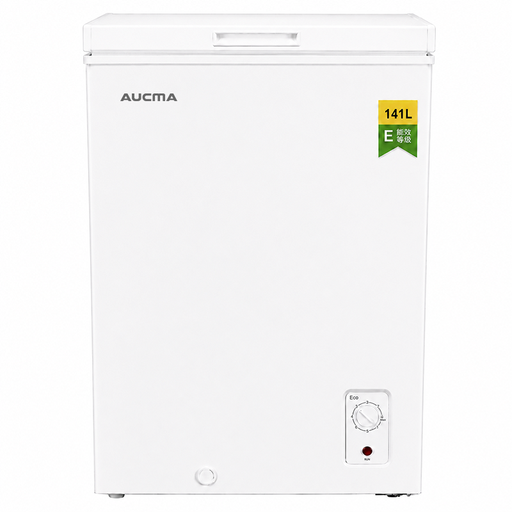 Image unavailable
AUCMA, 141 L convertible chest freezer
This 141 L chest freezer is described as convertible between fridge and freezer modes. Check that it’s set to the mode you need before storing frozen food. Its removable basket isn’t a substitute for drawer storage, so check access from above, the permitted room temperature range and the storage time during a power cut, especially if you plan to install it in a garage.
View on Joybuy
Frequently asked questions
Can you put a freezer in an unheated cellar or garage?
Yes, as long as the room temperature stays within the range permitted for the model. Bosch gives a range of 10 to 43 °C for climate class SN-T, so this won’t be suitable for a room that drops below 10 °C. Some Beko ranges and certain Liebherr models are stated to work at lower temperatures, but always check the instructions for the specific model.
Can a large fridge freezer replace a separate freezer?
Yes, if its freezer compartment has enough room for your meals and frozen food. Compare the freezer capacity separately from the total capacity, and check that the layout suits how often you need to access it. If you need more storage, it may be worth considering an upright or chest freezer.
What should you compare on the energy label?
Check the stated energy consumption, compartment capacity and noise emissions. The European Commission explains that this information appears on the energy labels for refrigeration appliances. To make a useful comparison, look at appliances with a similar type and capacity rather than focusing only on their energy class.
How should you store frozen prepared meals?
Anses states that home freezing at -18 °C stops bacteria multiplying, but does not eliminate most micro-organisms. Freeze meals as soon as they’re prepared, defrost them according to its recommendations and don’t refreeze food once it has defrosted.
Do you need No Frost when choosing a freezer?
No. This feature is worth considering if you want to reduce frost build-up and avoid manual defrosting, as manufacturers describe for the models that include it. Also compare freezer capacity, energy consumption, noise and suitability for the room where you plan to install it.


