For easy access to each portion
If you cook several recipes for the week, separate drawers or baskets can help you reach a dish without moving the rest of your food. Just check that your containers will fit in each compartment.


If you prepare several portions and want to find each dish quickly, an upright freezer with drawers is worth considering. A chest freezer is better suited to storing large batches, provided you have enough floor space and can keep its contents organised. For just a few portions, the freezer compartment in a fridge freezer or a small freezer may be enough. Before choosing, compare the usable freezer capacity, the space needed for installation and the dimensions of your containers.
When you’re preparing meals ahead, the most useful format depends as much on how you’ll retrieve each portion as on how much you need to store. UFC-Que Choisir distinguishes between upright freezers, chest freezers and compact models, particularly in terms of the space they take up and how they’re organised.
If you cook several recipes for the week, separate drawers or baskets can help you reach a dish without moving the rest of your food. Just check that your containers will fit in each compartment.
If you also prepare ingredients in bulk or use large containers, a chest freezer’s open storage space gives you a different way to load your food. Plan to use baskets or another system to help you find portions stored at the bottom.
If you only store a few portions, consider the freezer compartment in a fridge freezer or an under-counter model. The appliance’s total capacity won’t tell you how much space is available in the freezer section, so check its volume and drawer sizes separately.
Start by thinking about how you’ll use the freezer: taking out a meal each day, storing large batches or fitting the appliance into a specific space. The stated capacity doesn’t replace checking whether your containers will fit and how easily you can reach your food.
| What to consider | What to check | Who it matters to |
|---|---|---|
| Access to portions | The internal dimensions of drawers or baskets, and access to each level. | When I prepare several meals for the week, I want to take out the right container without undoing all my careful organising. Around 36% of consumers would prioritise access to and organisation of portions. |
| Capacity for batches | The capacity of the freezer compartment alone and the space available for larger containers. | If I’m freezing large dishes and ingredients as well as individual portions, I need to be able to fit everything in without stacking containers on top of each other. Capacity would be the main concern for around 29% of consumers. |
| Location | The appliance’s dimensions, how far the door or lid opens, and the ambient temperature range specified for the model. | If the appliance needs to fit under a worktop or in a utility room, I can’t choose based on capacity alone. Around 21% of consumers would prioritise whether it’s suitable for the intended location. |
| Everyday use | Energy consumption in kWh/year for a similar capacity, the defrosting method and the stated storage time in the event of a power cut. | When I’m storing a supply of meals, I want to consider the maintenance involved and know how long the food will stay frozen if the power goes out. These features would be the priority for around 14% of consumers. |
A large compartment doesn’t necessarily make small portions easier to reach, while drawers may make it difficult to store a wide dish.
Measure the containers you usually use, then compare their dimensions with the drawers, baskets or storage areas in the model you’re considering.
The temperature in a utility room or garage may fall outside the appliance’s specified operating range. A model designed for use in cold spaces isn’t necessarily suitable for every other model.
Check the climate class and the manual for the exact model before deciding where to put it.
Energy rating alone doesn’t tell you how much usable space you’ll have or what each appliance’s stated annual energy consumption is.
For models with a similar format and capacity, also compare the kWh/year figure and freezer capacity shown on the label. The European Commission lists these among the details provided for refrigeration appliances.
The cooling system and storage time during a power cut answer two different questions. For example, the Whirlpool model specifications cited in the research give different storage times for different models.
Check the defrosting method, storage time in hours and any alarms separately on the specification sheet for the model you choose.
The range includes freestanding and integrated upright freezers, worth considering if organising portions is a priority.
The range lets you compare compact integrated appliances with upright and chest freezers.
The range includes chest and upright freezers, with some models designed for specific installation conditions.
The range of upright and integrated appliances includes models with different storage layouts and power-cut storage times.
These Joybuy appliances illustrate three options for storing prepared meals: a fridge freezer compartment, a dedicated upright freezer and a chest freezer. To compare them, consider how each one suits the number of portions you need to store and the space available.
 Image unavailable
Worth considering if you’d rather store your portions in a fridge freezer than in a dedicated appliance. The 360 L figure is the total capacity, so check the space available in the freezer compartment and the dimensions of your containers separately.
The model name specifies Total No Frost and an energy rating of E.
 Image unavailable
Worth considering if your kitchen has space for an integrated appliance and you only need to freeze a limited number of portions. Check the freezer compartment’s capacity, the dimensions of the housing and the ventilation requirements in the manual.
The model is listed with TwinTech No Frost and an energy rating of E; its 249 L capacity is for the fridge freezer as a whole.
 Image unavailable
Worth considering if you want a dedicated appliance to keep your prepared meals separate. Before buying, check the external dimensions, how far the door opens and how much internal space is available for your containers.
The product name specifies 161 L, No-Frost and an energy rating of C.
 Image unavailable
Worth considering if you store large batches and have enough room to open the lid. Its removable basket can hold some of your food, but you’ll also need a system for organising items at the bottom of the freezer.
The product is described as convertible between fridge and freezer modes, with an energy rating of E. If you plan to install it in a garage, check the ambient temperature range allowed for this model.
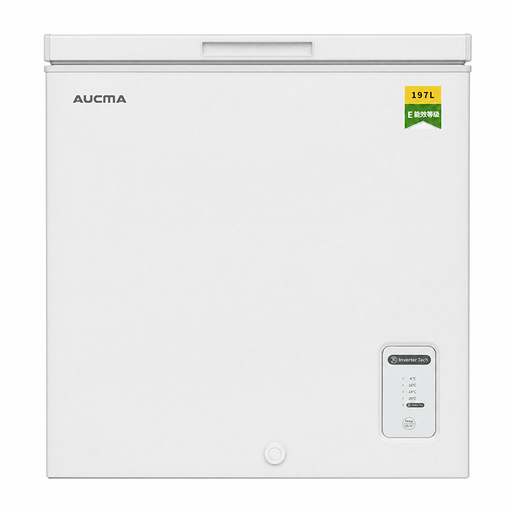 Image unavailable
Compare it with the 291 L chest freezer if you want to store portions in a freezer with a lower stated capacity. Still, measure the space you have and your containers: the removable basket won’t give you direct access to everything at the bottom.
This model is described as convertible between fridge and freezer modes, with an energy rating of E. Check its operating range before choosing a utility room or other outbuilding.
Start with the number and size of containers you want to freeze at once, rather than relying on a single capacity figure that’s meant to suit everyone. Measure your largest dish too. In a fridge freezer, compare the freezer compartment’s capacity, not the capacity of the whole appliance.
The format alone doesn’t tell you whether a chest freezer will keep food better. Compare the specifications of the exact model, including its stated storage time during a power cut and its operating conditions. Chest freezers are mainly suited to storing large batches, while the drawers in an upright freezer make portions easier to reach.
Yes, if the model’s specified ambient temperature range covers the conditions in your garage and you can follow its installation instructions. Check the climate class and the manual: a model’s stated suitability for a cold room doesn’t apply to every freezer.
Compare the energy rating and annual consumption in kWh/year for appliances with a similar function and capacity. The European Commission says that the label for refrigeration appliances also gives their capacity and noise level. These details help you put energy consumption in context when making your choice.
No. NoFrost relates to frost management, not cleaning or other care requirements. Check the model’s manual. For an appliance that builds up frost, Electrolux recommends following the appropriate defrosting procedure rather than using a sharp object.