Households running out of space in their fridge-freezer
If you’re buying more frozen food or batch-cooking, compare the freezer capacity of a new fridge-freezer with your usual stock before considering a second appliance.


If the freezer compartment in a fridge-freezer is big enough for your usual shop, replacing your main appliance could save you from needing a second one. For larger stocks, consider an upright freezer if easy access to food in drawers matters most, or a chest freezer if you have enough floor space and can organise its contents. Whichever you choose, compare freezer capacity, dimensions, the stated power-cut storage time and the installation requirements for the specific model.
If you’re buying more frozen food or batch-cooking, compare the freezer capacity of a new fridge-freezer with your usual stock before considering a second appliance.
A chest freezer is worth considering if you have enough floor space and are happy to organise your food so you can reach items at the bottom.
If the appliance will be in a warm kitchen, garage or unheated room, check its permitted ambient temperature range. If power cuts are a concern, also compare the stated storage time for the exact model.
Consider it if: you’re already replacing your main fridge and its freezer compartment can hold your usual shop.
The trade-off: the total capacity of a fridge-freezer includes the fridge section too, so it doesn’t tell you how much space is available for frozen food on its own.
Consider it if: you want a separate appliance with drawers that make it easy to organise food and access it from the front.
The trade-off: measure the available height and check that the drawers can fit your bulkiest packaging.
Consider it if: you store large quantities or bulky packs and have a suitable spot on the floor.
The trade-off: the lid opens upwards, so you’ll need to plan how to reach food stored at the bottom.
| What to consider | What to check | What I need |
|---|---|---|
| Freezer capacity | Compare the capacity of the freezer compartments in litres, separately from fridge capacity, using the information on the energy label as presented by the European Commission. Also measure the space available and the clearance required. | My frozen food needs to fit in the dedicated freezer section, not just in an appliance with a large total capacity. |
| Storage and access | Check the drawers and large compartments in an upright freezer, or the baskets and access to the bottom of a chest freezer. Make sure there’s enough room to open the door or lid. | I want to find the portions I use often easily, while still having room for larger packs. |
| Power cuts | Compare the stated storage time for each model and check the conditions it applies to. UFC-Que Choisir assesses how well appliances maintain their temperature separately during a simulated power cut. | If there’s a power cut, I need to know the stated storage time for the appliance I’m considering, without treating it as a guarantee for every situation. |
| Energy use and maintenance | Compare annual energy use in kWh and noise levels between appliances of a similar type and capacity. Check the model’s defrosting system. | In a living area, noise matters just as much to me as energy use and routine maintenance. |
| Installation location | Check the instructions for the permitted ambient temperature range for the exact model, as well as its dimensions and required clearances. | A garage or unheated utility room is only suitable if the appliance’s operating conditions match the temperature in that room. |
Some of that capacity is taken up by the fridge section. To work out how much space you’ll have for frozen food, compare the capacity of the freezer compartments.
Note the capacity in litres for each model, then compare it with the amount you usually store.
A chest freezer needs floor space and room to open the lid; food stored at the bottom can be harder to reach.
Measure the space, the lid clearance and the access route needed for delivery. Plan to use baskets or organise food into categories.
Whether an appliance will work in a cold room depends on the model, not simply on whether it’s a chest or upright freezer. Liebherr states that FrostProtect works down to -15 °C for its CFe 1870 Pure, but this doesn’t apply to other models.
Check the permitted ambient temperature range in the manual for the model you’re considering before deciding where to put it.
These details don’t replace checking freezer capacity, noise levels, stated storage time and how easy it is to access your food.
Compare these points separately across your shortlisted models, then check their dimensions and internal layout.
These examples of ranges and models can help you identify features to compare; they don’t represent every appliance made by each brand.
A useful reference for looking at upright freezers and their vertical storage layout.
A useful reference for comparing chest freezers when capacity and installation location matter.
A useful reference for exploring different designs that combine fridge and freezer storage in one appliance.
This selection includes fridge-freezers, an upright freezer and chest freezers. Compare their features based on how much frozen food you need to store and how much space you have.
 Image unavailable
A single appliance combining fridge and freezer storage. The model name indicates a capacity of 360 L and Total No Frost; compare the space reserved for frozen food separately and check that the dimensions suit your available space.
 Image unavailable
A way to add freezer space that’s easy to access from the front. The product title states a capacity of 161 L, three drawers, No Frost and an energy rating of C. Check the dimensions and permitted ambient temperature before choosing a spot for it.
 Image unavailable
Worth considering if you want a chest freezer that can switch between fridge and freezer modes. The product title states a capacity of 291 L, a removable basket and an energy rating of E; check the usable capacity in your chosen mode, access from above and installation requirements.
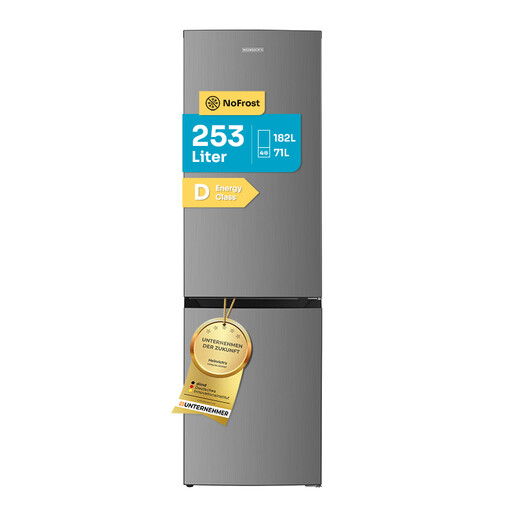 Image unavailable
A replacement for your main appliance that still has a separate freezer compartment. The product title splits the 253 L capacity into 182 L of fridge space and 71 L of freezer space, and mentions large drawers and No Frost. Compare the 71 L capacity with your usual stock.
 Image unavailable
A way to add 140 L of chest freezer space for frozen food. The product title mentions a basket, a counterbalanced lid and an energy rating of E. Measure the available floor space and the clearance needed to open the lid.
Compare the capacity of the freezer compartments in litres, rather than looking at the total capacity alone. The European Commission distinguishes freezer capacity from other capacities in the energy label information for the appliances concerned.
It gives the stated time a model can maintain its temperature, which you should read alongside the conditions used to measure it. UFC-Que Choisir’s testing protocols assess how long it takes to reach -9 °C during a simulated power cut. If you look at test results, compare those obtained using a similar method.
No. Check the permitted ambient temperature range in the manual for the exact model. Liebherr states that FrostProtect works down to -15 °C for its CFe 1870 Pure chest freezer, but this feature doesn’t automatically apply to other appliances.
For the household appliances concerned, look at the energy rating, annual energy use, capacity and noise level. The European Commission also describes EPREL as a database of information declared for models sold in the European Union.
Not necessarily. Its storage space can be useful for bulky packs, but you’ll need room for it on the floor and a way to reach food at the bottom. If you often take out small portions, also compare how easy it is to access food in an upright freezer’s drawers.