Which format is right for you?
The amount you need to store isn’t the only factor: the space you have available and how easily you can find your food matter too.
Households whose fridge-freezer is often full
If frozen food and prepared portions regularly fill the entire compartment, compare its freezer capacity with that of a separate appliance. Also think about how often you need to access your food reserves.
Households with a pantry, garage or cellar
A chest or upright freezer can free up space in your kitchen, provided the room temperature, ventilation and clearances meet the requirements in the chosen model’s manual. Not all appliances are suitable for use in cold rooms.
People with limited space at home
An under-counter model can provide extra capacity without taking up space for a large upright freezer. Check that it has enough capacity for the food you plan to store and that the space allows for the required door opening and ventilation.
What should you compare?
Start with the capacity available for freezing, then consider how each format fits your space and the way you like to organise your food.
| Criteria | What to check | Your needs |
|---|
| Freezer capacity |
Compare the freezer’s usable capacity, not just the total capacity of a fridge-freezer. If you regularly freeze fresh food, also check its freezing capacity in kg/24 h. |
Is my current compartment still big enough for frozen food and the portions I want to keep? |
| Access and space |
Check the drawers or baskets, external dimensions, access routes, how the door or lid opens, and the required ventilation clearances. |
I want to find my portions easily. If I choose a chest freezer, do I have enough floor space and a practical way to organise food at the bottom? |
| Room temperature |
Check the manual for the permitted ambient temperature range for the exact model, especially if it will be in a garage or cellar. |
Could the room where I plan to install the appliance get colder than the range specified by its manufacturer? |
| Power cuts |
Compare the stated storage time in hours and, if this is a deciding factor, test results obtained using the same method. UFC-Que Choisir, for example, measures how long the temperature takes to rise from −17 °C to −9 °C without power. |
I have a lot of food in storage and want to know how the model I’m considering will perform during a power cut. |
| Energy use and maintenance |
Check the annual energy consumption in kWh on the energy label and compare appliances of a similar type and capacity. Also check the stated noise level and defrosting method. |
Noise matters to me if the appliance is near living areas; I also want to know whether it needs manual defrosting. |
A guide to the brands
These model examples can help you identify which features to compare; they don’t represent every model in each range.
Bosch
A brand to consider for an under-counter freezer. Bosch lists a usable capacity of 83 l and a 16-hour storage time during a power cut for the GTV15NWEB.
- The GTV15NWEB’s specifications make it easy to compare its capacity with your needs for extra storage.
- Check the dimensions and installation requirements separately for any other Bosch model you’re considering.
Liebherr
The brand offers, among other options, large-capacity chest freezers. Its specifications for the CFe 2500 Pure list a capacity of 497 l and FrostProtect down to −15 °C.
- The CFe 2500 Pure is a specific example to compare with your available floor space: its stated dimensions are 82 × 167 × 71 cm.
- The stated temperature range for this model doesn’t automatically apply to other Liebherr freezers.
Whirlpool
Whirlpool France’s product specifications let you compare different interior layouts: the W3RHS19DW chest freezer has two baskets, while the WHFF 6403 W4E upright freezer has six drawers.
- Whirlpool lists a capacity of 404 l and energy consumption of 292 kWh/year for the WHFF 6403 W4E. Consider both figures when comparing upright freezers of a similar capacity.
- The basket or drawer count and energy consumption quoted apply only to the models mentioned.
Beko
For an unheated room, some Beko product specifications state the minimum ambient operating temperature.
- Beko says the B3RMFNE314W is suitable for temperatures down to −15 °C; the BRFNE157E20W specifications also list −15 °C as the minimum ambient temperature.
- These details don’t remove the need to check the manual and other installation requirements for the model you choose.
Options available on Joybuy
This selection includes a fridge-freezer to consider if you’d prefer a single appliance, an upright freezer with drawers to keep food organised, and chest freezers in a range of capacities for extra storage.
 Image unavailable
Haier HTW5618ENMG, 360 l three-door fridge-freezer
Worth comparing if you want to replace your fridge and freezer without adding a second appliance. The model name indicates a total capacity of 360 l, Total No Frost technology and an E energy rating. Check the freezer’s own capacity to see how much room there is for frozen food.
View on Joybuy
 Image unavailable
AUCMA, 291 l convertible chest freezer
This chest freezer is suited to a household with enough floor space for larger quantities of food. The product name lists fridge or freezer modes, a removable basket, LED lighting and an E energy rating. If you’re putting it in a cellar or garage, check the permitted ambient temperature range and allow for the ventilation clearance specified for this model.
View on Joybuy
 Image unavailable
Heinrich´s, 161 l No Frost upright freezer
An upright freezer to consider if you want to organise your food reserves across several storage spaces. The product name lists three freezer drawers, an LED display, an alarm and a C energy rating. Measure the space and check the required clearances before installation.
View on Joybuy
 Image unavailable
CHiQ JR99DWE, 99 l chest freezer
This smaller chest freezer is better suited to extra storage than to keeping very large quantities. The product name lists a removable basket, sliding lid and an E energy rating. Allow for the lid opening and the required ventilation clearance; this model needs to be defrosted manually.
View on Joybuy
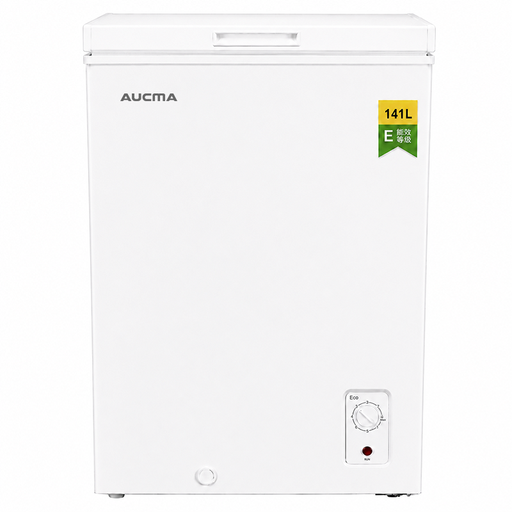 Image unavailable
AUCMA, 141 l convertible chest freezer
This chest freezer offers a mid-sized option for extra storage. The product name lists convertible fridge or freezer operation, a seven-setting thermostat, a removable basket and an E energy rating. If you plan to use it in a cold room, confirm the model’s operating requirements before choosing where to put it.
View on Joybuy
Frequently asked questions
When should you add a separate freezer instead of choosing a larger fridge-freezer?
Consider a separate appliance if the freezer compartment in your fridge-freezer is regularly too small for your food reserves. If you’re also replacing your fridge, compare the capacity set aside for freezing in each option, rather than just the total capacity. For example, the specifications for a 249 l Electrolux fridge-freezer list 62 l for its freezer.
Can you always put a chest freezer in a garage or cellar?
No: the permitted ambient temperature depends on the model, not its shape. Liebherr states that its CFe 2500 Pure chest freezer has FrostProtect down to −15 °C, while Beko also lists suitability down to −15 °C for some upright freezers. Check the operating range and installation instructions for the appliance you’re considering.
Does No Frost mean there’s no maintenance at all?
No. No Frost technology is designed to limit ice build-up and manual defrosting, but it doesn’t replace cleaning or following the ventilation instructions. Follow the model’s manual for maintenance.
What should you check if you’re concerned about power cuts?
Compare the stated storage time for each freezer. If this is important for your food reserves, also look for test results based on a clearly explained method. UFC-Que Choisir, for example, measures how long the temperature takes to rise from −17 °C to −9 °C without power. Without further information, this shouldn’t be treated as a universal estimate of how long food will stay safe to eat.
How can you use the energy label to compare two freezers?
Look at the annual energy consumption in kWh alongside the freezer capacity, and, ideally, compare appliances of a similar type and capacity. As the European Your Europe portal explains, the label helps you compare how much energy appliances use; the rating letter alone doesn’t tell you how much space you’ll have for your food reserves.


