Households with home-grown produce or bulk buys
You need space for fruit, vegetables or items bought in bulk. A chest freezer could suit your needs if you have enough floor space and are happy to organise its contents.


Choose a format based on what you need to store most and how often you need to find food: a chest freezer suits larger batches, while an upright makes portions easier to reach. A small freezer is better as an extra, while a fridge-freezer may be enough if you’re replacing your fridge too and its freezer compartment meets your needs. Then check the available space, the ambient temperature range, how long it can keep food frozen during a power cut and the specific features of the model.
You need space for fruit, vegetables or items bought in bulk. A chest freezer could suit your needs if you have enough floor space and are happy to organise its contents.
You open the freezer often to grab a prepared meal or a particular ingredient. Drawers and labelled containers may matter more to you than maximum capacity.
You need extra storage, but have to work around under-counter space or a room where the temperature fluctuates. Compare the dimensions, usable capacity and operating temperature range of the model you’re considering.
First, work out how much you need to store at your busiest time of year. Then weigh up capacity, everyday access and the space available. If you’re replacing your fridge too, check the fridge-freezer’s freezer capacity separately.
| Feature | What to check | Who it matters to |
|---|---|---|
| Capacity for larger batches | Compare the usable capacity with the most you’ll need to store, then measure the floor space and clearance needed to open the lid. | When my harvest or bulk buys start to pile up, I want room to store larger batches without running out of space; around 33% of consumers could make this their priority. |
| Access to portions | Check the dimensions of the drawers or baskets and the model’s defrosting method. | If I regularly take out a prepared meal, I want to find it without moving everything else; around 33% of consumers would put access and organisation first. |
| Space required | Measure the space, delivery route and required clearances, then compare usable capacity. | In a kitchen where every bit of space counts, I’m looking for a small amount of extra storage rather than a bulky appliance; around 17% of consumers would prioritise space constraints. |
| Replacing your fridge | With a fridge-freezer, distinguish the freezer compartment’s capacity from the total capacity and compare it with the most you need to store. | If I need to replace my fridge too, I’d rather check whether one appliance will meet my needs; this would be the priority for around 17% of consumers. |
There’s no point in having a large capacity if the freezer won’t fit through the delivery route, takes up too much room or is difficult to open.
Measure the appliance, access routes and the clearance needed to open the lid. Also plan how you’ll organise food inside the freezer.
A climate class indicates the range of ambient temperatures an appliance is designed for. A chest freezer’s format alone doesn’t guarantee it will work in a cold room.
Check the room’s temperatures throughout the year and compare them with the stated range for the exact model reference.
The capacity shown for a fridge-freezer includes the fridge compartment. For example, Electrolux lists 62 L of freezer capacity for its ENA7CD19S fridge-freezer, which has a total capacity of 269 L.
Compare the freezer compartment’s capacity with your harvests and portions before choosing a fridge-freezer instead of a dedicated freezer.
Without keeping track of what’s inside, a large freezer can make food hard to find. The ADEME recommends checking what you have in stock before you go shopping.
Label portions with their contents and date, group food by category and check what you have before adding new batches.
Worth considering for a high-capacity chest freezer or installation in a cold room, if this is explicitly stated for the model.
Worth considering for a drawer-style upright or a compact under-counter freezer.
Worth considering for a chest freezer if you’re planning to install it in a cellar or garage.
Worth considering when comparing a built-in upright freezer with the freezer compartment of a built-in fridge-freezer.
This selection includes chest freezers in different capacities, a small upright freezer and a fridge-freezer. Compare the format with your storage needs and available space before choosing.
 Image unavailable
Worth considering for home-grown produce or bulk buys if you have room for a chest freezer with a top-opening lid.
The product title lists fridge or freezer modes, a removable basket, LED lighting, a five-level digital setting and an E energy rating.
If you’re planning to keep it in an unheated room, check the model’s ambient temperature range. Also check how long it can keep food frozen during a power cut.
 Image unavailable
Worth considering for storing home-grown produce or prepared meals if a chest freezer suits the way you access your food.
The title mentions fridge or freezer modes, a removable basket, a five-level digital setting and an E energy rating.
Measure the clearance needed to open the lid, and check the ambient temperature range and how long it can keep food frozen during a power cut.
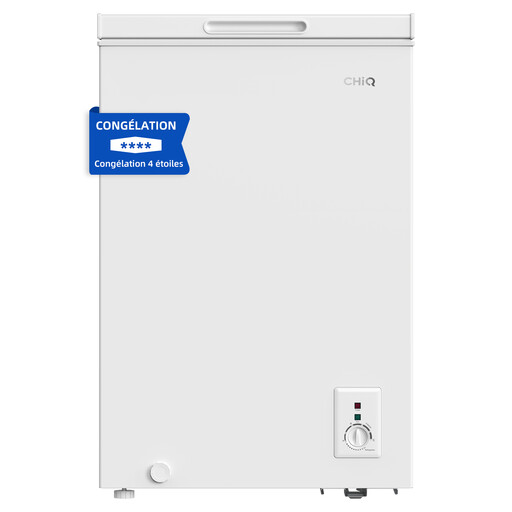 Image unavailable
This compact chest freezer is suitable as extra storage if 99 L is enough for your maximum stock of portions or small harvests.
The title lists a removable basket, an adjustable thermostat, a sliding lid and an E energy rating.
Check the clearance needed to open the lid, the ambient temperature range and how long it can keep food frozen during a power cut at your chosen location.
 Image unavailable
Worth considering for a few portions that you want to keep separate in a small space, rather than for large harvests.
The title lists three storage compartments, a reversible door, adjustable temperature settings and an E energy rating.
Compare the 60 L capacity with your maximum stock and check the installation dimensions, ambient temperature range and how long it can keep food frozen during a power cut.
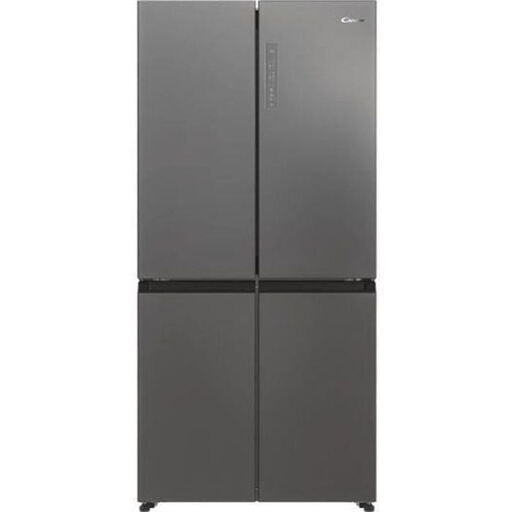 Image unavailable
Worth considering if you’re replacing your fridge too: the total capacity doesn’t tell you how much space is available for freezing harvests and portions.
The title lists four doors, a total capacity of 467 L, Total No Frost technology and an E energy rating.
Check the freezer compartment’s capacity separately, and compare annual energy consumption and dimensions with those of the other appliances you’re considering.
Start with how much you’ll be storing at the same time during your busiest storage period, rather than simply counting the people in your household. Make a note of your largest containers and usual portions, then compare the space they take up with the model’s usable capacity and layout. The UFC-Que Choisir guide says chest freezers can hold up to 600 L, while upright freezers range from around 200 L to 400 L for the largest models; these figures don’t replace checking the specifications of each appliance.
Yes, but only if the model’s stated operating temperature range covers the temperatures in your garage. Check the room’s minimum and maximum temperatures before you buy: Liebherr lists FrostProtect for some chest freezers, allowing operation at ambient temperatures as low as −15 °C, while Beko offers Freezer Guard on some models. These features don’t apply to every appliance from either brand.
Compare the energy rating and annual consumption in kWh of models that first meet your capacity needs. Also check the noise level and dimensions for your chosen location; an energy rating alone won’t tell you how much room there is for food.
No. No Frost helps manage frost in models with this feature, but you’ll still need to clean the interior and seals, close the door properly and wrap food. Electrolux notes that unwrapped food releases moisture, which can encourage ice to form.