How do the different formats compare?
For a regular supply of frozen food, first choose a layout that suits your shopping habits and available space, then compare the specifications of each appliance.
Chest freezer
Worth considering: if you store bulk buys or large items and have enough floor space.
Bear in mind: the open space is flexible to organise, but items at the bottom are less easy to reach.
Upright freezer
Worth considering: if you often take out portions and want to organise them in drawers.
Bear in mind: compartments make it easier to organise food, but may limit space for very large packs.
Table-top freezer
Worth considering: if a compact appliance is enough for your backup supply.
Bear in mind: check the actual usable capacity rather than judging it by the appliance’s external dimensions alone.
Under-counter freezer
Worth considering: if the appliance needs to fit under a worktop and you don’t need much storage space.
Bear in mind: the right height isn’t enough on its own: freestanding and built-in models have different installation requirements to check.
Large-capacity fridge freezer
Worth considering: if you also need to replace your fridge and would prefer a single appliance.
Bear in mind: the appliance’s total capacity isn’t the same as the capacity reserved for frozen food.
| Criteria |
What to check |
Who is it for? |
| Capacity and dimensions |
Usable capacity in litres, dimensions without packaging, and the space needed to open the door or lid. |
If I buy in bulk, I want to fit my usual quantities inside without blocking the way through the room; around 33% of consumers put this storage capacity first. |
| Room temperature |
The minimum and maximum temperatures where the appliance will be kept, then the model’s climate class and ventilation requirements. |
In a garage or cellar, I need to know whether the appliance is suitable for the temperatures it will face throughout the year; this compatibility is the main concern for around 27% of consumers. |
| Food organisation |
The number and size of drawers or baskets, and the space available for large packs. |
If I often take out portions, I want to find bags without having to move everything else; around 20% of consumers prioritise this everyday accessibility. |
| Long-term use |
Energy consumption in kWh/year, storage time during a power cut in hours, and the model’s defrosting method. |
If I’m concerned about power cuts or maintenance, I want to compare these features before choosing a larger capacity; they’re the top priority for around 20% of consumers. |
Freezers to compare on Joybuy
This selection includes four chest freezers with different capacities and one upright model with drawers. First choose the type of access that suits your stock, then check the installation requirements and specifications of the model you’re interested in.
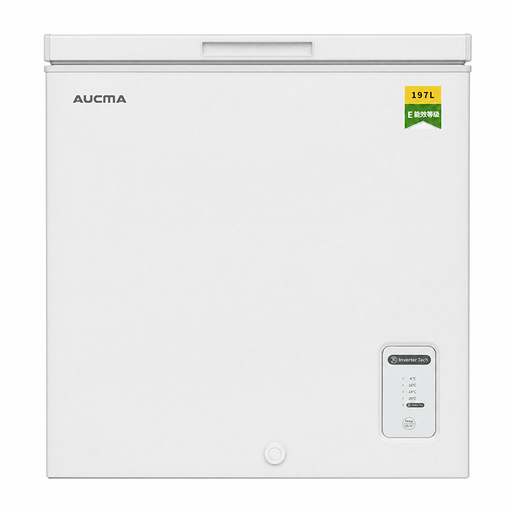 Image unavailable
AUCMA convertible chest freezer, 197 L
Worth considering if you buy in bulk and want a removable basket for smaller items.
The product title lists an E energy rating, five-level digital controls and a defrost drain. Check the climate class and storage time during a power cut for this model. Also check the instructions for its convertible freezing mode.
View on Joybuy
 Image unavailable
TCL CF182EWE0FR chest freezer, 140 L
Worth comparing if you want a chest freezer with a basket to keep part of your stock separate.
The product title mentions a counterbalanced lid, temperature control, adjustable feet and an E energy rating. Check the dimensions and required clearances, as well as the kWh/year, climate class and storage time during a power cut for this model.
View on Joybuy
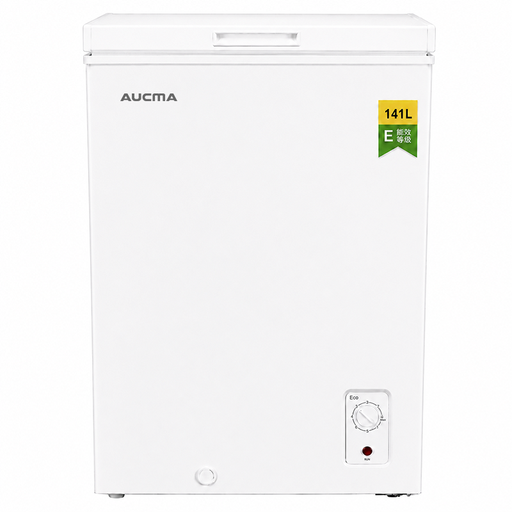 Image unavailable
AUCMA convertible chest freezer, 141 L
Worth considering if you’re looking for a 141 L chest freezer with a removable basket to organise your food.
The product title lists an E energy rating, a seven-level thermostat and a defrost drain. Before installing it in a cold room, check the model’s climate range. Also check its storage time during a power cut and the settings for its freezing mode.
View on Joybuy
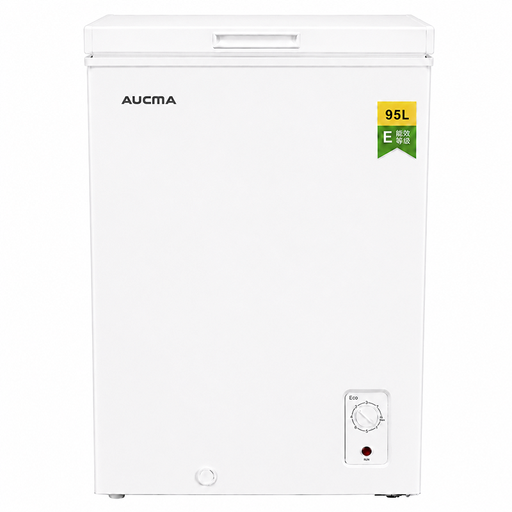 Image unavailable
AUCMA convertible chest freezer, 95 L
Worth considering for a smaller backup supply if you prefer a top-opening model and have enough space for the lid.
The product title lists a removable basket, an E energy rating, a seven-level thermostat and a defrost drain. Check the climate class, storage time during a power cut and the instructions for this model’s freezing mode.
View on Joybuy
 Image unavailable
Heinrich´s upright freezer, 161 L, stainless steel
Worth comparing if you’d rather organise your stock in drawers than in an open chest freezer.
The product title lists three freezer drawers, a No-Frost function and a C energy rating. Check the dimensions, kWh/year, climate class and storage time during a power cut to see whether this upright model is suitable for your space.
View on Joybuy
Frequently asked questions
What capacity do I need for storing frozen food regularly?
Start with how much you buy and the size of the packs, rather than using a fixed number of litres per person. UFC-Que Choisir describes chest freezers with capacities of up to 600 L, upright models generally close to 200 L, and smaller table-top or under-counter formats. Then check the usable capacity and layout of the model you’re considering.
Can I put a freezer in a cold garage?
Yes, if the model’s stated temperature range covers the temperatures the garage actually reaches. Bosch and Beko’s tables give a range of 10 to 32 °C for climate class SN and 10 to 43 °C for class SN-T. To use an appliance below 10 °C, it must be explicitly designed to tolerate low temperatures.
What should I compare on the energy label?
Compare annual energy consumption in kWh, capacity and noise levels between appliances that meet the same storage needs. The European Commission states that the energy label for the refrigerators and freezers covered also shows their energy efficiency class. Check the model’s specifications separately for its storage time during a power cut.
What should I check before installing and plugging in the freezer?
First, follow your model’s instructions on ventilation, positioning and switching it on. Electrolux recommends leaving space for air to circulate around the appliance and gives guidance on how long to wait before plugging in the appliances covered by its documentation. The instructions for your specific freezer always take priority.
Does a freezer need to be defrosted?
It depends on its cooling system, so check whether the model needs manual defrosting. Liebherr describes NoFrost as a feature that reduces the need for this on equipped models. For an appliance where frost builds up, Electrolux recommends defrosting when the layer reaches around 3 to 5 mm and warns against using sharp objects.


