Households that regularly stock up on frozen food
If bulk buys or prepared meals are taking up all the space in your existing freezer, a dedicated freezer lets you choose the capacity and storage layout separately from your fridge.


If your fridge freezer no longer has enough space, choose a freezer format based on how much you need to store, how much room you have and how often you need to access your food. A chest freezer is ideal for larger amounts if you have enough floor space; an upright freezer makes it easier to organise food in drawers, while a tabletop or under-counter model is a good option when space is limited, but offers less capacity. If you plan to keep it in a garage, cellar or unheated utility room, check the ambient temperature range for the specific model.
A separate appliance is most useful if you regularly need more storage than the drawers in your main fridge freezer can provide.
If bulk buys or prepared meals are taking up all the space in your existing freezer, a dedicated freezer lets you choose the capacity and storage layout separately from your fridge.
Keeping the appliance outside the kitchen can free up space, provided its operating temperature range is suitable for the room. Check this for each specific model: it isn’t determined by whether it’s a chest or upright freezer.
A tabletop or under-counter model can provide extra storage without the need for a large chest or tall upright freezer. Just make sure it has enough capacity for the amount you plan to store.
Start by deciding how much space you need and how you’ll access your food, then check the specifications for the model you’re considering to make sure it’s suitable for your chosen location.
| Priority | What to check | Think about your needs |
|---|---|---|
| Capacity | Compare the usable capacity with the amount you usually store and the size of your bulk buys. According to Que Choisir, chest freezers can hold up to 600 l; upright freezers generally hold around 200 l, with larger models reaching 400 l. | I regularly run out of room in my fridge freezer: do I need a large amount of extra storage, or just a little more space? |
| Access to food | Look at the drawers in an upright freezer or the baskets in a chest freezer. With a chest freezer, also consider how easy it is to reach items at the bottom. | If I reach for food every day, I’d prefer a layout that’s easy to look through. For food I don’t access often, I may be happy with a deep compartment. |
| Available space | Measure the width, depth and height of the space you have in mind. A chest freezer needs floor space and room to open the lid; an under-counter model needs to fit beneath the worktop. | My kitchen can fit a small appliance, but not necessarily a wide chest or tall upright freezer. |
| Room temperature | Check the room’s minimum and maximum temperatures against the range specified for the model. Que Choisir gives 10 to 32 °C for climate class SN and 16 to 32 °C for class N; some appliances have a temperature range specific to the model. | For my garage, cellar or utility room, I need to check the room temperature before choosing an appliance. |
| Everyday use | Compare the stated annual energy consumption of appliances with similar capacities. Also check the defrosting method, noise level and stated storage time in the event of a power cut. | I want to understand what using the model will involve, rather than making my decision based on its energy rating alone. |
The format doesn’t determine the acceptable ambient temperature. According to Que Choisir, the ranges for common climate classes can start at 10 °C or 16 °C; Beko and Whirlpool state a limit of −15 °C for certain specific models.
Find out how cold the room can get and compare this with the specifications or rating plate of the model you’re considering.
An open compartment can accommodate bulky food, but items at the bottom are less easy to reach than those stored in drawers.
Choose a chest freezer if its capacity and storage style suit your needs. If you often take out small portions, consider an upright model too.
Appliances with different capacities or formats may not meet the same storage needs.
First compare models with a capacity that suits your needs, then check their stated annual energy consumption and other features. The European Commission’s EPREL database lets you look up information about the models listed there.
If your old freezer is bulky, you may need to coordinate its collection with the delivery of your new one.
Before ordering, ask the seller about delivery, access to your home and collection of your old appliance. The Ministry for the Ecological Transition describes the ‘one-for-one’ take-back scheme when you buy a new appliance of the same type.
These models illustrate different formats and installation requirements; their specifications don’t apply to every appliance from the same brand.
Beko describes the HSM46740 as a 451 l chest freezer and the FSE1174N as a tabletop freezer.
Bosch Electroménager France lists a capacity of 249 l for the GSV36VWEV upright freezer and 83 l for the GTV15NWEB under-counter model.
Whirlpool presents the WHM2112 chest freezer as suitable for locations where the ambient temperature may be low.
Liebherr offers freezers with its NoFrost technology, which may be worth considering if defrosting is one of your priorities.
These models offer extra storage as an upright, chest or compact vertical freezer. First choose the format that suits your storage needs and available space, then check the installation requirements for the model you’ve selected.
 Image unavailable
Its vertical design is a good choice if you’d rather organise your extra food in drawers than rummage through a chest. The product title lists a 161 l capacity, No Frost, an alarm and a reversible door. If you plan to install it somewhere that isn’t temperature-controlled, check its ambient temperature range.
 Image unavailable
This compact chest freezer offers extra storage if you’re happy to access it from the top. The product title lists a removable basket and adjustable thermostat; items at the bottom won’t be as easy to reach as they would be in drawers. Check its ambient temperature range before placing it in an unheated outbuilding.
 Image unavailable
With a capacity of 60 l, this is better suited to a small amount of extra storage than a large stock of food. The product title mentions adjustable temperature settings and a reversible door. If you plan to place it under a worktop, check its dimensions and allow enough room to open the door.
 Image unavailable
This chest freezer offers more storage than the 98 or 99 l compact models in this selection, provided you have enough floor space for it. The product title lists a basket and a counterbalanced lid. If you plan to keep it in a garage or cellar, check the ambient temperature range for this model.
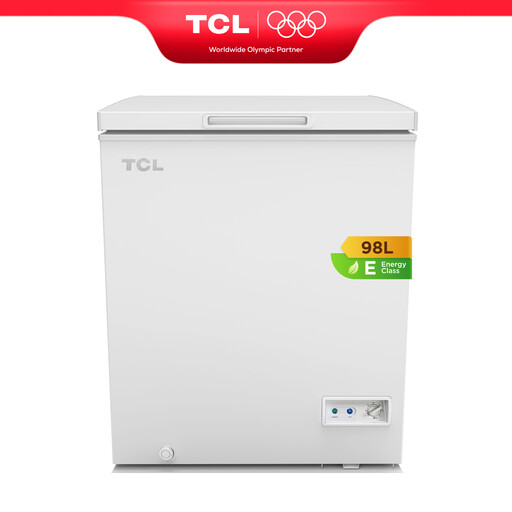 Image unavailable
This model is a good option for extra storage if you’d prefer a chest freezer to one with drawers. The product title lists a 98 l capacity, a basket, a counterbalanced lid and adjustable temperature settings. Check the temperature conditions at the installation location before buying.
No. The model’s ambient temperature range must cover the temperatures in your garage. Que Choisir gives 10 to 32 °C for climate class SN and 16 to 32 °C for class N; suitability for lower temperatures applies only to models that specifically state this. Check the specifications or rating plate for the appliance you’re considering.
First choose models with capacities and formats that suit your needs, then compare their stated annual energy consumption. The European Commission’s EPREL database lets you look up information about the models listed there; the energy rating alone doesn’t tell you everything about capacity and annual consumption.
Yes, especially if power cuts are possible where you plan to install it. Compare the stated storage time for the specific models you’re considering. For example, Bosch gives 11 h for the GSV36VWEV; this figure doesn’t apply to other models from the brand.
Contact the seller before delivery to arrange collection and discuss access to your home. The Ministry for the Ecological Transition describes the ‘one-for-one’ take-back scheme when you buy a new appliance of the same type.