A separate freezer is worth considering if harvests, bulk buys or prepared meals regularly exceed the freezing capacity of your fridge-freezer. A chest freezer is suited to larger quantities if you have enough floor space; an upright freezer makes portions easier to access, while an under-counter model or a large fridge-freezer is better for adding extra capacity when space is limited. Before choosing, compare the usable capacity and dimensions with what you plan to store, then check the installation requirements, especially if the appliance will be kept in an unheated room.
Who are these formats suited to?
Households with home-grown produce or bulk buys
If you regularly freeze large quantities or big dishes, compare the capacity of a separate appliance with that of your fridge-freezer. Que Choisir notes in particular that chest freezers offer large capacities.
People who prepare portions in advance
If you often want to find a particular meal, the drawer storage in an upright freezer may matter more than maximum capacity. Also check that there is room for your largest containers.
Households planning to install a freezer outside the kitchen
For a cellar, utility room or garage, compare the room temperature with the operating range of the model you are considering. You cannot assume an appliance will work in cold conditions just because of its format.
What should you check before choosing?
Start by considering how much you need to freeze and how often you need to access your food. These factors will help you choose between a chest and an upright freezer. If the space is cold or restricted, check its requirements before settling on a capacity; an under-counter model or fridge-freezer may be enough if you are simply looking for extra capacity.
| Factor | What to check | Who it matters to |
|---|
| Capacity for harvests and bulk buys |
Compare the usable capacity in litres with the quantities you usually store and the dimensions of your largest containers. |
When my harvest regularly fills the freezer compartment in my fridge-freezer, I first look for a separate appliance to store it; around 33% of consumers prioritise this need for capacity. |
| Access to portions |
Check the drawers or baskets and the space available for dishes of different sizes. |
If I often take out a prepared portion, I want to find it without moving the rest of the food; easy access and storage come first for around 25% of consumers. |
| Location outside the kitchen |
Compare the room’s minimum and maximum temperatures with the operating range of the exact model. |
A cellar or garage can be cold when I need to store food; around 25% of consumers prioritise compatibility with their intended location. |
| Available space |
Measure the space, the clearance required and, for a built-in model, the cabinet opening and door fittings. |
When there’s little room in the kitchen, I’d rather choose an extra appliance that fits properly, even if its capacity is more limited; this is the main consideration for around 17% of consumers. |
Mistakes to avoid
-
Choosing a chest freezer based on capacity alone
A large capacity doesn’t guarantee an easy installation or straightforward access to food at the bottom. Que Choisir says chest freezers are commonly 110 to 140 cm wide and around 70 cm deep.
Measure the space, the delivery route and the clearance needed to open the lid. Baskets can help you separate harvests, meals and bulk buys.
-
Assuming every chest freezer is suitable for a cold garage
The climate class specifies an ambient temperature range; the ability to operate below that range must be confirmed for the specific model. For example, Beko says some of its Freezer Guard models can operate at temperatures as low as -15 °C, but this doesn’t apply to all its freezers.
Compare the room temperature with the model’s specifications and manual. If it could fall below 10 °C, look for explicit confirmation that the model is suitable for low temperatures.
-
Focusing only on the energy label rating
The same rating doesn’t tell you how much usable space you’ll have or the annual energy consumption of the model you’re considering. The European Commission says the energy label scale for fridges and freezers has run from A to G since 1 March 2021.
When comparing appliances that suit your needs, also check their annual energy consumption in kWh, freezer capacity in litres and noise level in dB(A).
-
Ordering a built-in model without checking the cabinet opening
Installation dimensions vary by model: Electrolux specifies a 880 mm cabinet opening for the under-counter LUB3AE88S and a 1,780 mm opening for the tall KUN7NE18S.
Check the cabinet opening, door clearance, door fittings and ventilation instructions in the manual before choosing.
If the cabinet or fittings aren’t compatible, modifications or professional installation may be needed.
Brands to consider for your project
Beko
Worth considering if you plan to install your freezer in a room that may get cold, provided you choose a suitable model.
- Beko says some Freezer Guard chest and upright freezers are designed to operate at ambient temperatures as low as -15 °C.
- This applies to the Freezer Guard models specified by the brand. Check the exact model and its installation requirements.
Whirlpool
Chest freezers to consider if your project calls for a large amount of separate storage.
- Whirlpool lists capacities of 308 L for the W3RHS31DW2 and 204 L for the WHCF2044. The brand also says the W3RHS31DW2 can operate at temperatures as low as -15 °C.
- Check the capacity and suitability for cold rooms for each model; don’t assume these features apply across the whole range.
Liebherr
Upright freezers to consider if vertical storage and frost maintenance are important to you.
- Liebherr lists a capacity of 238 L and a noise level of 36 dB for its FNe 5006 Pure NoFrost upright freezer.
- Check the capacity, noise level and defrosting system of the model you choose rather than assuming they apply to all Liebherr upright freezers.
Electrolux
Models to compare for an under-counter or tall built-in installation.
- Electrolux lists a capacity of 98 L and an 880 mm cabinet opening for the under-counter LUB3AE88S, compared with 212 L and a 1,780 mm opening for the tall KUN7NE18S.
- Capacity alone doesn’t confirm compatibility: also check the door fittings and installation instructions for the model.
Haier
Chest and upright models to consider if the quantity you need to store is your main priority.
- Haier offers, among other models, a 696 L HCE715E chest freezer and a 301 L H4F306SDH1 upright freezer.
- These capacities relate to two different models. Check the dimensions and interior layout of the one you’re interested in.
Freezers and fridge-freezer available on Joybuy
These models let you compare two chest freezer capacities, an upright freezer for portions and a fridge-freezer if you’d rather keep chilled and frozen food in one appliance. Start by choosing the format that suits what you need to store and where you plan to put it.
 Image unavailable
AUCMA 291 L convertible chest freezer
Worth considering for harvests or bulk buys that need separate storage, if you can set aside enough floor space and fully open the lid.
Listed capacity: 291 L. Convertible between fridge and freezer modes, with an E energy rating, LED lighting, five-level digital control and a removable basket.
If you plan to keep it in a cellar or garage, check the ambient temperature range specified for this model.
View on Joybuy
 Image unavailable
Heinrich´s 161 L upright freezer, stainless steel
An upright freezer is a good choice if you want to organise prepared portions and access them regularly, rather than store very large containers.
Listed capacity: 161 L. The product description mentions drawers, a temperature range of -14 °C to -22 °C and a C energy rating.
The product description says No Frost, but the defrosting information is contradictory, so confirm the maintenance requirements for this version. Also check its ambient temperature range before installing it outside the kitchen.
View on Joybuy
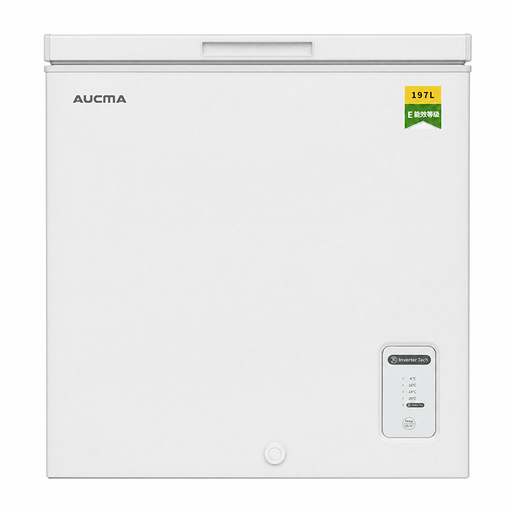 Image unavailable
AUCMA 197 L convertible chest freezer
Worth considering for storing prepared food or bulk buys separately, if 197 L suits the quantities you need to store and you’re happy to access it from the top.
Listed capacity: 197 L. Convertible between fridge and freezer modes, with an E energy rating, five-level digital control and a removable basket.
Measure the clearance needed to open the lid and check the ambient temperature range before installing it in a cold room.
View on Joybuy
 Image unavailable
Candy CFQQ5T817EPS four-door fridge-freezer, 467 L
Consider this fridge-freezer if you’d prefer one appliance for chilled and frozen food. However, compare its freezer compartment with the amount of produce or prepared meals you need to store.
Listed total capacity: 467 L, which should not be confused with freezer capacity. The product description specifies Total No Frost and an E energy rating.
Check the dimensions and the ambient temperature range for your intended location.
View on Joybuy
Frequently asked questions
When should I choose a separate freezer instead of a large fridge-freezer?
Choose a separate freezer if harvests, bulk buys or family meals regularly exceed the freezer capacity of your fridge-freezer. Que Choisir says chest freezers can hold up to 600 L and upright freezers typically offer around 200 L, with larger models reaching 400 L; however, compare the usable capacity of models that will fit in your home.
Can a freezer work in a cold cellar or garage?
Yes, provided the ambient temperature range specified for the model covers the actual temperatures in the room. Beko lists a range of 10 to 32 °C for climate class SN and 16 to 32 °C for class N. If the room drops below 10 °C, look for explicit confirmation that the model you choose is suitable for low temperatures.
What should I compare beyond the energy rating?
Compare annual energy consumption in kWh, usable freezer capacity in litres and noise levels in dB(A) between models that meet the same needs. The European Commission says the energy label scale for fridges and freezers has run from A to G since 1 March 2021; the rating alone doesn’t replace a comparison of appliance capacity and features.
Is No Frost essential for storing prepared meals?
No: your choice mainly depends on how much frost-related maintenance you’re happy to do. Electrolux describes No Frost as a system that limits frost build-up. For other systems, check the defrosting instructions for the exact model, as well as its storage layout and usable capacity.


