If you need to store a lot of food, start by looking at chest freezers. If you regularly take out individual portions, consider how an upright model is organised. An under-counter model is useful for extra storage, while a fridge freezer could be right if you also want to replace your fridge. Whichever type you choose, compare each model’s freezer capacity, space requirements, noise level and power-cut storage time: you can’t tell these from the format alone.
Who are these formats for?
Households that stock up on food
If you prepare large batches of meals, buy in bulk or freeze a harvest, start by working out how much freezer space you need. UFC-Que Choisir says some chest freezers offer up to 600 L of capacity. Then check how easy it is to reach your food and how long the model you’re considering can keep it frozen during a power cut.
People who take out portions every day
If you often open the freezer to take out a meal or an ingredient, keeping food separate and being able to remove containers easily matter just as much as capacity. Check the drawers or baskets, the door opening and how easy the appliance is to clean.
Households with limited space
An under-counter freezer can provide extra storage in a compact kitchen. Measure the space available and check that its capacity is enough for your portions: a small appliance won’t necessarily provide the space you need for a large stock of food.
Which features should you prioritise?
Chest freezer
Consider one: if bulk buys or harvests call for plenty of freezer space.
Bear in mind: you may need to sort and move food around to reach items at the bottom.
Upright freezer
Consider one: if you regularly take out portions and want to keep them separate in drawers.
Bear in mind: check that its capacity suits your stock; don’t assume it will match that of a large chest freezer.
Under-counter freezer
Consider one: for extra storage when installation space is limited.
Bear in mind: its capacity may be too limited for large bulk buys.
Fridge freezer
Consider one: if you’re also replacing your fridge and want both functions in one appliance.
Bear in mind: only part of the total capacity is for freezing, so check it’s enough for your food supplies.
| Feature |
What to check before buying |
Who might find it most important? |
| Freezer capacity |
Compare the usable capacity in litres of the freezer compartment and allow enough room to open the appliance. |
If I’m storing batch-cooked meals, bulk buys or a harvest, I want enough room for everything without making it difficult to manage; around 33% of consumers prioritise capacity. |
| Access to portions |
Check the drawers or baskets and whether you can reach food at the bottom. |
If I take out a portion almost every day, I want to find it without moving the rest of my food; easy everyday access comes first for around 27% of consumers. |
| Power cuts and cold rooms |
Check the stated storage time in hours and, if the appliance will be in an unheated room, the ambient temperature range it can operate in. |
If I’m planning to install the appliance in a cold cellar or need to account for power cuts, I first look for suitable operating conditions; nearly 20% of consumers prioritise these features. |
| Space, noise and energy use |
Measure the space, then compare the dB(A), kWh/year and usable capacity in litres of appliances that meet the same need. |
In a home where space is limited, I need to be able to fit the appliance without overlooking its noise level or energy use; these considerations come first for around 20% of consumers. |
Mistakes to avoid
-
Choosing the largest capacity without considering access
If a chest freezer is packed full, you may have to move food to reach items at the bottom. The stated capacity alone doesn’t tell you how easy it will be to find your portions.
Check how your usual containers fit in the baskets and through the opening. If you choose a chest freezer, plan to sort food into categories and label it.
-
Assuming a chest freezer will suit any garage
The minimum ambient temperature an appliance can operate in depends on the model, not just its format. Beko and Whirlpool state that some models can operate at temperatures as low as −15 °C, but this doesn’t apply to all chest freezers.
Before installing an appliance in an unheated room, check the operating temperature range and the manual for the exact model.
-
Assuming the format tells you how long food will stay frozen
How long food stays frozen during a power cut varies by appliance and test conditions. UFC-Que Choisir assesses this as a feature specific to each model.
If power cuts are an important consideration, compare the stated storage times rather than relying on the brand or whether the appliance is a chest or upright freezer.
-
Comparing energy ratings alone
Two appliances won’t do the same job if their freezer capacities differ. The energy rating alone doesn’t tell you how much space an appliance takes up, how noisy it is or its stated annual energy use.
Compare kWh/year, usable capacity in litres, dB(A) and dimensions together for appliances suited to the same amount of food.
Brands to know when comparing formats
Bosch
The range includes upright and under-counter freezers, which are worth comparing based on the capacity and layout you need.
- Bosch highlights transparent, removable drawers on selected models.
- Capacities vary by model: Bosch states 334 L for the GSN36AICM upright freezer and 83 L for the GTV15NWEB under-counter model.
Liebherr
Its chest freezers may appeal to households looking to organise a stock of food.
- According to Liebherr, StopFrost reduces frost build-up on models equipped with the feature.
- If you’re installing the appliance in a cold room, check the ambient temperature range for the model you choose.
Beko
Its range of chest freezers is worth considering if the appliance needs to go in an unheated room.
- Beko states a minimum ambient temperature of −15 °C for the HSM27050 chest freezer.
- This feature isn’t available across the whole range: also check the capacity and storage time of each model you’re considering.
Whirlpool
Some of the brand’s chest freezers have baskets and a convertible function that switches between freezing and refrigeration.
- Whirlpool states that the W3RHS37EW1 chest freezer has three baskets and a usable capacity of 371 L.
- Check that the model you choose has the convertible function and is suitable for the ambient temperature in your space; these features aren’t available on every model.
Electrolux
The range’s built-in freezers are worth considering for kitchen projects where fitting in with the cabinetry matters as much as storage.
- Electrolux states a net capacity of 212 L for the built-in EUN7NE18S model.
- Before choosing a built-in model, check the dimensions of the housing space and the installation requirements in the manual.
Products to suit your needs
These Joybuy models cover extra storage in a chest or upright freezer, drawer access in an upright model, and a fridge freezer. To choose between them, focus on the capacity available for freezing and the conditions in your chosen space.
 Image unavailable
CHiQ JR99DWE, 99 L chest freezer
For extra storage, with a removable basket to help you organise food.
Stated capacity of 99 L, sliding lid and E energy rating. If you’re planning to keep it in a cold room, check its storage time during a power cut and the ambient temperature range.
View on Joybuy
 Image unavailable
COMFEE' RCU60WH2(E), 60 L upright freezer
Worth considering for a few portions in a small space, rather than for a large stock of food.
Stated capacity of 60 L, interior storage, reversible door and E energy rating. Measure the space and check the storage time during a power cut if it’s an important consideration.
View on Joybuy
 Image unavailable
Heinrich´s, 161 L upright freezer, stainless steel
The drawers make it easy to separate portions you take out regularly.
Stated capacity of 161 L, No Frost technology and C energy rating. Check the dimensions and storage time during a power cut before deciding where to put it.
View on Joybuy
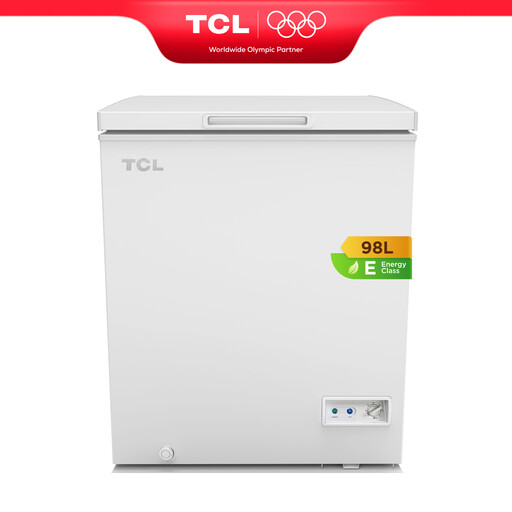 Image unavailable
TCL CF126EWE0FR, 98 L chest freezer
For extra chest freezer storage, with a basket to keep some of your food separate.
Stated capacity of 98 L, counterbalanced lid, temperature control and E energy rating. Check the dimensions and the ambient temperature range for your planned installation.
View on Joybuy
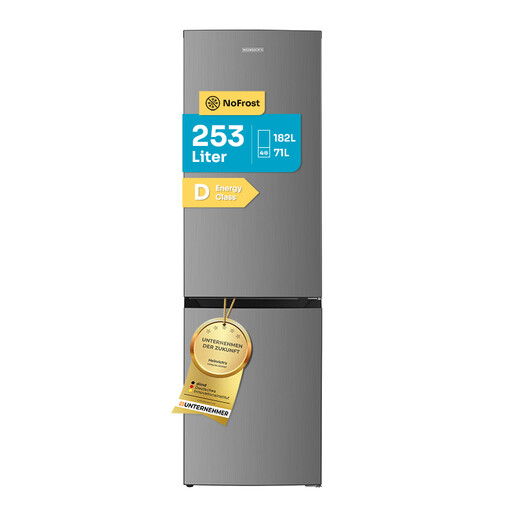 Image unavailable
Heinrich´s, 253 L fridge freezer, stainless steel
Consider this if you’re also replacing your fridge and the freezer compartment has enough space for your food supplies.
Stated total capacity of 253 L, including 182 L for refrigeration and 71 L for freezing; stated noise level of 39 dB and No Frost function. Compare the 71 L of freezer space—not the total capacity—with the amount of food you need to store.
View on Joybuy
Frequently asked questions
What capacity should you compare when storing portions?
Compare the usable capacity of the freezer compartment alone, then check whether your containers will be easy to fit and take out. With a fridge freezer, the total capacity includes the fridge too. UFC-Que Choisir also says some chest freezers offer up to 600 L, but capacity varies by model.
Can you put any freezer in a cold garage?
No. Check the minimum ambient temperature stated in the product information and manual for the model you choose. Beko and Whirlpool state that some appliances can operate at temperatures as low as −15 °C, but this doesn’t apply to all models; being a chest freezer doesn’t guarantee it’s suitable.
Will a chest freezer always keep food frozen for longer during a power cut?
No. Compare storage times model by model and in the stated test conditions. UFC-Que Choisir measures this, among other ways, by how long food stays below −9 °C during a simulated power cut. Don’t assume the format alone tells you how long it will last.
Is the energy rating enough to compare two freezers?
No. Also check the stated annual energy use in kWh, freezer capacity and noise level in dB(A). Where possible, compare appliances that can hold a similar amount of food, then check their dimensions against the space you have available.


